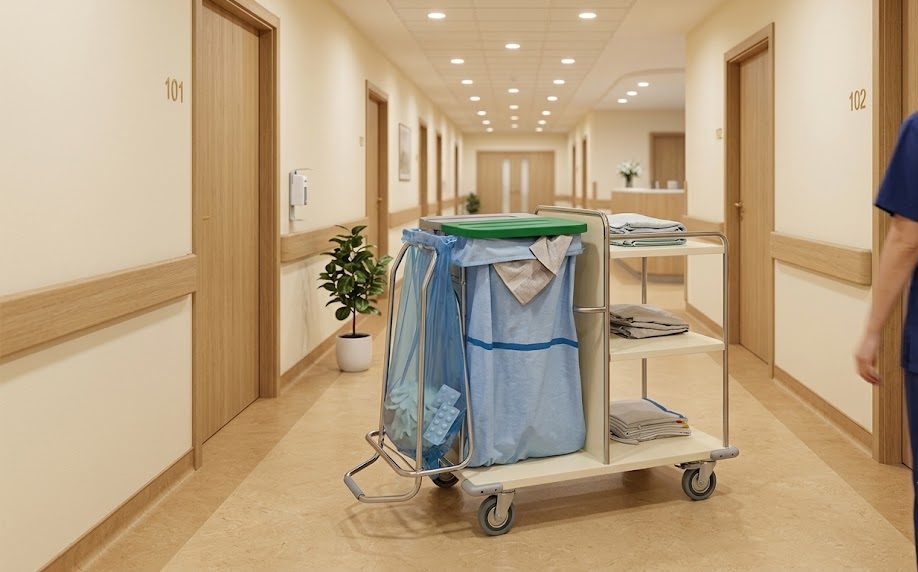
Hospital laundry trolleys should be selected according to the facility’s laundry collection, transport and distribution flows. Capacity, number of bags, materials and overall dimensions affect practicality across wards and internal routes. Doors, lifts and the frequency of movement should also be considered before purchase. A suitable configuration helps make linen management more organised and efficient.
The choice starts from the linen flows
Before comparing products, it's necessary to reconstruct the linen's path. The flow may begin in rooms, wards, clinics, or service areas and end in a temporary storage area or laundry room. Distances, collection frequency, and collected quantities determine the number and capacity of carts. A complex structure may require different models for ward collection and internal transport.
The route must also be considered from the operator's perspective. Narrow aisles, doors, ramps, and elevators affect space and maneuverability. A very capacious forklift may reduce the number of trips, but it may become difficult to drive within the available space. The right choice therefore stems from a balance between volume transported, route and frequency of use.
Dirty and clean linen require separate management
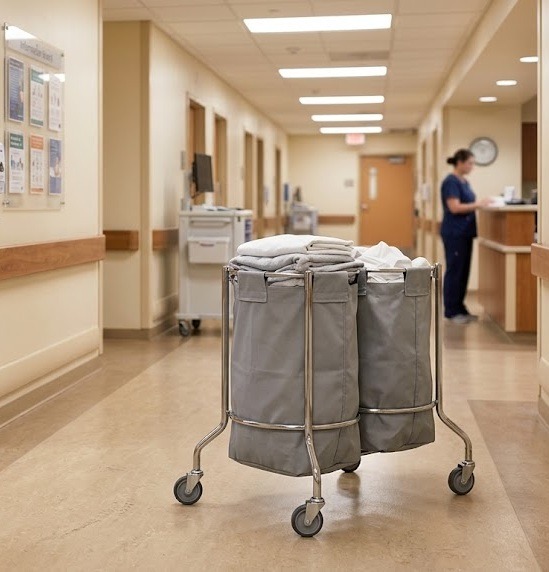 The collection of used linen and the distribution of clean textiles are different activities. Dirty carts are typically configured to hold bags, lids, and collection systems, while clean carts prioritize protection and internal organization. Using the same equipment for both functions without a defined procedure can make the flow less controllable. Separation must concern both the product and the operating methods adopted.
Dirty linen should be disposed of in the designated container, avoiding unnecessary handling. Bags and supports must be proportionate to the collected quantity and replaced before overfilling compromises the closure or handling. Clean linen, on the other hand, requires surfaces and compartments maintained in the conditions established by the facility. The cart does not replace internal protocols, responsibilities, and instructions, but should facilitate their daily application.
Capacity and number of bags depend on the departments
Cart volume should be calculated based on the average amount collected between one collection and the next. A department with frequent linen changes may require a different capacity than an outpatient clinic or administrative area. Even the number of beds is not sufficient to provide a complete estimate. Shifts, activities performed, and laundry organization all affect requirements.
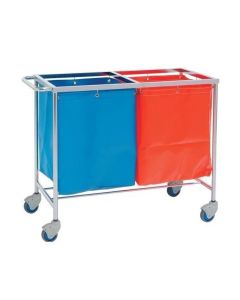
Multi-bag models allow you to separate laundry according to the categories established by the facility. This configuration can reduce subsequent operations, as long as colors, labels, and destinations are clearly identifiable. Holity, specialist in professional supplies for hospitals, clinics and nursing homes offers laundry carts with different capacities and configurations. Before purchasing, check bag dimensions, fastening systems, and available storage space.
Materials and surfaces affect maintenance
The material influences the weight, durability, and cleaning methods of the cart. Stainless steel, painted metal, and plastic materials meet different needs and cannot be evaluated through a classification that applies to every structure. Stainless steel offers a sturdy structure and surfaces suitable for frequent use, but can increase the overall weight. Plastic materials, on the other hand, can facilitate handling and reduce noise.
The choice must also consider joints, edges, supports, and hard-to-reach areas. A smooth exterior surface alone does not guarantee that the entire cart is easy to maintain. Any antibacterial properties or specific treatments must be verified in the model's technical documentation. The buyer should therefore compare the declared materials, maintenance instructions, and compatibility with the procedures adopted by the facility.
Lids and pedals make disposal easier
The lid helps contain the collected laundry and makes transport more orderly. It can be a single lid for the entire cart or for each bag, depending on the configuration. The system must open without obstructing the insertion of the linens and must remain stable during movement. Removal of the full bag must also be easy.
Pedal-operated models allow for hands-free operation. This advantage must be considered along with the control's location, the stability of the trolley, and the ease of cleaning the mechanism. Not all departments require the same configuration. The opening system must be responsive to operating procedures and the frequency with which linen is delivered.
Wheels and size determine maneuverability
Wheels must support the load and accommodate movement along the facility's pathways. Diameter, material, and rotation system affect how the cart negotiates curves, thresholds, and changes in flooring. Brakes can facilitate loading, unloading, and parking. Noise levels are also a significant concern in departments and areas frequented by patients.
Width and depth must be considered in relation to doorways, elevators, and maneuvering spaces. Height, on the other hand, affects the operator's visibility and ease of access to the bags. Holity, point of reference in professional equipment for the healthcare sector, allows you to compare forklifts with different dimensions and handling systems. The most suitable size is not necessarily the largest, but the one compatible with the load and route.
Cleaning trolleys protect contents
Clean linens must be distributed in an orderly and protected manner until they reach the point of use. Carts designed for this purpose can be equipped with shelves, walls, doors, or covers. The configuration depends on the type of linen, the quantity, and the frequency with which it is collected. The internal organization must make the contents easily accessible without requiring constant handling.
Shelves can be used to separate sheets, towels, uniforms, and other items, according to the system adopted by the facility. It's helpful to plan for a capacity consistent with the distribution route, avoiding overloading the compartments. The cart should be dedicated to this function and placed within the designated cleaning route. Protecting contents and clearly arranged layouts also facilitate tracking of delivered quantities.
Cleaning and checks keep the trolley efficient
The cart must be included in the facility's cleaning and maintenance program. Surfaces, lids, bag holders, pedals, and handles require regular checks. Even the wheels can collect debris and become less smooth over time. Frequency, products, and operating procedures must follow the manufacturer's instructions and internal procedures.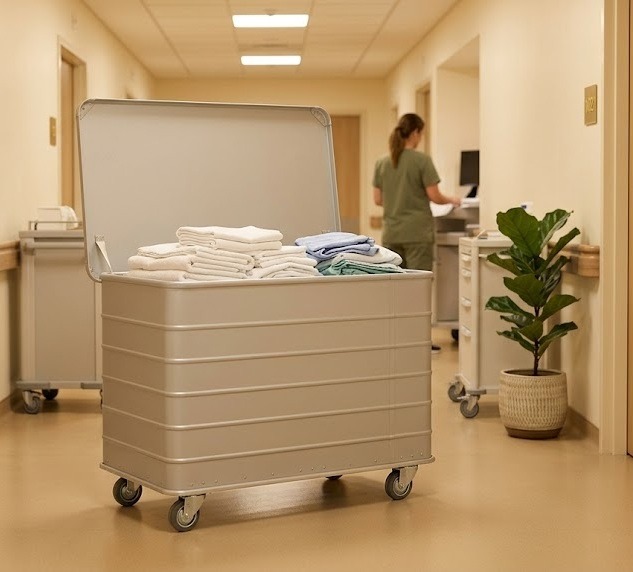
Maintenance includes checking brakes, fastenings, bags, and moving components. Abnormal noises, instability, or difficulty opening may indicate wear or the need for repairs. Spare parts must be compatible with the model, especially when it comes to bags, lids, or attachment systems. Recording any anomalies allows for intervention before the cart becomes unusable during operation.
Hospitals, clinics and nursing homes have different needs
A large hospital may require multiple carts distributed across departments, storage areas, and laundry facilities. The large volume of linens makes capacity, durability, and route coordination critical. In a smaller clinic, however, maneuverability may outweigh maximum volume. The configuration must therefore be proportionate to the facility and not just the department name.
In nursing homes, linen management is frequently linked to bed changes and care activities in the units. Corridors, elevators, and storage spaces may require compact or easily recognizable layouts. The frequency of collections must also be considered to avoid accumulations or oversized carts. An assessment based on actual flows allows for the selection of quantities and layouts consistent with the organization.
The technical data sheet guides a conscious supply
Before ordering, verify the dimensions, capacity, number of bags, and materials stated. The technical data sheet should be compared with the dimensions of the routes and the required accessories. It is important to distinguish the included equipment from the optional items shown in the images. The availability of spare parts and assembly methods can also impact future management.
Holity, leader in the selection of hospital linen trolleys and professional healthcare supplies, offers solutions for waste collection, clean distribution, and internal handling. The choice should be based on the number of departments, volumes, and procedures adopted. For multiple supplies, it's helpful to communicate quantities, configurations, and required lead times through a detailed quote. A properly sized cart streamlines linen management and facilitates operators' work without unnecessary steps.
 English
  Italian
 French
 German
 Spanish