Choosing bollards for street furniture requires distinguishing between fixed, removable, flexible and anti-parking models based on their intended function. Materials, fixing, visibility and frequency of movement affect the management of sidewalks, accesses, pedestrian areas and reserved parking spaces. Evaluating these elements allows you to identify the configuration best suited to the space, maintaining consistent delimitation, ease of use and integration with the urban environment.
Function comes before the shape of the bollard
The first useful distinction concerns what the bollard must achieve in the space. In some cases, a permanent delimitation between the roadway and the pedestrian area is needed, while in others it is necessary to maintain the possibility of temporarily opening a passage. In parking lots, however, the objective may be be to prevent unauthorized occupation of a stall or clearly indicate a reserved area. Defining this initial function avoids comparing products that belong to the same macro category but respond to different operational needs.
The level of transformation of the space also influences the choice. A square with a stable layout may require permanent elements, while an area used for markets, maintenance or technical access may benefit from removable solutions. In areas where maneuvers are frequent, a configuration capable of flexing in the event of contact may become useful. The correct question is therefore not which bollard is best in absolute terms, but what behavior it should have in the intended context.
Fixed bollards are suitable for permanent delimitations
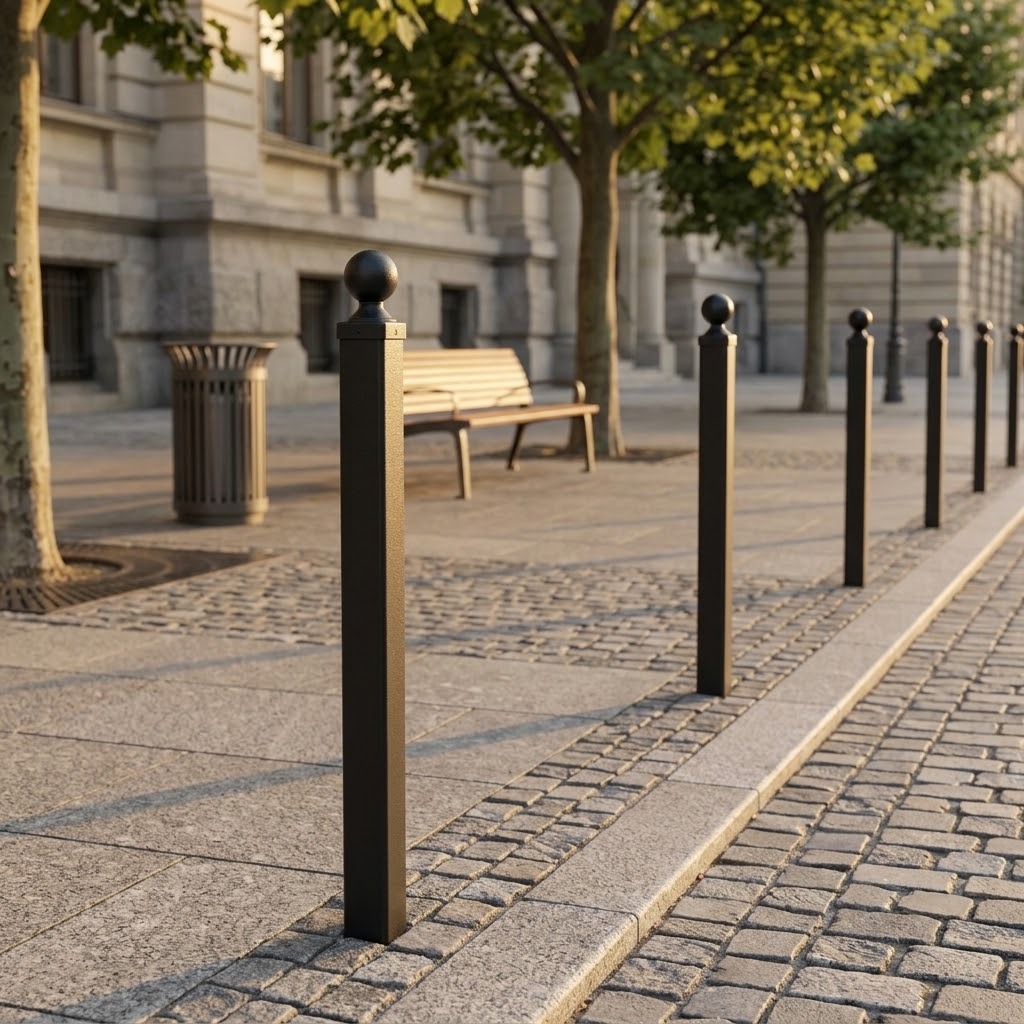 Fixed bollards are chosen when the separation of the space must remain stable over time. They can be used along sidewalks, pedestrian areas, squares, entrances, and paths where vehicle traffic does not need to be restored frequently. Fixing may vary depending on the model and surface, so the intended method must be verified in the technical data sheet. Once installed, the bollard becomes an integral part of the area's configuration and requires design consistent with paths and distances.
The choice of a fixed model is particularly rational when the need for delimitation does not change throughout the day or during different phases of space use. Materials such as steel, cast iron, or concrete can offer very different results in terms of weight, aesthetics, and installation management. It is therefore important to also evaluate the relationship with paving, facades, and other street furniture elements. Holity, a specialist in professional supplies for institutions, companies and public spaces, offers fixed bollards with different structures and finishes, useful for projects that require continuity and recognisability of the delimitation.
Removable bollards maintain the reconfigurable passage
The removable bollard responds to a different need because it allows a passage to be freed when access must be permitted temporarily. This configuration is suitable for passages used only at certain times, market areas, spaces for events or points intended for the occasional passage of authorised vehicles. The removal system and the base must be evaluated as parts of the same solution. Management of the element when it is removed from its housing must also be planned, especially in installations with numerous posts.
Removability It offers flexibility, but requires more organization than a completely fixed element. The manager must know who can remove the bollard, where it is stored, and how often the operation will be performed. In professional contexts, it is also useful to check the weight, grip, and locking system provided by the model. The choice therefore becomes a balance between access control and speed of reconfiguring the space.
. Flexible bollards are designed for contexts in which the delimitation must remain clearly visible but accidental contact with the post is more likely. Their structure uses materials capable of deforming and recovering their position according to the characteristics declared by the manufacturer. This behavior distinguishes them from rigid bollards, in which mechanical resistance and fixing play a different role. They may be of interest in car parks, maneuvering areas, cycle paths or areas where vehicles pass close to the demarcation line.
Flexibility should not be interpreted as an automatic substitute for any other bollard. If the objective is to create a permanent physical separation or to structurally prevent access, the design may require different characteristics. In flexible models, height, visibility, reflective elements, material and surface fixing system become central. The evaluation should therefore focus on the signalling and delimitation function in areas subject to occasional maneuvers and contacts.
Anti-parking bollards protect reserved spaces and accesses
The anti-parking definition identifies above all the function of the device, i.e. Prevent or discourage unauthorized occupation of a space. This family may include removable posts, folding arches, folding barriers, or other systems that allow the space owner to vacate the area when they need to access it. The choice depends on how often the parking space is used and the type of control desired. For a company or condominium parking lot, everyday practicality may outweigh the typical aesthetic function of a bollard placed in a square.
It is useful to distinguish the anti-parking bollard from a normal fixed post designed to prevent the entry of cars into an area. If the space is to be occupied by an authorized vehicle, the system must be able to be lowered, tilted, or removed according to the planned configuration. Locks, keys, locking systems, and visibility therefore become important parameters when reading the technical data sheet. Holity, a reference point for bollards parking and professional solutions for parking management, allows you to compare models with different operating logics before finalizing the supply.
Fixed, removable, flexible or anti-parking: the comparison starts from use
The four definitions should not be considered as perfectly equivalent categories. Fixed, removable and flexible mainly describe the behavior or construction configuration of the product, while anti-parking describes the function for which the device is installed. An anti-parking deterrent can in fact be removable or foldable, while a fixed post can perform an anti-parking function simply by physically preventing access to a certain area. Understanding this overlap helps the buyer to read the product sheets more precisely.
For a permanent delimitation, the fixed model generally represents the starting point of the comparison. If the gate needs to be reopened at certain times, removability becomes an operational requirement. If close maneuvers and accidental contacts are frequent, flexibility can take on greater importance. When the priority is to protect a reserved parking space, the discussion shifts to ease of opening, locking, and daily management of the anti-parking system.
. Materials and fixings change the management of the supply
. Steel, cast iron, concrete, and flexible plastic materials respond to different needs and should not be chosen solely for their appearance. Weight, exposure to atmospheric agents, the need for handling, and the frequency of possible impacts all influence the choice of material most consistent with the project. The finish also contributes to aesthetic continuity with benches, bins, planters, and other elements present in the area. In historic centers or representative spaces, this aspect can be crucial. be as crucial as the delimitation function.
The fixing must be read together with the material and type of bollard. A model to be embedded in concrete, one to be anchored, a free-standing element and a removable system with a dedicated base require different assessments of the paving and installation. In flexible bollards, the anchoring system must also be consistent with the expected behavior in the event of deformation. For this reason, the technical documentation should be verified before ordering, avoiding considering any installation method interchangeable between different models.
Visibility and aesthetic integration must coexist in the same project
A bollard must be recognizable by pedestrians and drivers, but in many projects it must also integrate with the character of the urban space. Color, height, shape and the presence of reflective elements modify the perception of the device during the day and in conditions of reduced visibility. In parking lots and maneuvering areas, immediate readability can take on a priority role. In a square or a historic center, however, form and finish may require closer coordination with the furnishing project.
The correct solution therefore arises from a balance between recognizability and visual continuity. A very discreet model may be unsuitable in a place where a clear delimitation is required, while a highly visible element may not be consistent with a monumental context. Even the repetition of multiple bollards along the same path changes the overall impact of the installation. The buyer should evaluate the individual product by thinking from the beginning about the sequence of elements that will characterize it. space.
The technical data sheet helps avoid improper comparisons
The photographs show shape and finish, but are not sufficient to correctly compare bollards with different functions. Height, diameter, material, fixing method, any removal system and the presence of reflective components must be verified in the product documentation. In anti-parking models, opening, closing and locking devices are also important. In flexible models, however, it is necessary to focus on the characteristics of the material and the planned configuration for anchoring.
A uniform comparison allows you to quickly exclude alternatives that do not respond to the real conditions of the area. It is useful to start from the required function and only then compare aesthetics, material and price between products of the same type. This method avoids putting on the same level a fixed decorative post, a removable element for an opening and a folding barrier intended for a parking space. The technical data sheet thus becomes the tool for transforming a generic search into a selection consistent with the urban or parking project.
An effective supply arises from the correct combination of typologies
The same project may require more than one configuration. A pedestrian area can use fixed bollards along the perimeter and provide removable elements at the points where authorized vehicles must enter. A parking lot can instead combine flexible posts to make the routes legible and anti-parking systems to protect certain spaces. Thinking of the supply as a coordinated whole avoids using a single product for functions that require different behaviors.
Holity, leader in the selection of bollards for street furniture and professional delimitation systems, offers fixed, removable, flexible configurations dedicated to the management of parking for public and private contexts. Before purchasing it is It is useful to define which areas must always remain closed, which must be reopened and where close manoeuvres are most likely. Only after this analysis can materials, finishes and fixing systems be compared in a truly useful way. The street furniture bollards thus become coordinated parts of a project that organises access, parking and routes without relying on a single solution for each space.
 English
  Italian
 French
 German
 Spanish