Bus stop shelters: accessibility and European references
When designing a public transport stop, it is important to consider the accessibility of the entire waiting space. At European level, EN 17210:2021 – Accessibility and usability of the built environment – Functional requirements defines functional requirements and recommendations for making the built environment accessible and usable according to the principles of Design for All and Universal Design.
Technical document CEN/TR 17621:2021 supports EN 17210 by providing criteria and technical specifications relating to the accessibility of the built environment, including outdoor areas and spaces intended for public use.
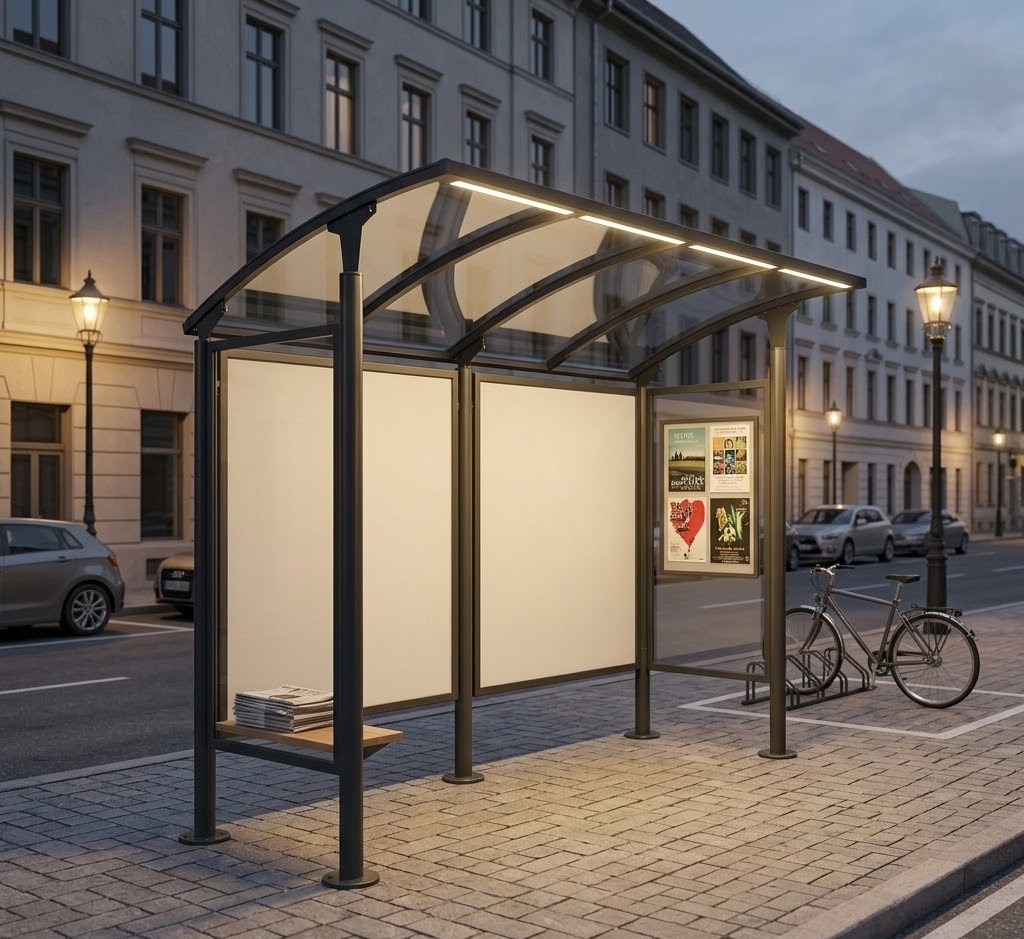
When designing a shelter and the surrounding area, aspects such as continuity of accessible routes, absence of obstacles, possibility of maneuver, recognizability of elements and usability of information must therefore be evaluated. The dimensional requirements and applicable provisions must in any case be verified in relation to the national and local regulations of the country in which the installation is carried out.
A well-organized bus stop must allow passengers to easily find information on lines, routes and timetables. Noticeboards, information panels and displays can be integrated into the shelter, while adequate lighting improves the usability of the space in the evening hours.
More advanced solutions may include LED lighting and digital systems to communicate waiting times and information about the service. These elements must also be positioned so that they are easily visible and do not interfere with users' routes.
Installation and maintenance of the bus shelter
The installation method depends on the structure of the shelter, the characteristics of the ground and the fastening system provided by the manufacturer. Before installation, the subfloor, the dimensions, the position with respect to the roadway and the presence of any underground services must be evaluated.
Maintenance must also be considered during the selection phase. Structures, roofs, and panels must be easy to clean and inspect; in public facilities, it is also useful to evaluate materials and finishes that are resistant to intensive use and the expected environmental conditions.
Which shelter to choose based on the urban context
In busy urban centers, it may be useful to favor robust structures, equipped with side protection, seating, and information systems. In small towns or green areas, shelters made of wood or combined materials, capable of integrating with the surrounding landscape, may be more suitable.
For peripheral and extra-urban stops, protection from atmospheric agents and the resistance of the structure are particularly important, while in urban redevelopment projects, design, finishes, and coordination with other furnishing elements also become determining criteria.
Bus shelters for municipalities and public bodies
For municipalities, public administrations and transport companies, the choice of shelter must combine functionality, durability and management over time. Before purchasing, it is useful to define the number of stops, available dimensions, desired materials, necessary accessories and characteristics of the installation area.
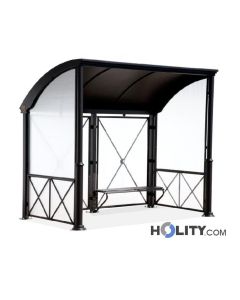
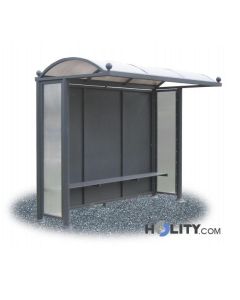
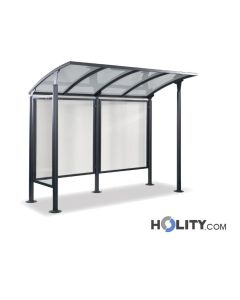
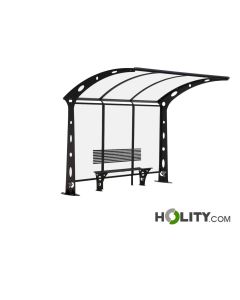
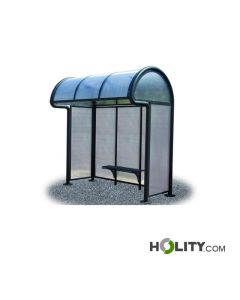
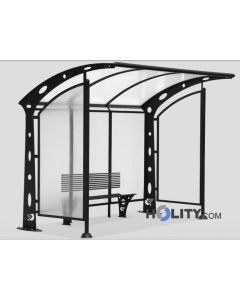
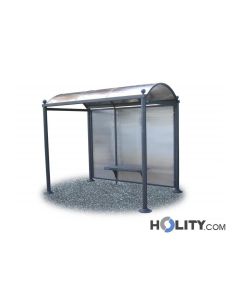
In the Holity catalogue it is possible to compare different bus shelters intended for street furniture, choosing configurations, materials and dimensions according to the needs of the project.
Frequently asked questions about bus shelters
Which materials should you choose for a bus shelter?
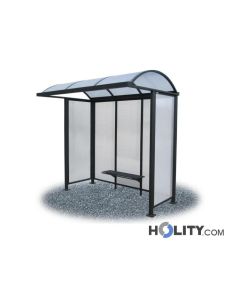
The choice depends on the context and maintenance needs. Steel and aluminium are suitable for robust and long-lasting structures, while wood may be preferred when greater integration with green areas or traditional contexts is sought. Glass and polycarbonate are frequently used for protective walls.
How big should a bus shelter be?
The dimensions must be established considering available space, expected number of users, presence of seats and the need to maintain accessible routes. There is therefore no single size valid for all stops.
Can a bus shelter have a built-in bench?
Yes. Many models include built-in seats or benches to improve comfort while waiting. However, their arrangement must be compatible with the passage spaces and the accessibility needs of the stop.
What aspects should be considered before installation?
It is advisable to check the size of the area, characteristics of the terrain, fixing system, exposure to atmospheric agents, pedestrian flows and accessibility requirements, in addition to the national and local regulations applicable to the project.
 English
  Italian
 French
 German
 Spanish
 To choose a