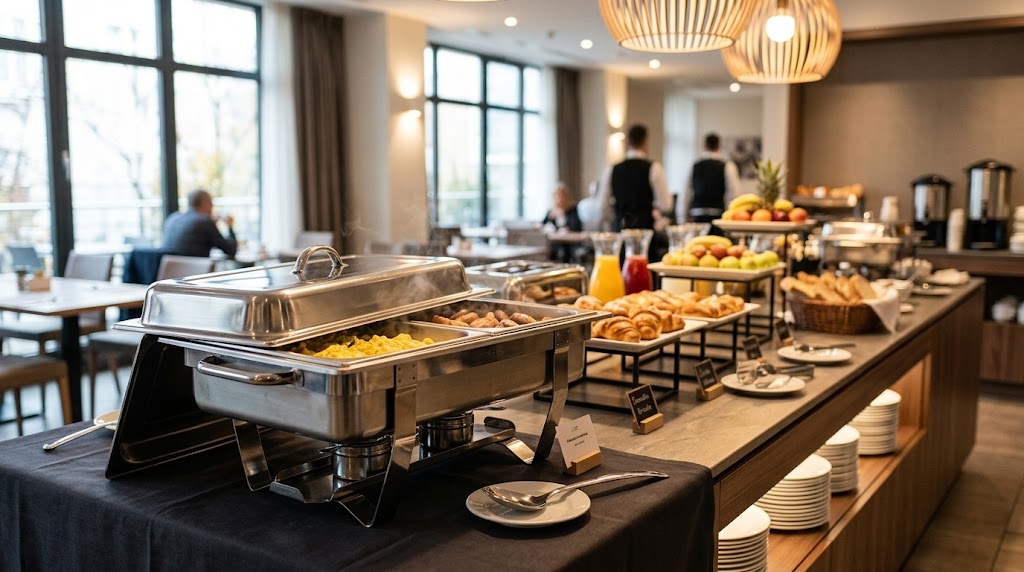
A professional electric food warmer must be chosen considering much more than just the declared power. Capacity, temperature regulation, tank size and service duration in fact affect the way in which the equipment is used in restaurants, hotels, buffets, catering and canteens. A model suitable for a small self-service station may be impractical in a high-rotation line. The choice should therefore start from the actual operational flow of the structure.
The power must be read together with the capacity
The value expressed in watts is one of the first data that appears in the technical data sheet of a electric food warmer, but it should not be interpreted in isolation. A higher power does not automatically mean that the model is better for every type of service. The quantity of food must be considered at the same time. of food to be held, the volume of water possibly used in the bain-marie and the overall dimensions of the tank. Power only becomes significant when related to the capacity and configuration of the appliance.
The professional range clearly shows this relationship. There are compact models with relatively low power consumption, intended for a single tank or small quantities, and larger hot tables with more powerful heating elements and more containers. This does not necessarily make the second model more suitable for a small buffet, because size and consumption must be justified by the actual volume of service. For a Horeca buyer it is therefore more useful to ask how many dishes will need to be held at the same time and for how long, rather than comparing products solely by the number of watts.
The thermostat makes it easier to Flexible food maintenance
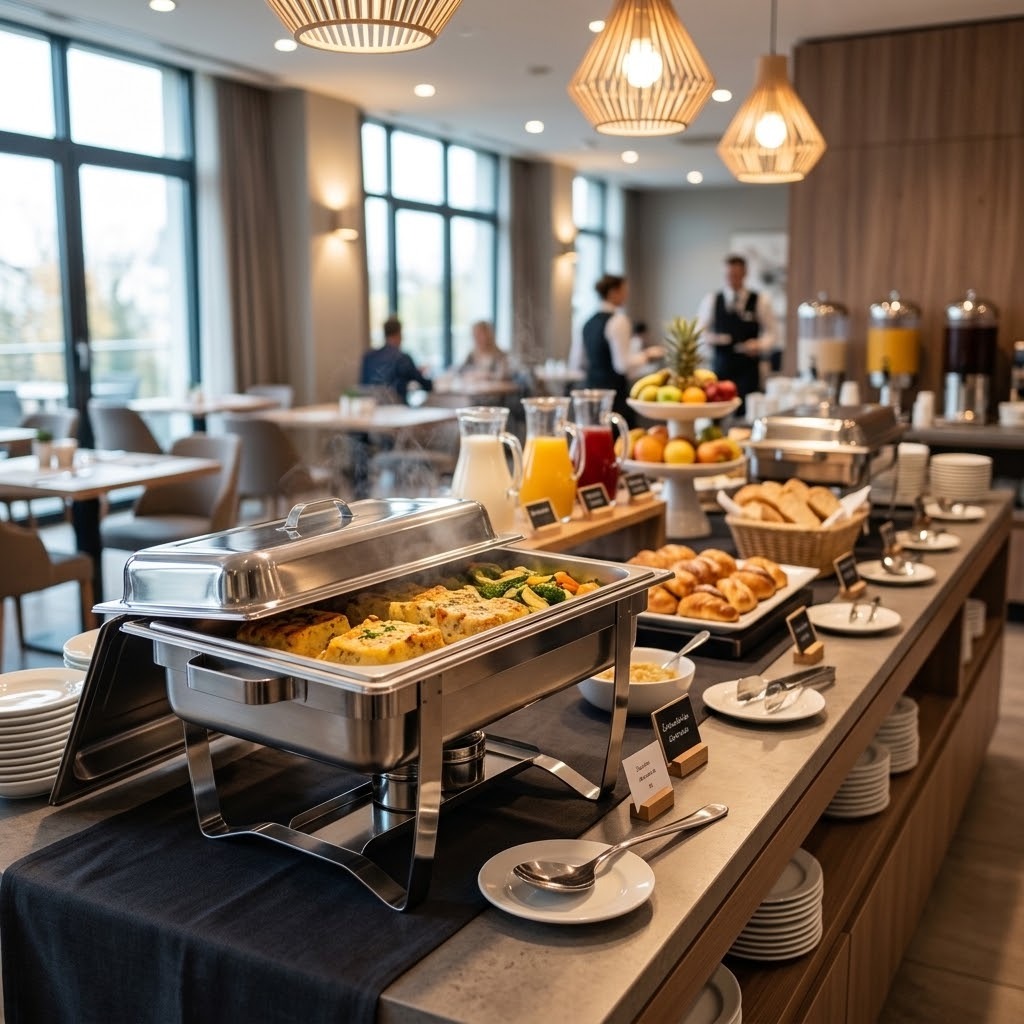 The presence of an adjustable thermostat allows the food warmer's operation to be adapted to the characteristics of the preparation and the organization of the service. In professional catering, not all dishes are managed in the same way and not all remain on display for the same length of time. The possibility of modifying the heating level can therefore facilitate operational management compared to an appliance with very limited adjustment. The thermostat must be considered a maintenance control tool and not a simple indicator of the machine's power.
Some professional Holity models have adjustable temperature ranges and electronic or thermostatic control systems, with different configurations depending on the capacity. This allows the buyer to compare appliances intended for different services without assuming that a wider range is always preferable. The temperature set on the appliance must also be managed within the operational and hygiene procedures adopted by the facility. Holity, a specialist in professional equipment for the Horeca sector, offers different solutions precisely because keeping warm must be adapted to the type of service.
The bain-marie modifies the way heat is distributed
In bain-marie food warmers, the resistance heats the water in the lower tank, which then transfers the heat to the food containers. This configuration creates indirect heating and is frequently used in buffet lines and hot tables. However, the presence of water also introduces specific operational activities, such as filling, level control and emptying at the end of use. Choosing a bain-marie model therefore means evaluating both the thermal behaviour and the daily management of the machine.
In a professional kitchen, this distinction can have important consequences on the organisation. A model with a drain tap can facilitate end-of-service operations, while a configuration with multiple tanks allows you to simultaneously maintain different preparations. Some professional Holity hot tables use bain-marie and provide multiple Gastronorm containers or separate pots. Before purchasing, it is therefore advisable to check how much water the appliance requires, how it is drained, and how much operating space is required around the station.
The nominal capacity must be related to the quantity actually needed during the shift. A very large container can reduce the frequency of refills, but it can also be oversized when the food turnover is rapid or the number of covers is limited. A configuration with multiple tanks can, however, be useful when the buffet includes several first courses, side dishes, or hot preparations available at the same time. Correct sizing therefore arises from the relationship between quantities served, variety of preparations and frequency of replenishment.
Compatibility with the Gastronorm system can also simplify the organization of a professional kitchen. Using standard containers makes it easier to coordinate preparation, storage, internal transport and keeping warm, when the other equipment in the facility works with the same format. However, not all food warmers have the same useful depth or the same internal configuration. It is therefore necessary to check in the technical data sheet which containers are compatible, which are included and which must be ordered separately.
The electrical supply must be compatible with the station
A electric food warmer requires an adequate station not only in terms of space, but also of system availability. Coffee machines, ovens, fryers, hotplates, refrigerators, and numerous other appliances can be operating simultaneously in a buffet or kitchen. The power consumption of the food warmer must therefore be considered within the overall load expected for the line. The electrical power indicated in the technical data sheet must be verified with respect to the specific location in which the appliance will be used..
Voltage, frequency, and type of connection must also correspond to the manufacturer's instructions. When purchasing, it is not advisable to assume that similar appliances have identical electrical requirements. The position of the socket must also allow for orderly use without creating improvised connections in areas where staff or guests pass. For permanent or particularly complex professional installations, the compatibility of the system must be evaluated as part of the correct design of the location.
Materials and cleaning affect daily use
The food warmer is handled, filled and cleaned very frequently, especially in daily services. For this reason, the materials must also be evaluated in relation to ordinary maintenance and not just the aesthetic aspect. Stainless steel is very common in Horeca equipment because it is suitable for the creation of tubs, frames and surfaces intended for professional use. Ease of access to the parts to be cleaned can become a purchasing criterion as important as the capacity of the machine.
Removable tubs, extractable containers and drain taps can simplify some operations, but the cleaning methods must always follow the manufacturer's instructions. It is also useful to check which components can be washed separately and which must be treated without immersing the electrical part. Holity offers professional food warmers with different configurations also in this respect, from Gastronorm containers to models with removable pans. Comparing these features before purchasing allows you to evaluate the real effort required at the end of the service.
Lid and accessibility influence the pace of service
The lid does not only have an aesthetic function. The way it is opened affects the way in which the customer or operator accesses the food, especially in high-traffic buffets. Removable, folding or roll-top lids generate different gestures and encumbrances and must be chosen based on the configuration of the counter. In self-service services, ease of opening can directly affect the fluidity of the queue.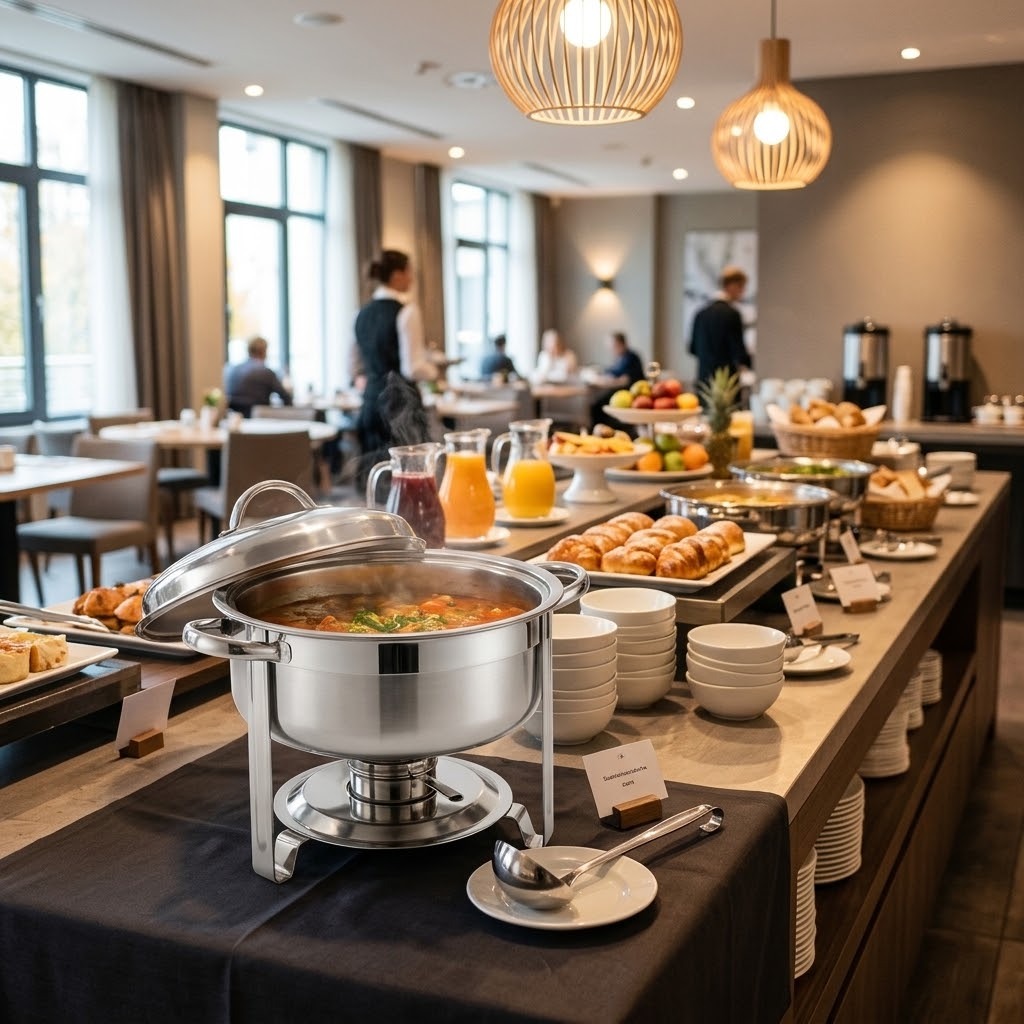
It is also useful to consider the protection of the food and the space available above and behind the food warmer. A very large lid may be impractical if it interferes with shelves, splashbacks, or other equipment. Conversely, a solution that remains attached to the structure can reduce the need to find a surface on which to rest the lid during service. These aspects may seem secondary in the technical data sheet, but become evident when dozens of people use the same station consecutively.
Buffets, restaurants, and canteens require different configurations
In a hotel, the food warmer may be used every morning for the breakfast buffet, while in a restaurant it may be used to keep certain preparations ready during more concentrated windows. A canteen, on the other hand, may require larger volumes, more tanks, and a structured distribution line. Catering adds further variables, because the equipment can be moved and installed in different locations. The context of use therefore determines which combination of capacity, size and adjustment is truly functional.
A 6 or 10 litre food warmer does not necessarily meet the same needs as a snack bar with multiple GN containers. For this reason, the comparison should start from the number of covers, duration of service, variety of dishes and expected frequency of refills. The position with respect to the kitchen also changes the needs: a station distant from the preparation area requires different programming than a counter placed next to the operating line. The product should therefore be chosen as part of the Horeca organisation and not as an isolated appliance.
The final choice must start from the technical data sheet and the actual service
Before purchasing, it is a good idea to compare some fundamental data: actual capacity, number and size of containers, absorbed power, adjustment range, external dimensions and cleaning methods. It is also necessary to check whether containers, lids or other components are included or available as optional extras. A brief commercial description cannot replace this detailed reading. The correct food warmer is one that responds to the expected service without introducing unused capacity or operational limits during peak times.
Holity, a point of reference in professional supplies for restaurants, hotels and catering, offers electric food warmers with different capacities, power and configurations, including Gastronorm models and bain-marie hot tables. The choice of one professional electric food warmer should therefore derive from the joint analysis of power, thermostat, capacity, location and pace of service. The facility's food safety procedures must also be considered, because the adjustment of the appliance does not replace the control provided for in the business's operational plan. In this way, the purchase becomes consistent with the real needs of the kitchen instead of being based on a single technical data.
 English
 Italian
 French
 German
 Spanish