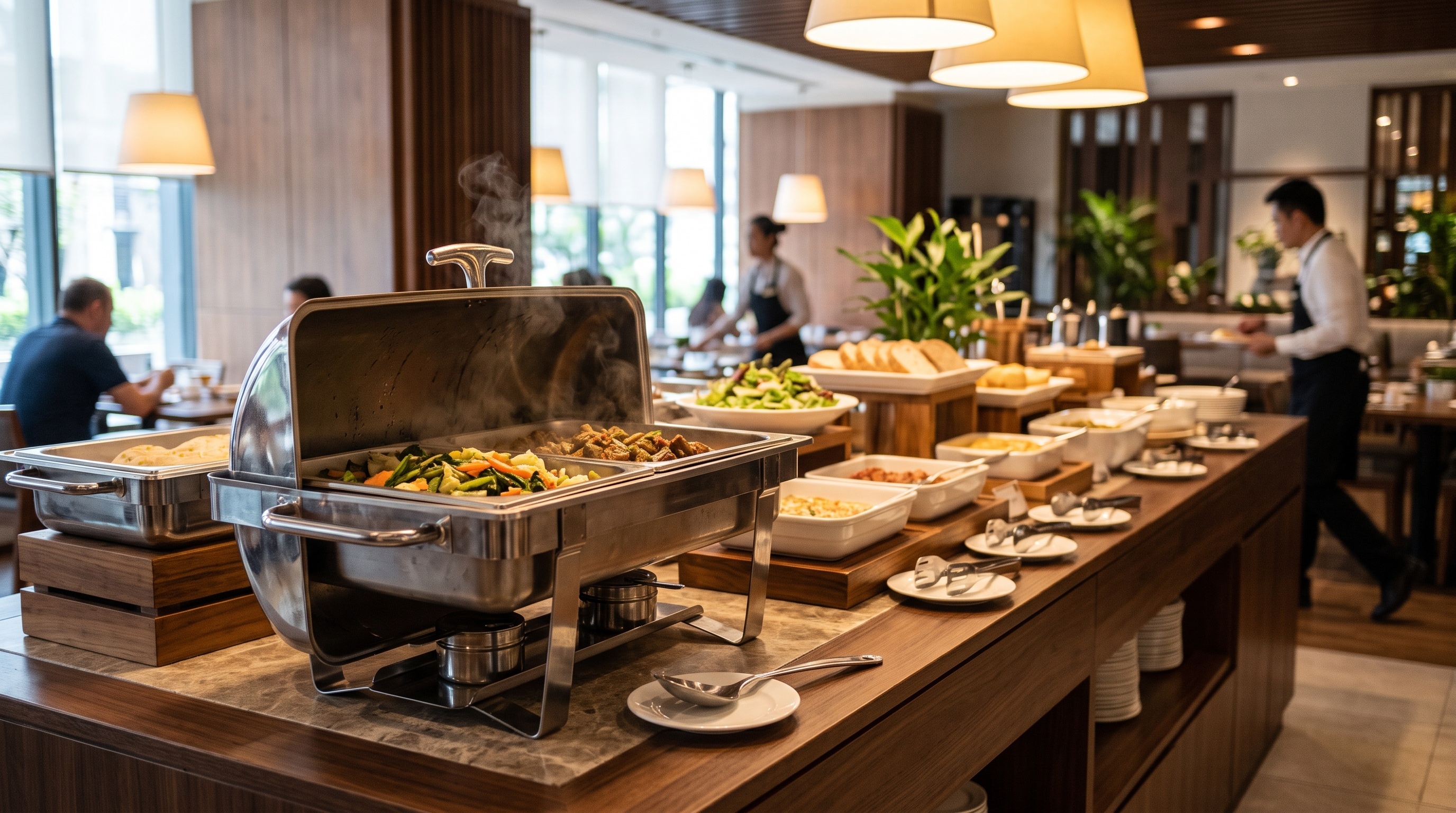
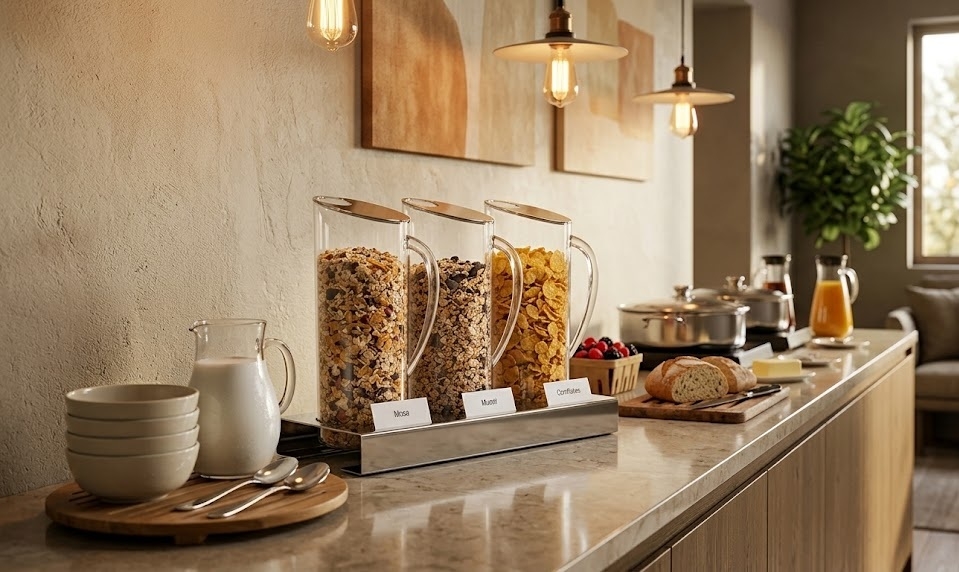
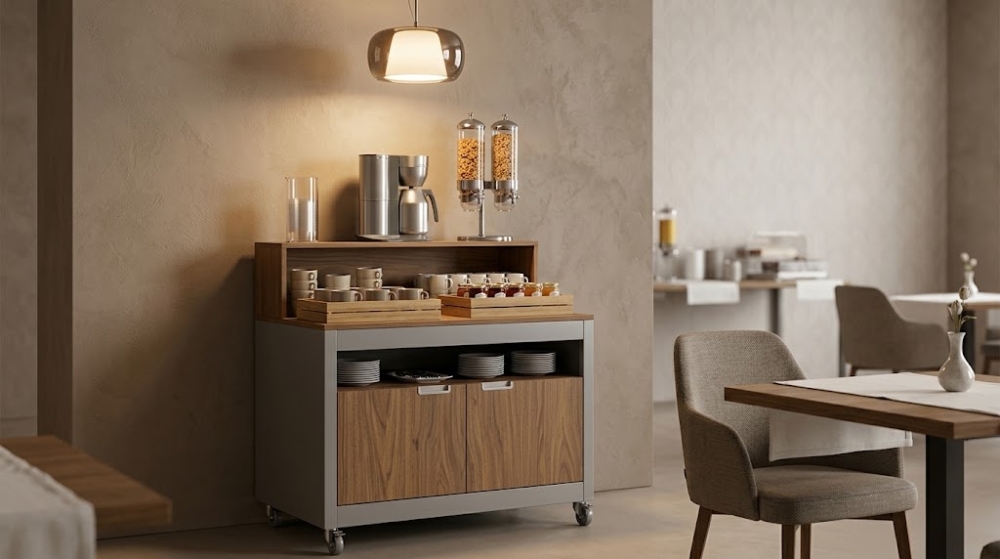
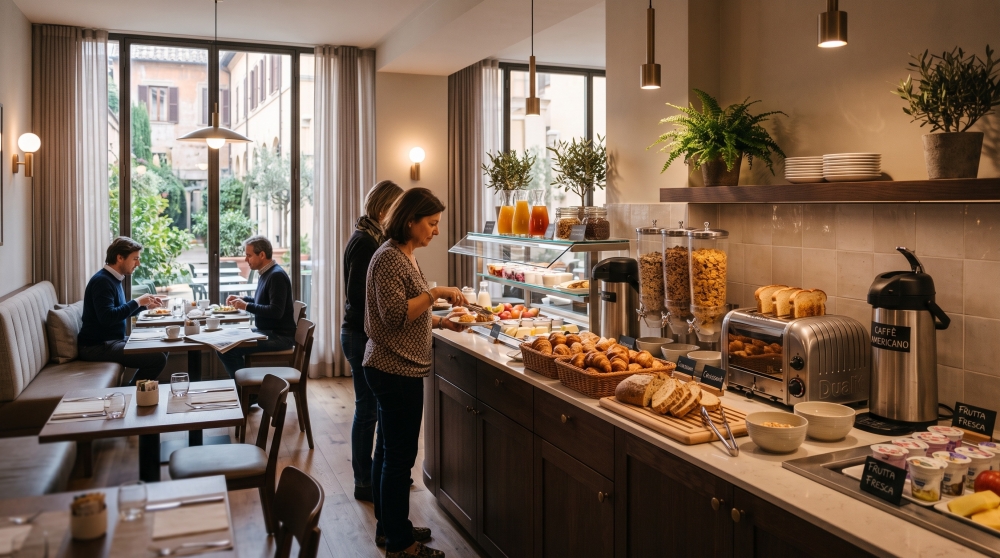
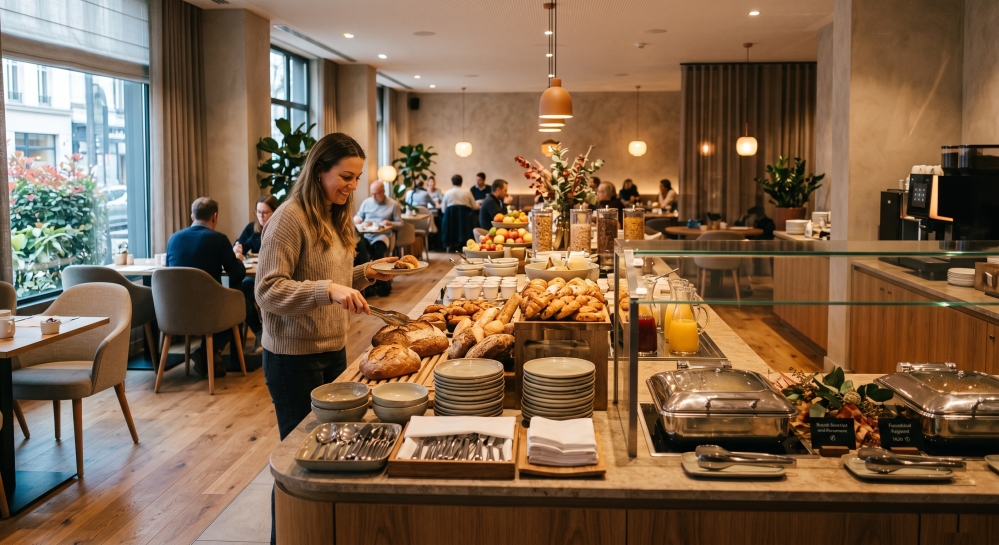
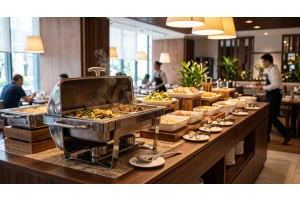
In a hotel breakfast service, an abundant buffet does not necessarily equate to efficient management. Preparing and displaying large quantities right from the start may seem like the simplest way to ensure availability for guests, but it makes it more difficult to adapt the offering to the actual progress of the service. The issue of hotel food warmers and waste must therefore be addressed within a broader strategy, in which equipment, quantities prepared, replenishments, and guest flows are coordinated. The food warmer does not eliminate surpluses on its own, but it can support a more rationally organized buffet.
For hotels and other accommodation facilities, breakfast management is in fact about much more than the presentation of products. Every morning it is necessary to correlate the number of guests, the times of greatest influx, the composition of the offering and the work of the staff. A correct choice of equipment allows for a better structure of this activity and to avoid the buffet being managed according to fixed quantities independent of demand. Operational efficiency, cost control and quality of service can thus be addressed as parts of the same process.
In the breakfast buffet the food warmer has a specific function: to keep the foods intended for hot service in the operating conditions established for their administration, according to the characteristics of the equipment used and the procedures of the facility. From an organizational point of view, however, its presence also influences the way in which the buffet is constructed. The size and capacity of the containers determine how much product can be presented at the same time and how frequently it will need to be replenished.
It is precisely this relationship between capacity and replenishment that makes the equipment interesting from a management point of view. Filling a large container only once and keeping it on the buffet for the entire service does not necessarily represent the most efficient solution. In many contexts, it may be preferable to organize quantities consistent with the influx of guests and schedule replenishments during the morning. Holity, a specialist in professional supplies for hotels and the Ho.Re.Ca. sector, represents a point of reference for facilities that must select buffet equipment by comparing technical characteristics and service organization.
Why waste arises before the buffet opens
A significant part of the surplus can be linked to decisions made before guests arrive. Preparing the same quantities every day without considering occupancy, customer type, and historical breakfast trends means working with a forecast that is not very close to the actual service. A hotel with highly variable attendance between weekdays, weekends, and high season periods also needs to adapt breakfast to these fluctuations.
The food warmer enters this process when its capacity is used as an organizational parameter and not as a quantity that must necessarily be filled. Staff can think about the initial quantities and subsequent replenishments based on the procedures defined by the facility. Reducing waste means first of all avoiding transforming the maximum capacity of the equipment into a standard production quantity. The buffet should follow the expected demand, not the volume available in the containers.
Size the food warmers based on the actual service
 The choice of the food warmer should start from the number of covers and the composition of the hot proposal. A facility with an offering concentrated on a few preparations has different needs than a hotel that offers a more varied breakfast. The space available on the buffet must also be considered, because multiplying the equipment without a real need can make the service area less visible and complicate the work of the operators.
Before purchasing, it is therefore useful to identify which preparations actually need to be kept warm and what quantity is normally required during the different phases of the morning. The dimensions and capacity of the individual models must be verified in the relevant technical data sheets. A correctly sized food warmer facilitates proportionate management of the buffet, while a capacity chosen without considering consumption can indirectly encourage the preparation of quantities greater than required.
Small refills can make the buffet more flexible
A buffet does not necessarily have to present the same quantity of product from opening to closing. In the early stages of service, it may be useful to start with volumes defined on the basis of the expected attendance and subsequently observe the trend in consumption. Replenishment thus becomes part of the breakfast routine and allows the offering to be gradually adapted to the actual number of guests present in the room.
This approach naturally requires a coherent staff organization. If the buffet is checked only occasionally, initial quantities that are too small can produce discontinuity in the service. On the contrary, a system of scheduled checks and replenishments allows you to work with greater precision. Reducing waste should never be achieved at the expense of availability for the guest: the goal is to find a balance between the quantity displayed and the ability to intervene quickly when necessary.
Adapt the buffet to breakfast time slots
Those who work daily in hotel catering know that the flow of breakfast is rarely uniform. There may be time slots in which the room fills up quickly and subsequent periods characterized by a much lower turnout. Continuing to maintain the same quantity displayed regardless of the phase of service can produce surpluses, especially towards the end of breakfast.
Management of food warmer should follow this curve. During busier times, it may be necessary to organize more frequent replenishments, while as we approach the end of service, the quantities can be calibrated more carefully based on the expected residual presence. The buffet must be able to change pace during the morning. This flexibility allows the equipment to be used as a management support and not as a container that must be kept full until the last minute.
Knowing consumption helps control costs
Intelligent breakfast management requires observation. Recording over time which preparations are consumed most and which tend to generate surpluses allows for more reliable forecasts to be built. This information can be read together with occupancy, day of the week, seasonality and characteristics of the hosted clientele, progressively creating a more useful basis for organising production.
The food warmer becomes one of the points through which this strategy is applied concretely. If a preparation has limited consumption in certain time slots, it is not necessary to automatically use the maximum available capacity. Knowing what is available helps control costs that is actually consumed allows the buffet to be transformed from a system based on preventive abundance to a service managed on demand. This approach can help control costs while maintaining the quality and variety of the breakfast experience offered to guests.
Professional food warmers help hotels optimize breakfast buffet management by improving portion planning, scheduling replenishments, and reducing food waste without compromising the quality of service provided to guests.
Do not confuse abundance and perceived quality
A professional buffet must convey care and availability, but this does not necessarily mean presenting large quantities of each preparation. A very large container filled completely may appear abundant upon opening, but the perception of the service also depends on the order, continuity and consistency of the food. of replenishments and the attention with which the area is maintained throughout the morning. Quantity is therefore only one component of the experience. Holity, A more dynamic management allows you to work on the presentation without using excess product as the main tool for communicating quality. The staff can monitor the preparations and intervene when necessary, keeping the buffet consistent with the standards defined by the structure. specialist in professional equipment for the hotel industry is aimed specifically at structures that need to build functional service spaces, in which each piece of equipment responds to a specific organizational need.
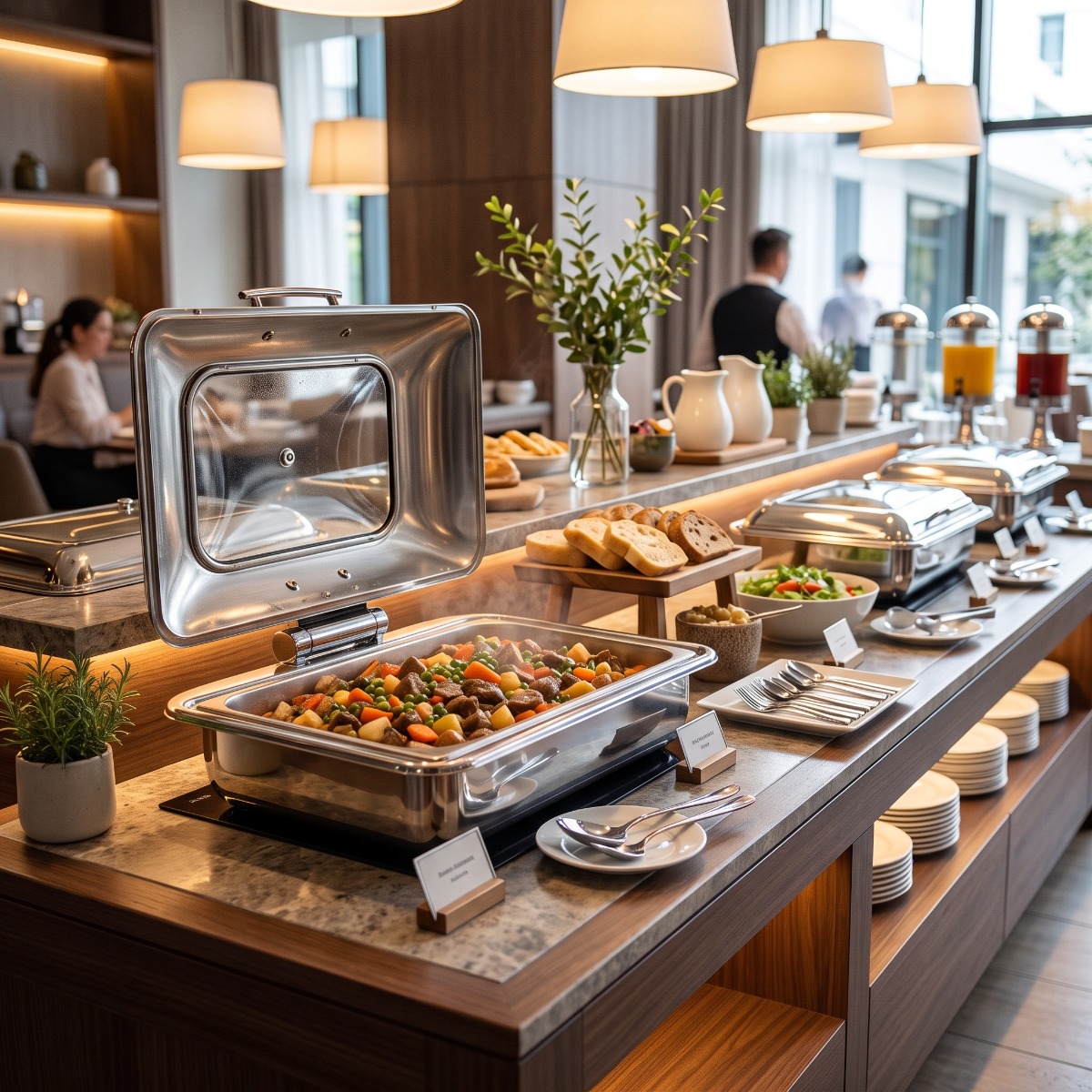 Not all hot preparations are requested in the same way and with the same frequency. The composition of the menu should therefore precede the choice of the number and size of the food warmers. It is It is useful to identify which products are a stable presence at breakfast, which are offered only on certain days and which require different quantities depending on occupancy. This approach avoids building the buffet starting from the available equipment and then deciding what to include in it. The opposite should happen: menu, consumption and service methods define the necessary equipment. The characteristics of the individual food warmer must then be verified in the product documentation, especially with regard to capacity, dimensions, operating methods and expected conditions for use.
Evaluate power supply and operating methods Professional food warmers can adopt different configurations and operating systems. The choice must be made on the basis of the characteristics declared by the manufacturer and the compatibility with the organization of the breakfast room. It is not It is advisable to consider models that use different systems as equivalent, because installation, management and operating procedures may change.
When comparing products, it is therefore necessary to check how each appliance fits into the existing buffet. Space availability, power supply methods and frequency of use are parameters that must be analysed before ordering. The most suitable solution is not the one with the greatest capacity or power overall, but the one that is consistent with the expected service and the technical conditions of the environment in which it will be used.
Optimising space on the buffet
Each appliance occupies a portion of the available surface and alters the guest's path. Inserting numerous food warmers without considering the layout can concentrate people in a single point and also make staff operations more difficult. Before purchasing, it is therefore useful to measure the buffet and establish which areas to allocate for hot preparations, drinks, and other products required by the service.
The layout should also allow operators to check and replenish food warmers without continuously interfering with the guests' flow. This aspect becomes particularly important during peak periods, when even small obstacles can slow down service. Breakfast efficiency also means reducing unnecessary movements, building a layout in which equipment and flows work in the same direction.
Reducing waste without reducing variety
Controlling surpluses does not necessarily mean eliminating preparations from the buffet. A facility can maintain a varied offering by working instead on the initial quantities and the frequency of replenishments. Some products may require larger volumes, while others can be presented in smaller quantities and integrated during the morning. It is It is precisely this differentiation that prevents each product from being managed according to the same scheme.
Variety therefore remains compatible with a more careful approach to waste when breakfast is monitored. Staff must know consumption habits and use this information to adapt preparation. Operational sustainability comes from precision, not necessarily from reducing the offering. A buffet can remain complete even when quantities are calibrated more carefully.
The role of staff in managing food warmers
No piece of equipment can completely replace the team's organization. The food warmer performs its technical function, but it is up to the staff to control the buffet, apply the facility's procedures and coordinate replenishments. For this reason, it is important that the methods operations are shared and do not depend exclusively on the experience of the individual employee present during a given shift.
Defining common criteria also allows for the collection of more reliable information on consumption. If each operator manages quantities and replenishments in a completely different way, it becomes difficult to understand which surpluses derive from demand and which from service methods. Equipment and procedure must work together. The food warmer is effective from a management point of view when it is inserted into a clear and repeatable process.
Manage the final phase of service with greater precision
The last moments of breakfast represent one of the most delicate phases in the management of quantities. The buffet must continue to offer a consistent service to guests who arrive later, but preparing new large volumes when the turnout is now reduced can be difficult. increase the risk of surpluses. This is where knowledge of flows and progressive management of replenishments become particularly useful.
The facility can define procedures to adapt quantities while still maintaining the availability required by its service standard. There is no universal quantity to use, because the number of guests, menus, and organization vary from hotel to hotel. The final phase should be managed on the basis of real data and not the habit of keeping every container completely full. This approach allows you to work on waste at the point where it can become most evident.
Food warmers and food safety
The objective of reducing waste must never lead to improperly modifying times or methods of food management. Temperatures, storage, display, and procedures must comply with the provisions of the facility's self-control plan, the applicable food indications, and the characteristics of the equipment used. The economic organization of the buffet therefore remains subordinate to correct hygiene and health management.
It is essential to follow the food warmer manufacturer's instructions and the HACCP procedures defined for the activity. Any decisions regarding the maintenance, replacement, or management of preparations must be adopted by the facility according to its own procedures and applicable provisions. Waste reduction and food safety are distinct objectives that must be coordinated without compromise..
Evaluate the cost of the equipment beyond the purchase price.
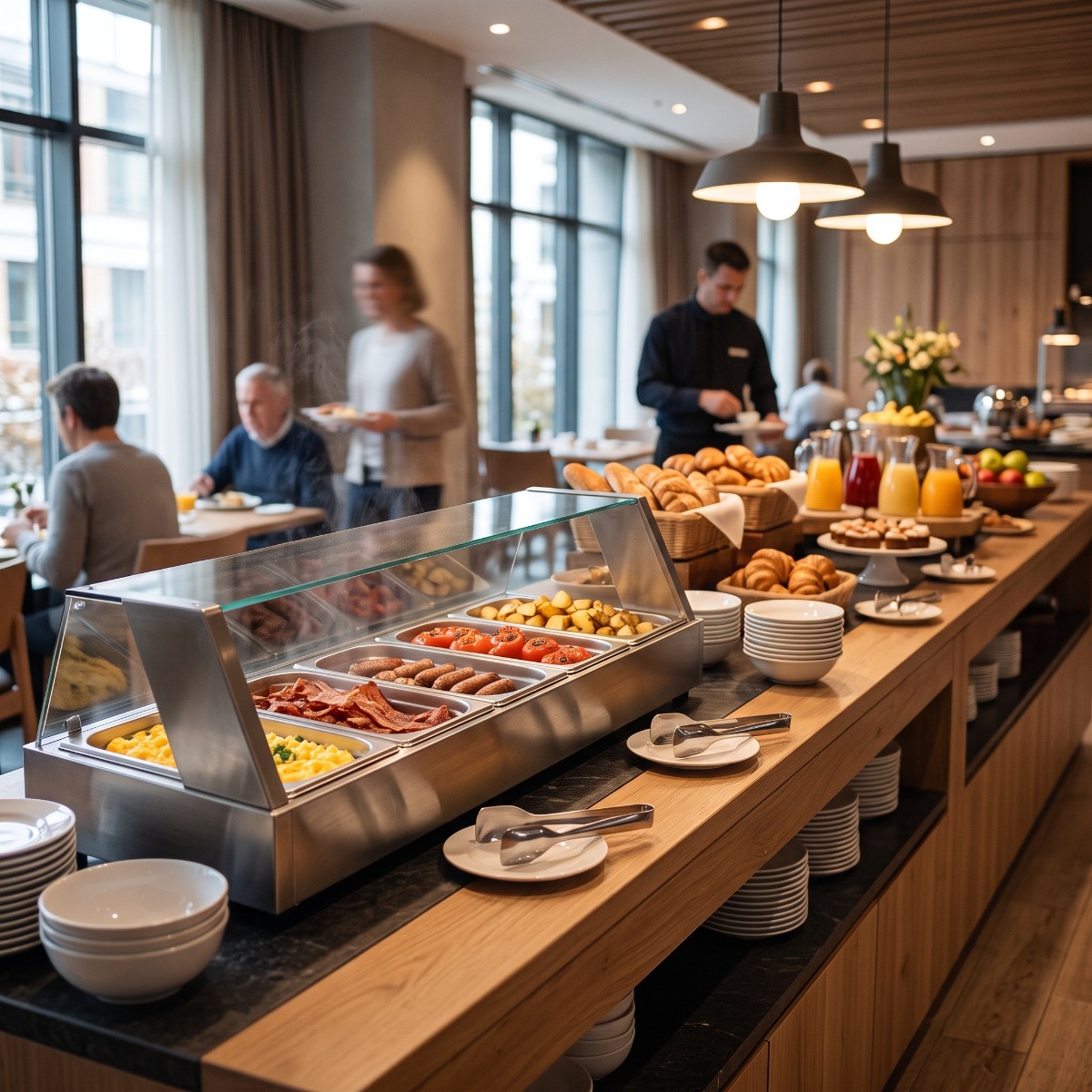 When a hotel chooses a food warmer, the initial price represents only one of the parameters to consider. Sizing, compatibility with the buffet, and the method of preparation are all important factors. of operation and frequency of use affect the real usefulness of the purchase. An oversized device compared to the service can take up space and encourage poorly proportioned management of quantities, while an insufficient solution may require an excessively complex organization of refills.
For this reason, the comparison should be made starting from the operating costs that the equipment helps to organize. Holity offers professional supplies also dedicated to the management of hotel breakfasts, allowing hotels and accommodation facilities to compare solutions based on the necessary technical characteristics. The choice becomes more effective when the investment is evaluated in relation to the way in which breakfast is actually managed.
Mistakes to avoid in managing the hot buffet
One of the most common mistakes is the lack of a proper management of the breakfast buffet. A common mistake is to consider the food warmer as a container that must remain full for the entire duration of breakfast. This approach can lead to disconnecting the quantity displayed from the actual number of guests. Another mistake is to use the same strategy every day, ignoring variations in occupancy, seasonality, and time slots. A professional buffet, on the other hand, requires the ability to adapt.
It is also ineffective to purchase equipment before defining the menu, table settings, and space organization. A model may be technically valid but not consistent with the layout or the quantities normally managed. Finally, waste reduction should not be pursued through procedures that could compromise the quality or safety of the service. True optimization comes from the coordination between forecasting, equipment, personnel, and consumption control.
Breakfast management becomes more effective when decisions can be compared with what actually happens every morning. Number of guests, quantities prepared, replenishments and surpluses can provide useful indications for progressively correcting the organization. It is not necessarily necessary to transform breakfast into a complex system: even consistent monitoring of consumption can help identify oversized preparations or time slots in which it is possible to better calibrate the offering.
Evaluate power supply and operating methods hotel food warmers thus enter, together with waste, into a more rational relationship. The equipment is not chosen to fill a space on the buffet, but to support a certain volume of service and a replenishment strategy. Holity, a specialist in professional supplies for hotels and the Ho.Re.Ca. sector., represents a reference for facilities that want to organize breakfast using equipment consistent with their operating model. An efficient buffet is born from the ability to offer continuity and quality to guests, using quantity, space and resources with greater awareness.
 English
 Italian
 French
 German
 Spanish