Prevention starts before the weather alert
 A barrier stored in a warehouse is not automatically ready for use after months of inactivity. Before the autumn and winter seasons, it is a good idea to check where the necessary panels, guides, and components are located, ensuring that they are accessible without having to move goods or equipment. The personnel who will have to assemble them should know the sequence recommended by the manufacturer. The preparation of the Flood barriers must therefore precede the weather alert, when it is still possible to intervene without haste.
This organization is particularly useful in buildings that have already shown critical issues during heavy rain or accumulations of water on the street. Knowing the points through which water tends to approach the building allows you to assign priority to the truly vulnerable accesses. A test performed under normal conditions can also highlight missing components, obstacles, or difficulties in tightening. When a critical prediction arrives, the system should already be known and not become a piece of equipment to be understood for the first time.
Doors, garages and low accesses are the first points to check
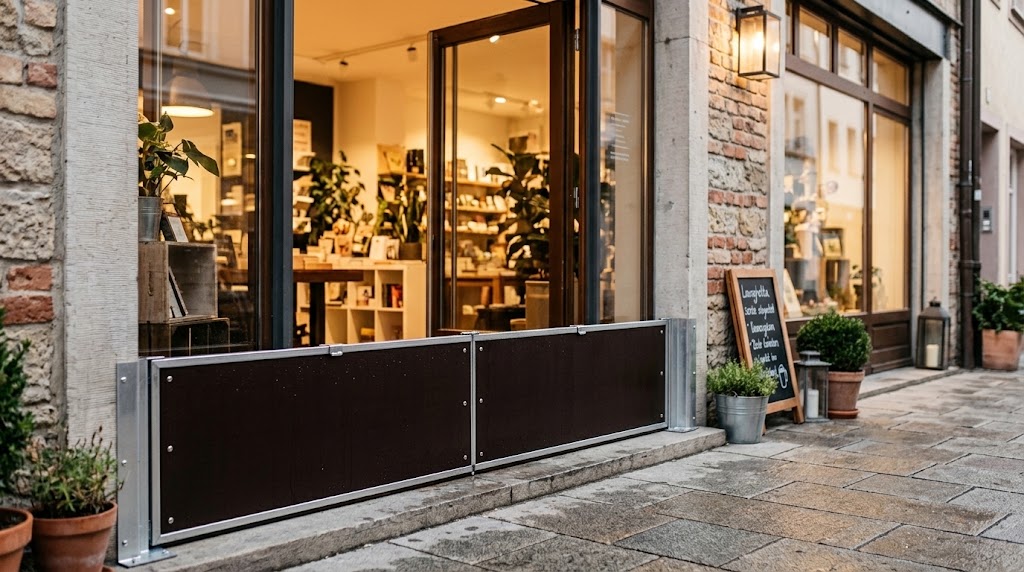
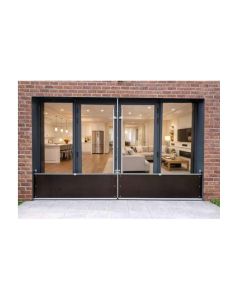
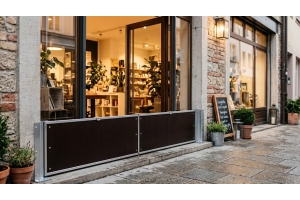
The vulnerability of the building does not depend only on its geographical position. A door at street level, a ramp leading down to a garage or an entrance located lower than the sidewalk can create paths favorable to the entry of water. Even shop windows, warehouse doors and driveways deserve a specific check. Protection should start by identifying the gaps through which water can most easily reach the internal rooms.
In an underground garage, for example, the problem does not necessarily coincide with that of a normal pedestrian door. The width is greater and the water can concentrate along a ramp, making it necessary to evaluate a barrier suitable for the space. In a shop, however, the protection must coexist with an entrance used continuously during ordinary activities. These differences explain why the same bulkhead cannot be chosen generically for every building or opening.
Measurements and height of the barrier must be evaluated on the actual space
The width of the opening is one of the first data to be collected, but it is not the only one. The configuration of the side jambs, the threshold and the space available for the fixing elements must also be considered. Adjustable systems can cover different dimensional ranges, while other models are intended for more precise widths. Measuring the space before purchasing reduces the risk of choosing a barrier that is incompatible with the point it is supposed to protect.
The height also requires a thoughtful evaluation and should not be chosen simply by looking for the highest available value. It is necessary to consider the historical risk of the location, the configuration of the access and the conditions that may occur near the building. The Holity range currently includes models with different heights and widths, including adjustable systems for larger openings. Holity, a specialist in professional supplies for buildings and organised businesses, therefore allows you to compare different configurations depending on the space to be protected.
Seals and support surface affect the seal
The barrier does not work through the rigid panel alone. The seals have the task of adapting to the contact points and limiting the passage of water along the lower edge or laterally. Even a small irregularity in the surface can affect the continuity of contact, especially when the threshold has deep joints, dirt or debris. The seal therefore depends on the interaction between the bulkhead, gaskets, fixings and the surface on which the system is installed.
Before the rainy months it is useful to inspect the elastic parts and verify that they do not show any obvious damage, abnormal deformations or accumulations of material. The guides and contact areas should be kept free of soil and residues that may hinder assembly. Cleaning and maintenance methods must follow the instructions given by the manufacturer of the specific model. Speaking of a "waterproof" barrier without considering these elements risks oversimplifying a performance that depends on the entire system.
A removable barrier must be able to be assembled quickly
One of the advantages of removable solutions is that they allow free access during ordinary activities and only provide protection when necessary. This advantage makes sense, however, if assembly is compatible with the time available before conditions worsen. Components that are difficult to find or a poorly understood procedure can slow down the intervention. The speed therefore depends both on the design of the barrier and the preparation of the person who will install it.
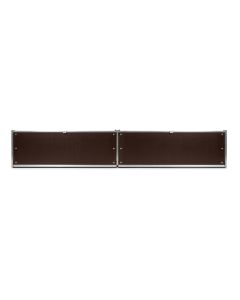
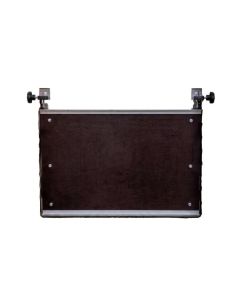
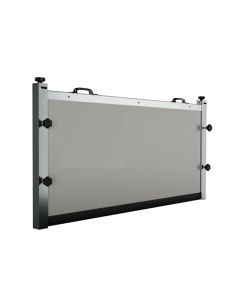
The current Holity range includes aluminium barriers with guides and seals, as well as adjustable barriers also designed for larger openings. Some models are described as having assembly times in the order of a few minutes, a useful feature when the system is already correctly set up. Holity offers different configurations of Flood barriers specifically to adapt the protection to the geometry and use of the access. The time indicated in the technical data sheet must however be read in the conditions foreseen by the manufacturer and not as a guarantee valid for any installation.
Shops and warehouses require a procedure shared with the staff
For a commercial activity it is not enough to purchase a barrier and store it in a warehouse. It is necessary to establish who controls its availability, where it is stored and who is authorised to set it up when critical weather conditions are experienced. The procedure must be compatible with the staff's timetables and with the normal management of access. A bulkhead becomes truly usable when its activation is.
The same principle applies in warehouses, where doors and loading areas may be significantly wide and remain essential until business closes. Installing the barrier too early can hinder operational flows, while waiting for already dangerous conditions unnecessarily exposes staff. The decision must therefore be linked to internal procedures and information disseminated by the competent authorities. Preparation and coordination are particularly important when multiple access points need to be protected at the same time.
Before autumn, it is a good idea to check and test the barrier
A seasonal check allows you to identify problems while there is still time to solve them. Panels, profiles, clamping mechanisms, and seals should be checked according to the instructions provided for the product. The space in which they are stored also deserves attention, because the components must be accessible quickly. An assembly test before the rainy season allows you to check both the condition of the barrier and the operator's familiarity with the procedure.
After the test, the system should be cleaned again and stored in the conditions indicated by the manufacturer. In models with removable elements, it is useful to keep all the essential components together, preventing mobile guides, clamping systems or accessories from being separated. Holity, a point of reference in professional equipment for companies, structures and buildings exposed to specific operational needs, presents models with different construction characteristics, so maintenance must always refer to the individual technical data sheet. There is no universal procedure that is identical for every barrier.
During an alert, the safety of people comes before property
The preventive function of the bulkhead must not become a reason for exposing oneself to danger. When an alert is broadcast, the indications of the authorities Local authorities and Civil Protection agencies must take precedence over the protection of cars, goods, or equipment. Barriers can be set up when conditions allow and without entering areas that are already dangerous. The useful phase for protecting the property is the one before the water arrives, not the one in which the flooding is already underway.
This aspect is particularly relevant for garages, cellars, and basements. During a flood, it is not necessary to go down into these areas to try to secure material goods, because the water can rise rapidly and make exit difficult. The management of flood barriers must therefore be part of a broader culture of prevention, in which warnings and indications from the area are followed. A flood barrier is
Seasonal protection works best when planned
Preparing for autumn and winter rains means transforming the bulkhead from an occasional purchase into a component of a known procedure. It is necessary to know which accesses to protect, what measures are required, where the components are stored and how to carry out the assembly. Seals and contact surfaces must be checked before use, not during the emergency. The Flood barriers are more useful when the choice, maintenance and installation are planned in advance.
The Holity professional range allows you to evaluate aluminum barriers, kits with guides and seals and adjustable models also intended for openings of different sizes. The choice must start from the actual opening and the way in which the structure intends to manage the seasonal risk. Doors, garages, shops, and warehouses all have different needs, so the same configuration isn't automatically suitable for everyone. Preparing the system before the rains means, above all, reducing improvisation and making protection available when conditions still allow for safe operation.
 English
 Italian
 French
 German
 Spanish