The AED defibrillators Devices intended for businesses, schools, sports facilities, and organizations must be chosen considering the installation environment, usage, and technical features. Automatic or semi-automatic operation, battery life, electrodes, pediatric mode, and accessories all impact the device's long-term management. Evaluating these aspects before purchasing allows you to identify a solution consistent with the facility's needs and properly plan checks and replacements.
The choice of AED starts from the installation context
 A defibrillator placed in an office responds to different organizational conditions than a device intended for a school, a sports facility, or a public space. The number and type of users, the size of the facility, and the layout of the spaces influence the choice of location. The presence of a stable staff or a variable audience also alters operational requirements. The first step, therefore, is to define: where the AED will be installed and who might be using it.
In large spaces, the relationship between the device's location and internal routing must also be assessed. A poorly visible location or one located in a difficult-to-reach area can impair the effectiveness of the facility's organization. In locations exposed to dust, humidity, or particular environmental conditions, it is necessary to compare the manufacturer's declared characteristics with those of the intended enclosure. The design must consider the device, accessibility, and installation conditions together.
Automatic and semi-automatic defibrillators respond to different operating modes
The defibrillator external semi-automatic It analyzes the rhythm and, when the device determines that a shock is indicated, prompts the operator to activate delivery according to the instructions provided by the device. In the automatic model, however, the device delivers the shock without manually pressing the shock button. This difference must be understood before purchasing because it changes the operating sequence followed by the user. Both configurations are available in the professional offering dedicated to external defibrillation.
The choice shouldn't be based on an absolute classification of best and worst solutions. It's more useful to determine which mode is consistent with the context, internal organization, and required technical features. Displays, controls, voice prompts, and visual cues may also vary between models. Holity, Specialist in professional supplies for first aid, companies and institutions, offers defibrillators with different configurations, allowing you to compare the features reported in the individual technical data sheets.
Interface and user guidance impact emergency management
Modern AEDs are designed to provide guidance during various phases of use through voice prompts and visual cues. The way this information is presented may vary from model to model. Before purchasing, it's helpful to check the language of the instructions, the clarity of the indicators, and the layout of the controls. A clear interface helps make the device's operation easier to understand in a context where timing and the correct interpretation of the prompts are particularly important.
Some models also integrate compression support functions or systems that record usage information. These features should be compared based on the individual product documentation, avoiding assuming they are present on every AED. For facilities with multiple locations, the ability to remotely monitor the status of certain compatible devices may also be of interest. The truly useful function depends on the organizational complexity of the structure and the way first aid supplies are managed.
Pediatric mode and electrodes must be checked before purchase
Schools, sports facilities, and facilities frequented by children should carefully review the model's pediatric capabilities. Some AEDs use specific electrodes, while others have different modes or systems specified by the manufacturer. It is therefore incorrect to assume that every device has the same configuration. The technical data sheet and manual provide guidance. how the model manages pediatric employment and what components are needed.
This aspect also impacts consumable management. When dedicated electrodes are used, the facility must consider their availability and expiration dates, along with those intended for adults. If the device uses a different system, it is still necessary to ensure that the intended mode is correctly identified and managed. Holity, reference point in the selection of professional first aid equipment, allows you to compare models intended for different contexts, including school and sports facilities.
Battery and electrodes affect the operational continuity of the AED
A defibrillator It must be considered along with the components that enable its use. The battery and electrodes have characteristics, compatibility, and expiration dates defined by the manufacturer and must be checked according to the relevant instructions. The lifespan and replacement methods are not the same for all models. Before purchasing, it is therefore advisable to check which consumables are required and how they can be obtained over time.
The initial cost of the device represents only part of the economic evaluation. The future availability of compatible batteries and electrodes, along with the expected replacement intervals, contributes to the operating cost of the station. It's also useful to check whether the device automatically reports anomalies or conditions that require attention. Considering these factors when choosing a device reduces the risk of finding yourself with a Improperly equipped AED when a consumable needs to be replaced.
Display case, location and signage complete the location
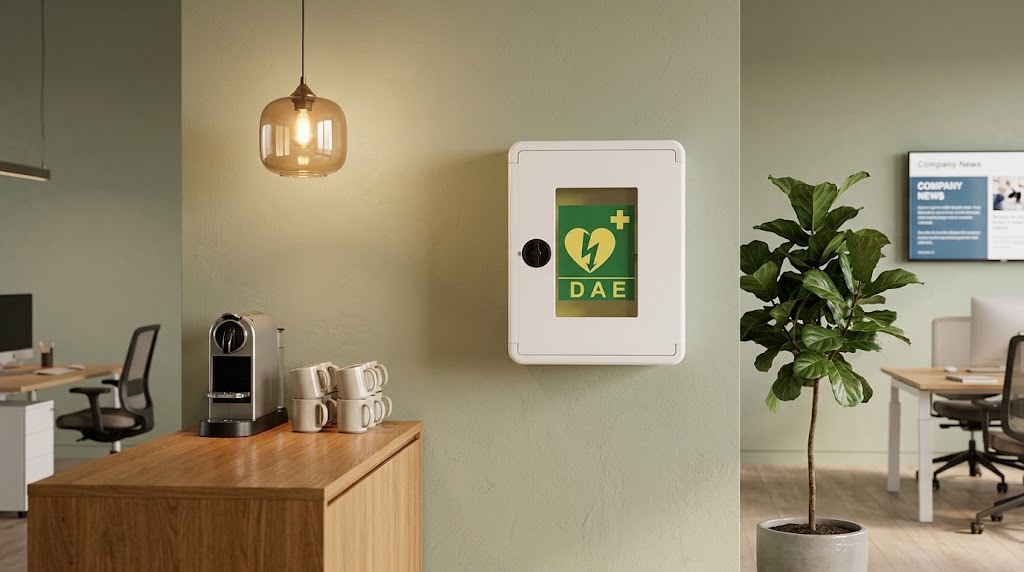
The device should not be evaluated separately from its location. Cases and cabinets help organize and protect the location, while signage makes it easier to locate. The enclosure features should be chosen based on the environment and the intended product specifications. An indoor location presents different conditions than an exposed installation or one located in a high-traffic area.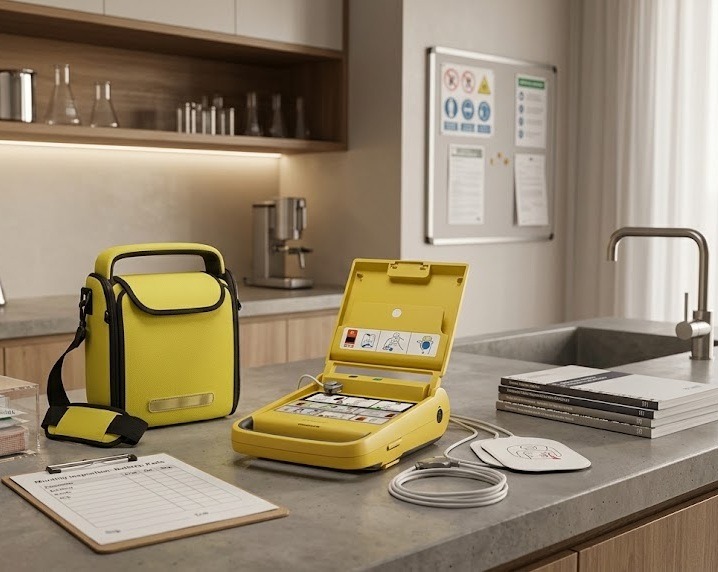
In Italy, Law No. 116 of August 4, 2021, regulates the distribution and use of semi-automatic and automatic defibrillators, while the Ministry of Health Decree of March 16, 2023, defines criteria and procedures for the installation of AEDs and requires that they be identified by appropriate signage. Regulatory review must, however, be conducted based on the specific context and any applicable requirements for the facility. Therefore, site design cannot be limited to simply selecting the device. Visibility, accessibility and correct placement they are part of the same project.
Maintenance and checks must be scheduled over time
AED maintenance continues after installation. Status indicators, batteries, electrodes, case, and accessories must be checked according to the manufacturer's instructions and the facility's established procedures. Even an unused device requires attention, as some components may have specific expiration dates or storage conditions. Establishing responsibilities and frequency of checks helps avoid occasional or memorized checks.
For organizations managing multiple workstations, it may be useful to establish an organized system for recording deadlines and interventions performed. Some compatible devices or systems also allow for remote monitoring of operational status. These functions must be evaluated based on actual needs and product characteristics. The key criterion remains: operational continuity of the AED station, which depends both on the device and on its correct management.
The technical data sheet allows you to correctly compare defibrillators
Before finalizing your order, it's helpful to consistently compare the specifications of the selected models. Dimensions, weight, power supply, declared environmental features, pediatric mode, consumables, and accessories allow you to distinguish products that may appear similar in photographs. Available languages, self-diagnostic systems, and additional features should also be verified in the specific documentation. A technical comparison reduces the burden of evaluations based solely on price or brand awareness.
It's also important to check which components are included in the proposed configuration and which must be purchased separately. A carrying case, display case, pediatric set, or other accessories shown with the product should not automatically be considered part of the package. The same principle applies to any additional services. Reading the product information sheet systematically allows the buyer to build a comparison based on characteristics actually documented.
A coordinated supply simplifies AED management
For businesses, schools, and organizations that need to install one or more devices, it's helpful to define the quantities, spaces, and accessories needed in advance. A facility with multiple buildings may require different configurations or choose to standardize the models to simplify the management of batteries, electrodes, and internal procedures. Display cases and signage can also be planned alongside the devices. This setup makes it easier to prepare a complete supply request and accurately compare alternatives.
Holity, leader in the selection of AED defibrillators and professional first aid equipmentoffers solutions for companies, schools, sports facilities, organizations, and organized structures. The choice should begin with the installation context and continue with a comparison of operating mode, battery life, consumables, accessories, and subsequent management. The value of the supply emerges when these elements are considered together and not as separate purchases. This way, the AED is placed in a station designed to remain recognizable, manageable, and properly equipped over time.
 English
  Italian
 French
 German
 Spanish