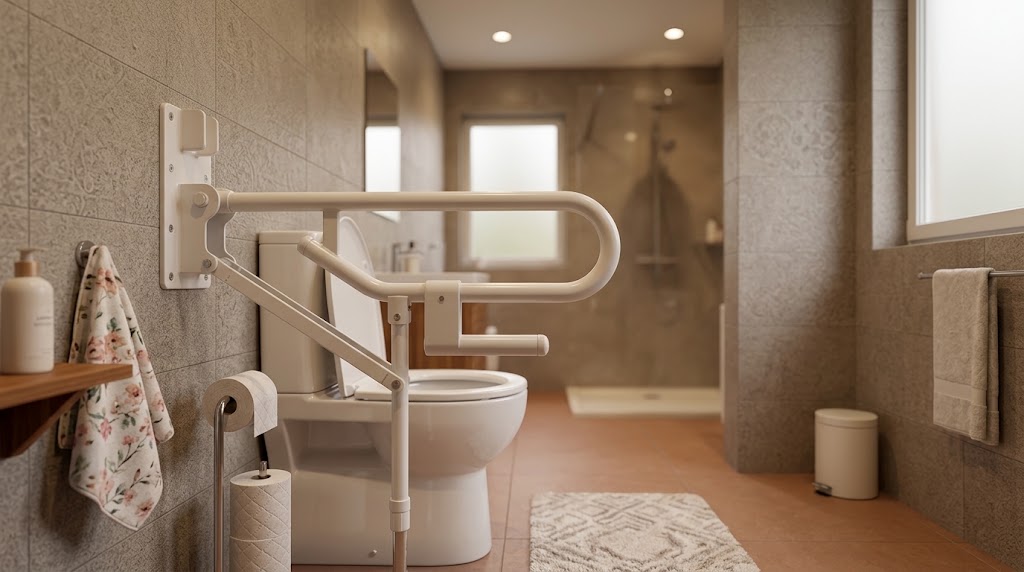
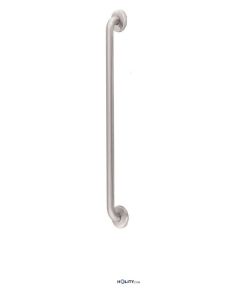
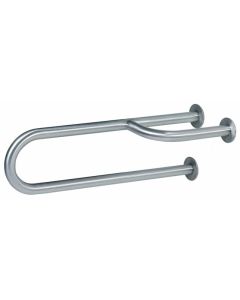
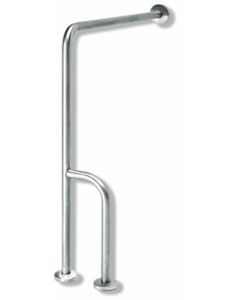
Choosing a folding grab bar for the disabled requires evaluating the length, diameter, material, fixing and lifting method in relation to the bathroom fixture and the surrounding space. The possibility of bringing the support into a vertical position allows you to free up part of the area when it is not in use. However, the load capacity and locking system must be verified for each individual model. The correct configuration therefore arises from the relationship between the product, the wall or floor where it is fixed and the overall bathroom design.
The folding mechanism allows you to manage the space differently
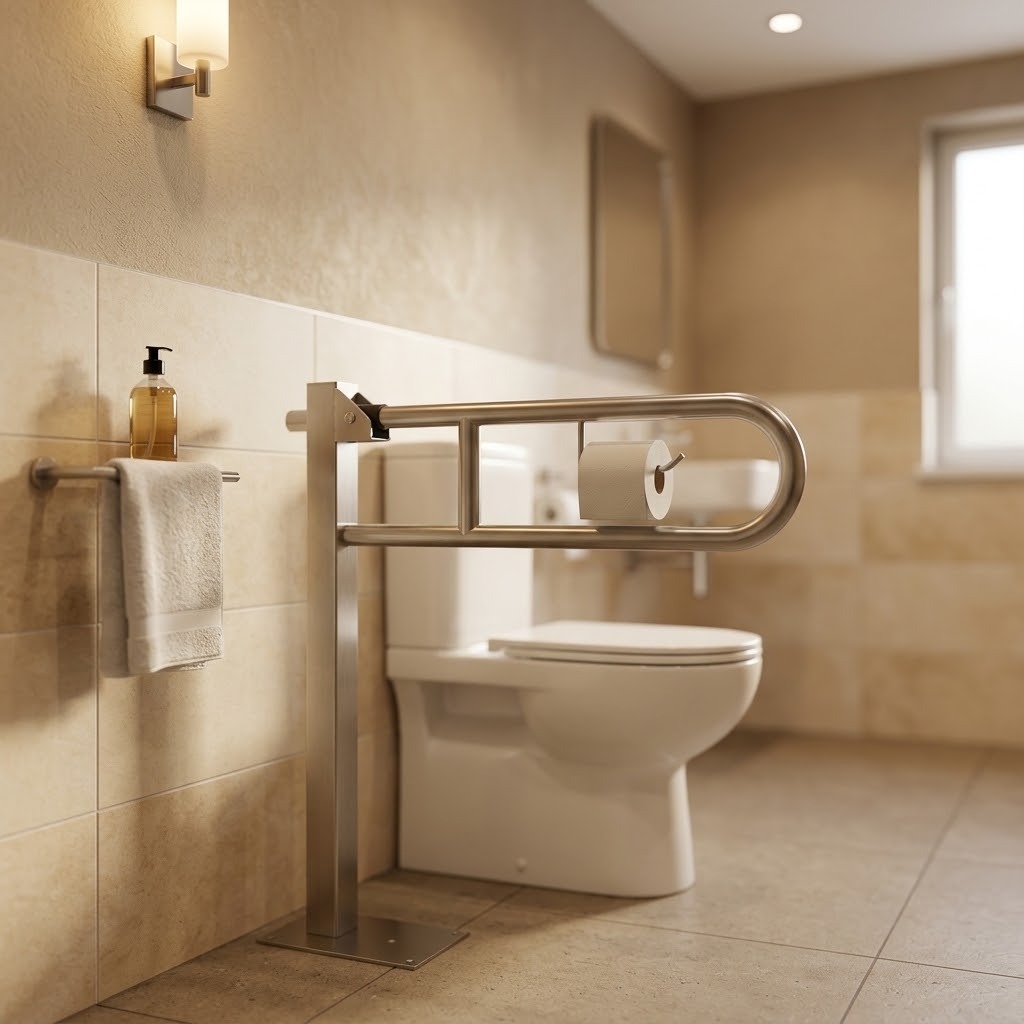 The feature that distinguishes this type from a fixed grab bar is the possibility of modifying the position of the bar. During use, the support is brought to a horizontal position, while when not needed it can be raised towards the wall. This solution is particularly interesting next to the toilet, where the lateral space can also be used for approaching, transferring or assistance. The advantage of the folding system is therefore above all in the dynamic management of space.
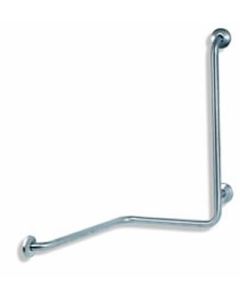
Not all mechanisms, however, work in the same way. Some products provide a simple vertical movement, others can integrate stopping systems or devices that make the descent more controlled. The Holity catalogue includes both traditional folding handles and an AISI 304 stainless steel bar with an integrated progressive braking system. Before purchasing, it is therefore useful to check how the opening, closing and vertical position are maintained.
Length and diameter must be consistent with the position
The length directly influences the area in which the user can reach the support. A handle that is too short compared to the configuration of the toilet may not respond to the intended organisation, while a longer bar increases the overall size when brought into a horizontal position. It is It is therefore necessary to relate the measurement to the toilet, the back wall and the available space laterally. The length should not be chosen as an isolated data, but verified on the plan and on the model actually installed.
The Holity range shows concretely that there is not a single size for all uses. For example, 60 cm fold-down models, 70 cm solutions and bars with a length of 800 mm are available, while other configurations can have even different extensions. The diameter also varies between products, although several professional models use tubes of approximately 32 mm. Holity, a specialist in professional supplies for accessible bathrooms, therefore allows you to compare different dimensions starting from the actual configuration of the room.
Fixing is an integral part of the capacity
A wall-mounted grab bar transfers the stresses generated during use to the wall support. For this reason, it is not sufficient to choose a product with a specific declared load capacity without checking where it will be fixed. The material and consistency of the wall, the anchor plate, and the fixing system must be evaluated together. A lightweight wall or an inadequately prepared surface finish may require different solutions than a wall structure capable of directly receiving the anchors.
The same product sheets may provide different indications regarding fixings. A 60 cm Holity model in painted steel, for example, specifies that the kit is not included and recommends screws and plugs suitable for the characteristics of the wall, while other solutions are proposed with fixing materials included. There are also fold-down handles mounted on a column and fixed to the floor, useful when the project requires a solution other than direct anchoring to the wall. Structural support and fixing methods Installation instructions must therefore be checked before ordering.
Stainless steel and other materials meet different needs
The bathroom is an environment in which humidity, frequent cleaning and contact with detergents make the choice of materials important. Stainless steel is used in numerous professional grab bars precisely because of its resistance characteristics and the possibility of adopting different surface finishes. Models in painted steel or made with different coatings and materials are also available. The selection must therefore take into account both the environmental conditions and the cleaning procedures required by the structure.
The Holity catalogue includes fold-down grab bars in polished stainless steel, versions in AISI 304, models in painted steel and solutions with a plastic surface. Some products also have a slightly grooved surface, designed to offer a more defined grip. However, it is not correct to deduce the overall quality of the support from the nominal material alone. Material, finish, diameter and surface conformation must be read together with respect to use, maintenance and installation environment.
Load capacity and resistance must be read in the data sheet for the individual model
The declared load capacity is a central piece of information in the comparison, but must be interpreted according to the manufacturer's instructions. Not all handles are tested or described in the same way and some data sheets can distinguish different load conditions. It is therefore not prudent to assume that two products of the same length automatically have the same support capacity. The structure of the plate and the fixing system also contribute to the overall behaviour of the installation.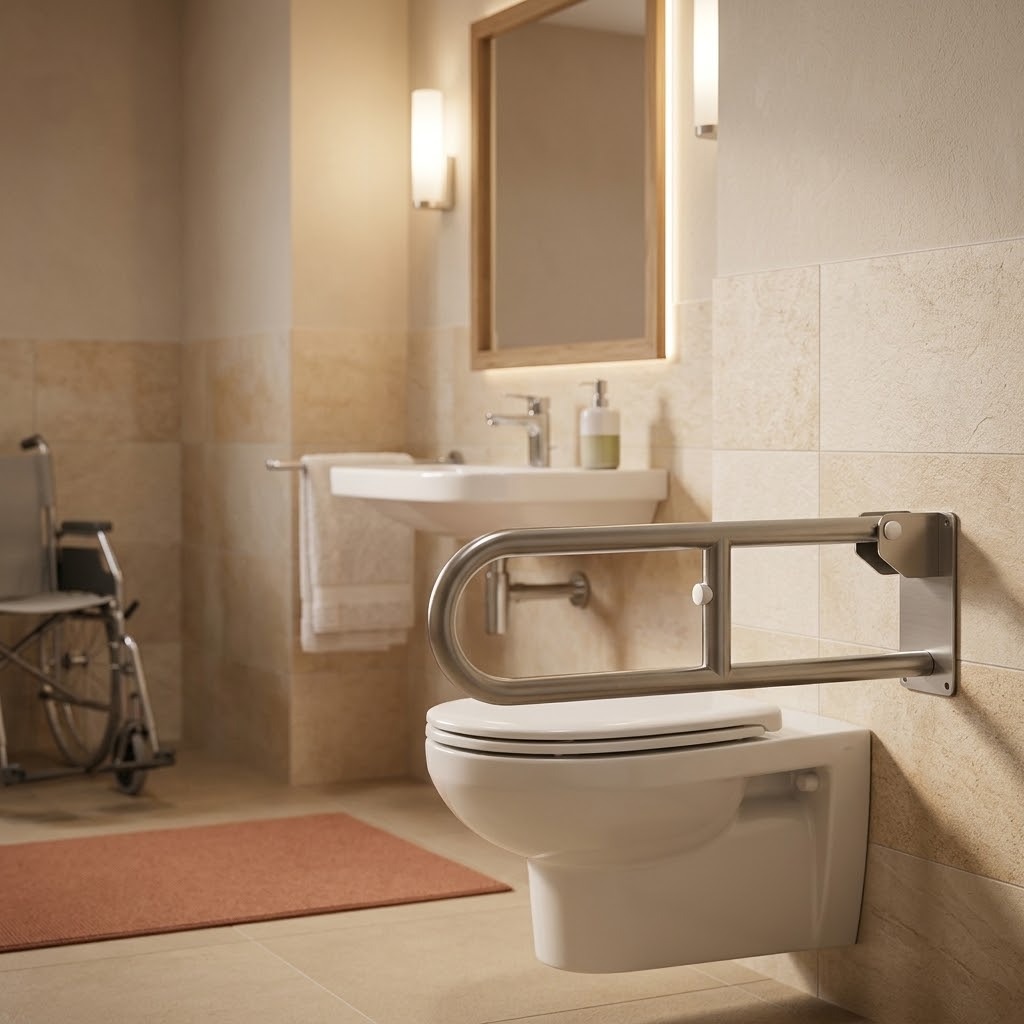
Among the Holity models consulted are, for example, a 60 cm stainless steel handle with a maximum declared load capacity of 125 kg and an AISI 304 folding bar with a declared holding capacity of 150 kg. These are characteristics of the individual product and not values applicable to any folding grab bar for the disabled. The comparison must therefore be made between technical data sheets that are actually homogeneous and take into account the installation conditions indicated. Furthermore, a high value declared by the product does not replace the verification of the suitability of the structure to which it will be anchored.
The position near the toilet must be defined together with the layout
The folding grab bar is frequently placed next to the toilet because it can offer a point of support when necessary and free up lateral space when lifted. However, its location should not be established after having positioned all the other bathroom elements. The toilet, walls, lateral space and areas required for the approach must be considered simultaneously. The bar is part of the sanitary design and does not represent an accessory to be added once the layout is complete.
The Ministerial Decree 236/1989, in the specifications relating to accessible toilets, requires a minimum space of 100 cm for lateral approach to the toilet bowl measured from the axis of the sanitary fixture. It also establishes that, when the axis of the toilet is more than 40 cm from the side wall, a handle or handrail must be provided 40 cm from the axis to allow transfer. These indications concern the configuration of the bathroom and do not automatically define the length or mechanism of every folding bar available on the market. The design must therefore coordinate the regulatory dimensions with the geometry and characteristics of the chosen product.
The regulatory dimensions do not replace the accessible bathroom design
In toilets open to the public, Ministerial Decree 236/1989 indicates the presence of a handrail near the toilet bowl at a height of 80 cm from the floor and with a diameter between 3 and 4 cm. When the handrail is fixed to the wall, the decree also indicates a distance of 5 cm from it. Presidential Decree 503/1996 expressly refers, for public toilets, to points 4.1.6 and 8.1.6 of Ministerial Decree 236/1989. These dimensions constitute design references to be read within the scope of the regulation.
. However, this does not mean that every 80 cm folding grab bar must necessarily be installed in the same way or that a single configuration can be used in every bathroom. The type of building, intervention, position of the sanitary fixture and accessibility project may require specific checks. Local regulations or requirements related to the structure may also add further elements to consider. Before a professional supply for hotels, nursing homes, hospitals or buildings open to the public, it is therefore advisable to check the project and the regulations actually applicable.
Braking mechanisms and accessories can differentiate the configuration
In addition to the traditional bar, there are models that introduce additional functions. The integrated paper holder can reduce the need to place a separate element near the toilet, while a braking system can make the descent movement of the bar more controlled. These are features that can be useful in certain projects but should not be considered indispensable in every installation. The priority always remains the coherence between support, available space and method of use.
Holity offers, for example, a 60 cm fold-down handle with paper holder and an 800 mm professional bar with a progressive braking system. In the same category, more essential configurations and models with different finishes, lengths and mounting systems are available. This variety allows the supply to be built starting from the bathroom rather than from the rest of the room. subsequently adapt the environment to a product chosen solely on price or appearance. Holity, the reference point for professional aids for accessible bathrooms, thus allows you to compare different configurations based on documented characteristics.
The final comparison must start from the actual use of the bathroom
Before purchasing, it is useful to define the position of the toilet, available lateral space, type of wall and how the support will be used. Subsequently, the length, diameter, material, tipping mechanism, declared load capacity and accessories can be compared. This order allows you to quickly eliminate models that are incompatible with the project. The price thus becomes a parameter for comparing products that actually perform the same function.
Choosing a folding grab bar for the disabled therefore means evaluating the product as part of a system composed of sanitary fixture, maneuvering space, fixing structure and accessibility requirements. A longer bar A longer or more load-bearing version is not automatically the most appropriate solution if it is not consistent with the bathroom in which it is to be installed. The technical data sheets allow you to narrow down the choice to compatible configurations, while the project defines the position and installation method. In a professional supply, this distinction helps you choose the support based on its specific use and not just the commercial name.
 English
  Italian
 French
 German
 Spanish