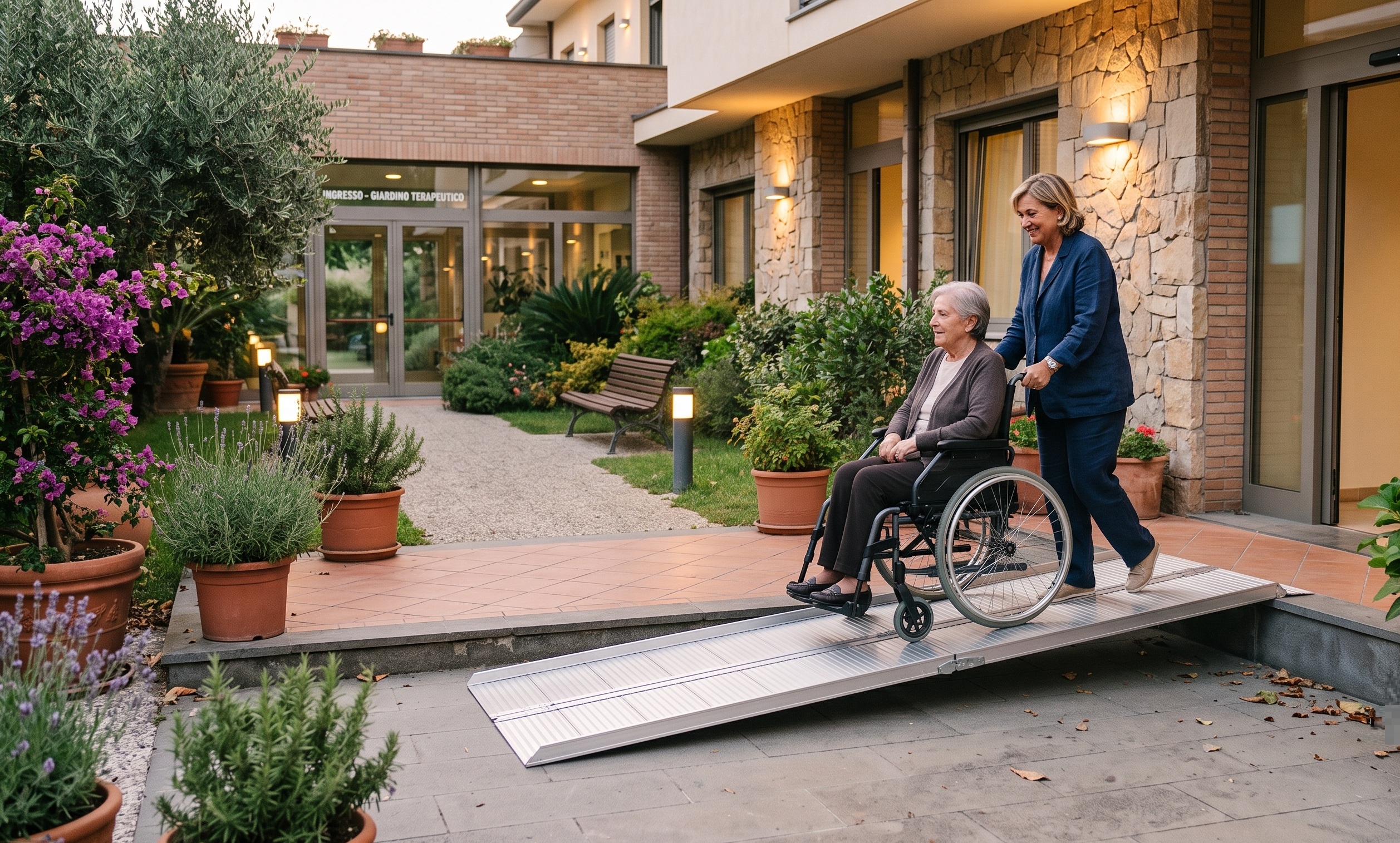
mobile ramps for disabled people are solutions designed to make it easier to overcome steps, thresholds and small differences in level without necessarily requiring permanent installation. They can be used in homes, shops, offices, hotels, healthcare facilities and spaces open to the public where easier access is needed for people in wheelchairs or with reduced mobility. Their main advantage is flexibility, because they can be placed only when needed, moved between multiple entrances or stored away after use.
The choice of a portable ramp , however, should not be based only on ease of transport. Length, slope, load capacity, useful width, material and support system directly affect the functionality of the product. A ramp that is too short can create a difficult-to-manage slope, while a solution not compatible with a wheelchair may be impractical even for modest height differences. Before purchasing, it is therefore necessary to analyze the entrance and the methods with which the passage will be managed.
What are mobile ramps for the disabled
The term mobile ramps for disabled people refers to inclined planes that can be positioned and removed without becoming a stable part of the building. They are often made of aluminum or other resistant but relatively light materials, so as to allow movement by the companion or staff. Depending on the model, they can be monoblock, foldable, telescopic or composed of two separate guides on which the wheelchair wheels slide.
These ramps are particularly useful when the height difference is limited and the space does not allow or does not justify a structural intervention. They can also offer a practical solution in the presence of temporary access, events, seasonal activities, or buildings where a fixed ramp would require complex work. Portability, however, does not eliminate the need for a technical assessment. The product must support correctly, remain stable, and support the total weight of the user, the wheelchair, and any accompanying person.
When a portable ramp is more suitable than a fixed solution
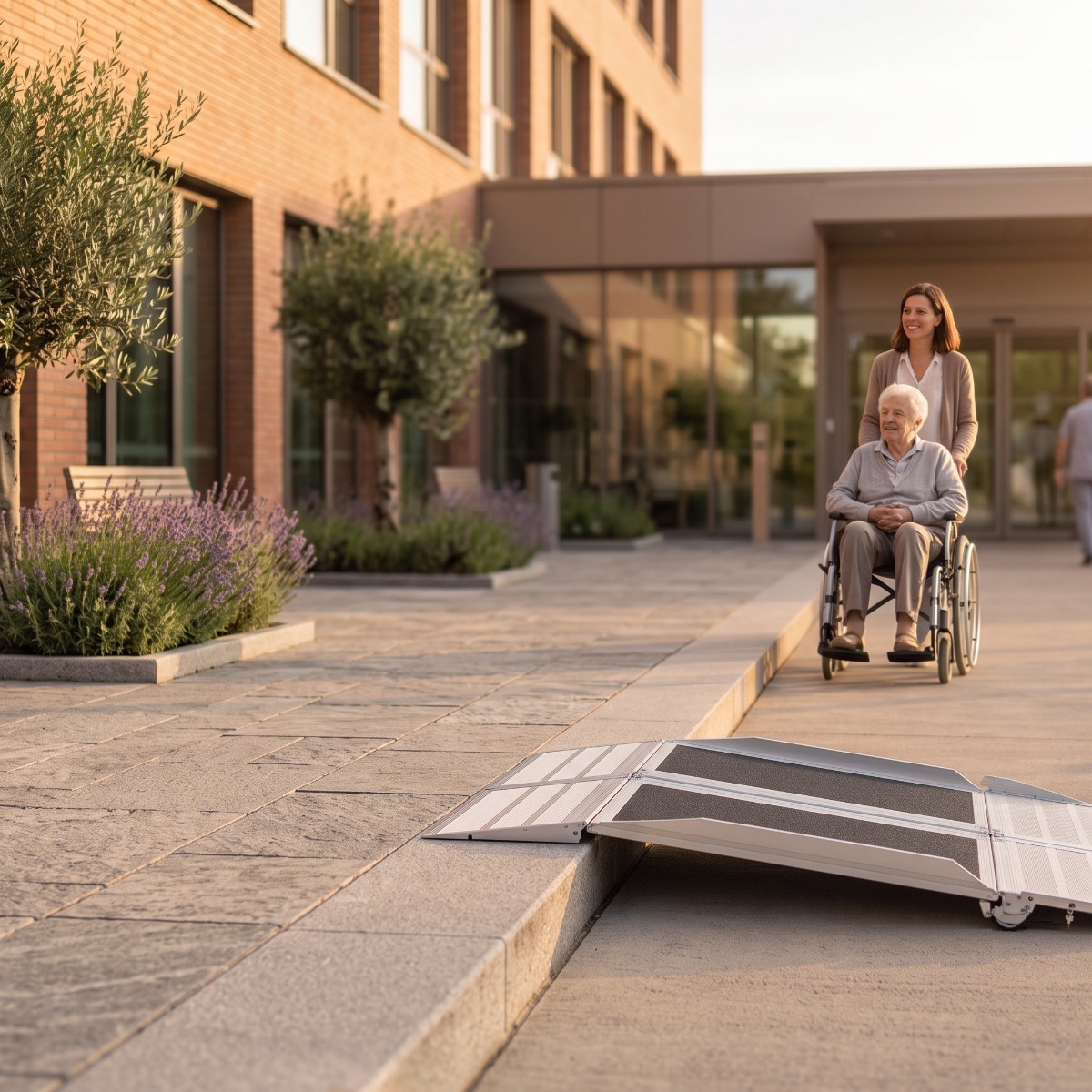 A mobile ramp may be convenient when the access is used only on a few occasions or when the difference in height affects a secondary entrance. In a shop, a hospitality facility, or an office, for example, it can be set up by staff when the user arrives and removed immediately afterwards. This configuration allows the passage to be kept clear and avoids permanent clutter when the ramp is not needed.
The portable solution may also be suitable when the building is undergoing renovations or when temporary support is needed while waiting for a definitive intervention. However, it does not automatically represent the best alternative in every situation. If the passage is daily, unattended or used by many people, a fixed or modular solution may be more practical. The choice must therefore consider frequency of use, user autonomy, presence of staff and positioning method.
Folding, telescopic and removable ramps: the main differences
Folding ramps consist of a continuous surface that can be folded to reduce their overall size. Some models fold lengthwise, others in multiple sections, making transport and storage easier. The single platform offers a continuous passage for the wheels and can be used with manual, electric wheelchairs or small aids, as long as the declared load capacity and width are respected. Weight and dimensions when closed must be carefully evaluated.
Telescopic ramps are generally made up of two independent guides that can be extended based on the difference in height. They take up little space when closed, but require correct alignment with the wheelchair wheels. Removable monoblock ramps, on the other hand, have a simple structure and do not include folding systems. They may be easier to position, but are less practical when they need to be transported frequently or stored in small spaces.
Length, slope and height of the difference in height
The length of the ramp must be proportionate to the height to be overcome. For the same difference in height, a longer ramp produces a steeper slope. gradual, while a short ramp results in a greater inclination. This affects the effort required, the stability of the wheelchair and the possibility of using the ramp independently. For this reason, the measurement of the step must be measured precisely before choosing the product.
It is also necessary to consider the space available in front of and above the difference in level. The ramp must be able to be opened completely without invading dangerous areas, obstructing doors or creating interference with the passage. The upper support point must be stable and sufficiently deep, while the lower one must rest on a smooth surface. A mobile wheelchair ramp should not be used with inclinations or supports other than those indicated by the manufacturer.
Load capacity, width and compatibility with the wheelchair
The capacity must include the weight of the person, the wheelchair and any accessories transported. Electric wheelchairs can be considerable weight and require ramps with adequate capacity. Using an undersized product can compromise stability and damage the structure. The declared capacity must therefore be checked on the technical data sheet and respected during each use, without relying on approximate estimates.
The useful width is also crucial. The surface must accommodate the wheels without leaving insufficient margins, while the telescopic guides must be compatible with the distance between the axles. It is useful to measure the external width of the wheelchair and take into account any anti-tip wheels, motors or protruding elements. A sufficiently wide ramp facilitates alignment and makes the passage easier. controllable, especially when used with the assistance of an attendant.
Non-slip surface, edges and stability of the support
 The surface of the ramp must offer adequate grip for the wheels, even when used outdoors or in the presence of humidity. Professional solutions may include non-slip finishes, reliefs or specific coatings. The choice must also consider ease of cleaning, because dust, water and residues can reduce grip. Regular maintenance allows the functional characteristics of the surface to be preserved for longer.
The side edges help keep the wheels within the usable surface and can increase control when passing. The upper support point must prevent involuntary movements of the ramp, while the base must remain stable on the floor. Some models have shaped ends or non-slip surfaces in the contact area. Before use, it is always advisable to check that the ramp does not wobble and cannot slip during ascent or descent.
Use in homes, shops, hotels and public spaces
In homes, portable ramps are often used to overcome one or two steps at the entrance, access terraces or manage small thresholds. In these contexts, they can be moved between several points and stored when not needed. The choice must, however, consider who will be responsible for positioning it and whether the person will use the ramp independently. A lightweight product may be more practical, as long as it maintains adequate load-bearing capacity and stability.
In shops, hotels and buildings open to the public, management should be entrusted to trained and easily available personnel. The ramp must be able to be set up quickly and without creating danger for other users. It is also useful to identify a storage area near the entrance, so as to avoid delays or lengthy movements. When the access is very busy, it may be appropriate to evaluate permanent or modular solutions that are more integrated into the building.
Transport, storage and daily management
The weight of the ramp affects the ease with which it can be moved. The aluminum models generally offer a good balance between strength and lightness, but their length can still make transport challenging. Handles, locking systems and folded dimensions must be evaluated in relation to the person who will operate the product. A frequently used ramp must be able to be opened and closed without complex operations.
During storage, the product should be kept in a dry place and protected from impacts. The position must not create obstacles in passageways or emergency routes. It is useful to periodically check hinges, telescopic guides, non-slip surfaces and support ends. Orderly management helps keep the ramp functional and allows you to identify any damage before use.
How to choose a professional mobile ramp
Before purchasing, it is necessary to measure the height and depth of the difference in level, available space, width of the wheelchair and total weight to be supported. It is also necessary to define the frequency of use, the need for transport and the presence of an accompanying person. This data allows you to select the length, load capacity and configuration of the product. A complete quote request reduces the risk of comparing ramps intended for different uses.
Price must be evaluated together with construction quality, ease of opening and expected duration. An economical but too heavy model may remain unused, while a lightweight but undersized ramp does not meet the access needs. It is useful to check the instructions, limitations of use and compatibility with the aid. The mobile ramps for disabled people must be selected as professional accessibility tools, not as simple inclined panels.
Professional solutions to improve accessibility
Holity, specialist in professional supplies for accessibility, institutions, companies and accommodation facilities , offers mobile, foldable and removable ramps designed for private and public contexts. The presence of models with different lengths, capacities and locking systems allows you to evaluate the solution in relation to the height difference and the methods of use. This approach is useful for purchasing managers, managers and administrators who need to provide more functional access.
Holity represents a point of reference in professional equipment dedicated to overcoming architectural barriers . The choice of a portable ramp must however start from correct measurements, verification of the capacity and analysis of the context. When flexibility, transport and the possibility of removal are priorities, a mobile solution can offer concrete support. A properly selected product makes it easier to overcome small height differences and improves the management of daily access.
 English
  Italian
 French
 German
 Spanish