A dog agility course for beginners should help dog and handler become familiar with the activity without immediately introducing complex sequences or difficult-to-manage equipment. At the beginning, clarity, gradualness, and the possibility of repeating the exercises in an orderly fashion are what count. For this reason, a basic setup can be more useful than a very rich field, but unsuitable for the actual level of the couple. The choice should therefore be based on the first skills to be developed and the space actually available.
Before purchasing, it is useful to distinguish between a kit intended for home play, a modular set for regular training, and equipment designed for dog training centers or areas open to the public. The difference does not depend only on the number of obstacles included. Materials, stability, adjustments, and assembly frequency affect daily use. Evaluating these aspects allows you to purchase a coherent first core, avoiding both oversized products and solutions that need to be replaced after a short time.
Start from the dog's level and the objective of the activity
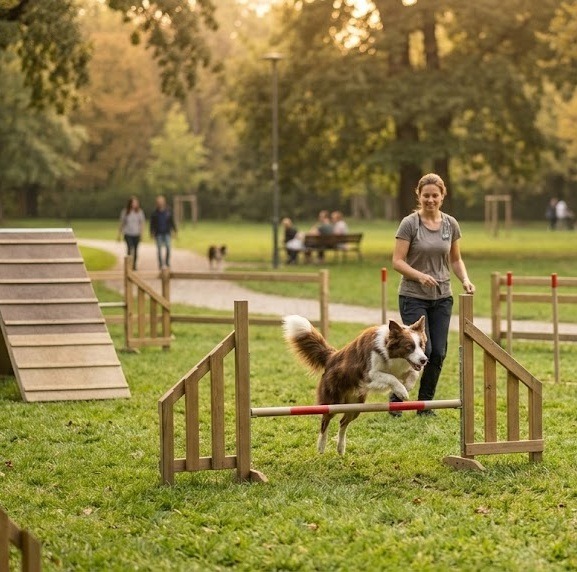 The choice of course begins with the dog's level of experience, not the amount of equipment available in the set. A dog new to agility training should familiarize itself with simple, recognizable, and easily adjustable elements. The initial goal may be to improve collaboration with the handler, introduce short sequences, or create controlled motor activity. At this stage, it is preferable to avoid great heights, too narrow passages, and combinations that require already experienced technical management. consolidated.
The context of use also changes the most suitable configuration. An owner who wants to carry out occasional exercises in the garden will have different needs than a dog trainer who uses the equipment with multiple dogs. A training center must also consider the repetition of sessions, ease of recovery and the possibility of frequently changing the route. Defining the objective in advance makes it easier to select a dog agility course for beginners that is truly proportionate to the planned activity.
Evaluate the space before choosing the obstacles
The available space determines the number of elements, their distance and the possibility of creating fluid sequences. It is not enough to check that tunnels, jumps and slaloms physically fit into the area. It is necessary to leave free areas for the approach, the exit from obstacles and the movement of the handler. In a small garden, it may be more functional to use a few movable tools, rotating them during different sessions, rather than installing a fixed path that limits the passages.
The surface of the area deserves the same attention as the dimensions. A smooth surface makes it easier to position the bases and reduces unwanted movements of the tools during use. If the path is set up outdoors, it is necessary to consider slope, drainage and soil conditions after rainfall. When the space is shared, removable or foldable elements allow you to free up the area and store the equipment more orderly between one session and the next.
An essential kit offers a ready-to-use base and can be used as a base for the equipment. The modular set includes a tunnel, some adjustable jumps, and a series of slalom poles. This solution reduces the time needed to assemble the initial purchase and maintains a certain uniformity between the elements. Before choosing, however, it is advisable to check the dimensions, fastening systems, and the possibility of adjusting the difficulty. A large set is not automatically more useful if it includes equipment that is unsuitable for the space or the dog's ability.
The modular set is suitable when you want to expand the course over time without replacing the initial equipment. Equipment purchased separately, however, allows for a more precise selection and can meet needs already defined by the instructor or the camp manager. The choice between the three options depends on the budget, the continuity of the activity, and the need to customize the course. Holity, a specialist in professional supplies for dog areas and equipped spaces, allows you to compare individual elements and more complete configurations.
Stability, materials and ease of assembly
For a beginner, a simple to assemble tool is useful because it allows you to dedicate more attention to the exercise and less to preparing the field. Speed, however, should not compromise the stability of the structure. Adequate bases, well-connected components and intuitive adjustments make the course tidier to use. It is also important to check that there are no protrusions, damaged edges or parts that could loosen with frequent movements.
The materials must be evaluated in relation to the environment and frequency of use. A lightweight set may be convenient to transport, while continuous outdoor use requires greater resistance to atmospheric agents and maintenance compatible with the structure. Surfaces intended for the dog's passage must be easy to check and clean. For professional fields or areas accessible to multiple users, construction quality takes on more weight than just initial convenience.
What elements to include in the first course
A first course can be built around three functions: crossing, overcoming, and changing direction. The tunnel introduces a defined passage and allows you to work on confidence and continuity of movement. Adjustable jumps allow you to keep the pole at a height consistent with the dog's level. The slalom, initially proposed in a simplified form, adds an orientation exercise that requires more gradual learning times.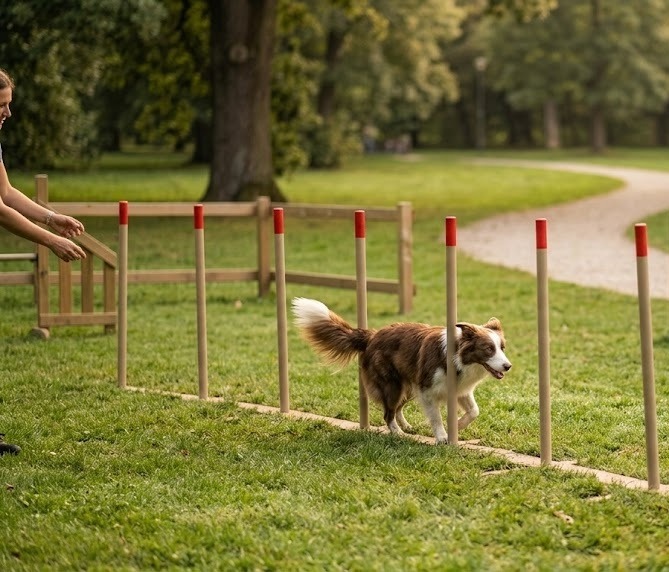
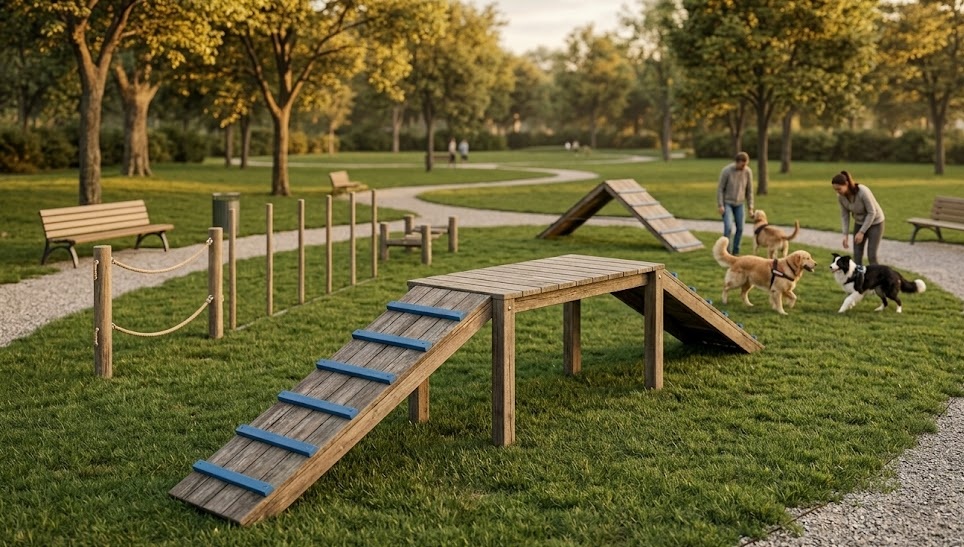
Contact tools such as walkways, fences, and seesaws require more precise management. These accessories are carefully planned and are not always necessary in the first purchase. They can be added when the training course becomes more structured and when there is space and skills to use them correctly. The priority should remain on the quality of the initial experiences, not on the immediate reproduction of a complete competitive field. A few well-combined elements already allow you to create different sequences and maintain interest.
Building an expandable course without buying twice
A well-planned purchase also considers what might be needed in the following months. Choosing modular, adjustable, and compatible elements makes it easier to expand the course without abandoning the initial equipment. It is useful to check the availability of additional components, spare parts, and fastening systems consistent with the tools already purchased. In this way, the course can grow along with the dog's abilities and the handler's needs.
In the Holity catalogue it is possible to evaluate equipment for dog agility courses intended for different contexts, from recreational areas to professional spaces. Comparing measurements, materials and installation methods helps to avoid impractical combinations. For complex supplies, a request for a quote allows you to describe the surface area, number of users and project objectives. Commercial support thus becomes part of the choice, especially when the course must be expandable or inserted into an already equipped area.
An initial choice that accompanies the dog's progress
The most suitable course for a beginner is not necessarily the one with the greatest number of obstacles. It is the one that allows you to start with easy exercises, gradually modify the difficulty and organize the space without creating unnecessary clutter. The dog's level, frequency of sessions, stability and ease of assembly must be considered together. This evaluation makes the purchase more informed and reduces the risk of choosing a set that is not consistent with the real activity.
Holity, a point of reference in professional equipment for institutions, structures and areas dedicated to animals, offers useful solutions for composing essential routes or more complex configurations. Consulting the product sheets allows you to compare characteristics and intended uses before ordering. When the space presents specific constraints, consulting with a contact person helps define a proportionate selection. The result is a more orderly initial route, expandable and suitable for supporting progress without oversizing the setup.
 English
  Italian
 French
 German
 Spanish