Buying Guide Playground climbing frames and climbers
Buying Guide: How to choose playground gyms and climbing frames compliant with UNI EN 1176 for public parks, schools, and play areas
In the design and redevelopment of municipal public parks, school gardens, courtyards, campsites, tourist villages and open-air play areas, the playground gyms and climbing frames These are equipment designed for active play and the development of children's motor skills. Through climbing, balancing, suspension, and obstacle-surmounting activities, these structures can promote hand-eye coordination, muscle strength, spatial awareness, and socialization. The choice of equipment must consider the age group of users, the number of children allowed at a time, the available space, and the installation conditions. For equipment intended for collective play areas, the set of standards UNI EN 1176 constitutes the main technical reference for safety, while the standard UNI EN 1177 regulates the test methods for evaluating the impact attenuation of surfaces. The catalogue of Holity.co.uk The collection includes multifunctional gyms, compact structures with nets and wall bars, handhold panels, and three-dimensional climbing pyramids over 5 meters high. The configurations use a variety of materials, including Nordic pine, aluminum, galvanized steel, polyethylene, and reinforced ropes. This buying guide analyzes construction types, materials, age groups, installation requirements, shock-absorbing surfaces, environmental criteria, and price ranges to help municipalities, schools, designers, and recreation center managers identify the best solution.
The equipment configuration should be selected based on the available space, expected attendance, the children's ages, and the physical activities you want to encourage. It's important to distinguish the physical footprint of the structure from the overall space required for its use:
Multifunctional Gyms and Integrated Gymnastics Courses: These structures combine various play and motor activities within a single system. The Holity catalog includes configurations with wall bars, ladders, horizontal bars, rings, shrouds, poles, ropes, and climbing panels. Some models also include ramps with handholds, turrets, and slides. These equipment can be used in schoolyards, public parks, and recreational areas to offer a variety of movement and shared play experiences. The presence of multiple activities does not automatically imply a high capacity: the maximum number of simultaneous users must be verified in the technical data sheet.
Space Net Climbing (Pyramids and Rope Cones): Three-dimensional nets allow children to climb along different routes within the structure. Some configurations include a central galvanized steel post and a reinforced rope net connected by special connectors. The Holity catalog offers pyramids with overall heights of approximately 250, 270, 359, and 516 cm, each with different capacities. The net's geometry can promote balance, coordination, and movement planning. For this type of equipment, it is important to verify the specific requirements of UNI EN 1176-11, the anchoring methods, and the configuration of the fall zones.
Climbing Walls (Vertical and Inclined Panels): Some gyms integrate vertical or inclined panels in high density polyethylene, plywood or other materials suitable for outdoor installation, equipped with climbing holdsHolds can be made of composite materials, such as polyester resin and quartz powder, depending on the product's characteristics. These configurations allow children to experiment with climbing, coordination, and gripping movements. It's important to distinguish play panels intended for playgrounds from walls specifically designed for sport climbing, which may have different technical requirements.
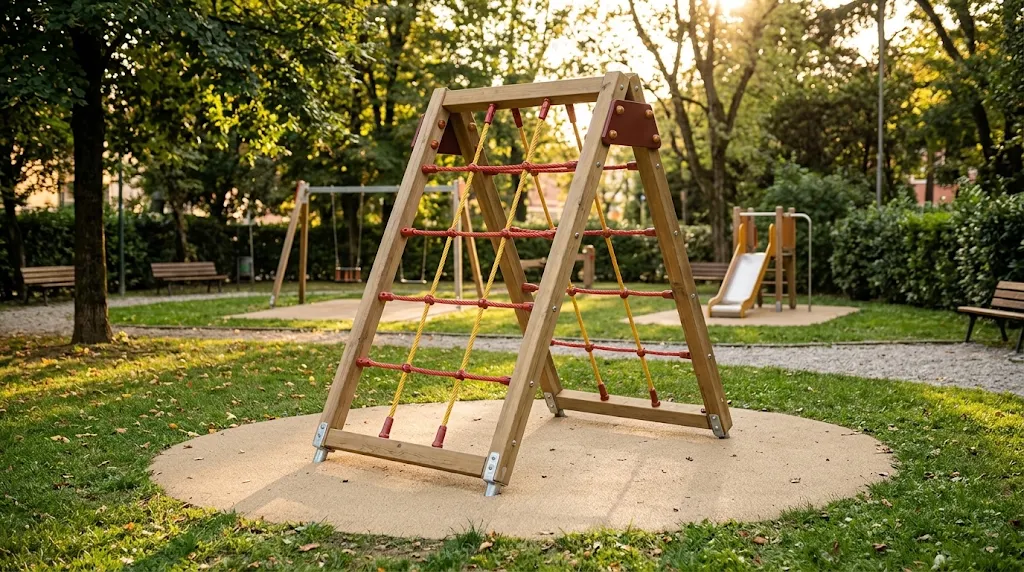
Compact Structures for Preschoolers: Compact play gyms may include inclined surfaces, climbing frames, wall bars, and handholds, distributed according to the product configuration. The Holity catalog includes models designed for children aged 2 to 8 and 3 to 8, with varying heights and difficulty levels. For installation in nurseries and preschools, it is essential to ensure the declared age range is compatible with that of the children being housed. A small structure is not automatically suitable for children under 3 and must be used in accordance with the manufacturer's instructions and supervision requirements.
2. Construction Materials and Environmental Durability: Treated Wood, Metal, Reinforced Ropes and HDPE
Play equipment installed outdoors is exposed to rain, solar radiation, temperature fluctuations, humidity, and mechanical stress. The choice of materials must consider environmental conditions, the quality of protective treatments, and maintenance requirements:
Solid and Laminated Wood Impregnated in Autoclave: Wooden play gyms are particularly suitable for schoolyards, nature parks, agritourism facilities, and green spaces where landscape integration is desired. The Holity catalog features structures made of solid or laminated Nordic pine, with specific protective treatments depending on the product. Laminated wood offers good dimensional stability, but does not completely eliminate the possibility of cracking, warping, or deterioration over time. Autoclave impregnation helps improve resistance to biological agents, while special metal supports can limit the uprights' direct contact with the ground. The wood's use class, treatment characteristics, and any FSC or PEFC certification must be verified in the product documentation. Actual lifespan depends on environmental exposure, installation, and regular maintenance.
Aluminum and Galvanized or Painted Steel: Metal structures are used in public play areas for their mechanical properties and the possibility of applying corrosion protection treatments. Some Holity gyms use EN AW 6060 aluminum alloy uprights, while others include hot-dip galvanized, electrogalvanized, or painted steel elements. Galvanizing and surface coatings can improve weather resistance, but they do not guarantee corrosion resistance or a predetermined maintenance-free lifespan. In coastal locations, it is advisable to check the suitability of treatments for salt exposure, paying attention to bolts, joints, and any damaged surfaces.
Reinforced Ropes for Nets and Climbing Structures: Many professional equipment uses composite ropes made of synthetic fibers and ainternal steel core, designed to offer resistance to mechanical stress. The Holity catalog features nets made with reinforced ropes, even with a declared diameter of 16 mm. The fiber composition, diameter, tensile strength, and connector characteristics vary depending on the model. The presence of a metal core can improve cut resistance compared to a common textile rope, but it does not make the net immune to wear or intentional damage. During inspections, it is necessary to check the integrity of the coating, rope tension, condition of the joints, and any exposed metal components.
High Density Polyethylene (HDPE) Panels and Components: High-density polyethylene, also known as HDPE, is used to make climbing panels, side protection, decorative elements, and other gym components. It is characterized by good moisture resistance and easy cleaning. Some configurations use mass-colored or treated panels to improve resistance to sun exposure. Performance against UV rays, impacts, and temperature fluctuations depends on the characteristics of the material used. HDPE components also require periodic inspection to detect any deformation, cracks, damage, or deterioration of the fastenings.
3. Ergonomics, Age Groups and Inclusive Design
The size of the rungs, the position of the handholds, the geometry of the nets, and the height of the play elements influence how the equipment is used. To design an appropriate play area, it's necessary to consider children's different motor skills and the specific product specifications:
Calibration by Age Group (2-8 years, 3-12 years, 5-12 years): Holity play gyms are available in configurations designed for different age groups, including 2-8 years, 3-8 years, 3-11 years, 3-12 years, and 5-12 years. These ranges represent specific product specifications and are not a universal classification established by UNI EN 1176. The standard includes requirements that take into account the accessibility of the equipment and the safety needs of children, including the youngest. The choice must therefore be based on the manufacturer's instructions, the complexity of the routes, the access methods to the structure, and the abilities of the users. Adequate supervision is particularly important for very young or less experienced children.
Inclusiveness and Accessibility of the Play Area: An inclusive project should offer diverse participation opportunities, considering children with varying motor, sensory, and cognitive abilities. Climbing structures can be complemented by activities accessible from ground level, manipulative panels, accessible play elements, and obstacle-free paths. Not all play gyms or rope pyramids are suitable for independent use by children with limited mobility. Accessibility must be assessed by considering the entire area, including surfaces, access routes, rest areas, and shared play opportunities.
Concurrent User Capacity: The maximum number of simultaneous users is an important parameter for sizing the equipment based on the expected attendance. The Holity catalog includes gyms with a declared capacity of 5, 9, or 12 children, as well as pyramid structures designed for 14, 25, or up to 35 users. Capacity varies depending on the geometry, size, and construction features. If this figure isn't listed in the product description, it's best to request it before purchasing. The maximum number of children should not be estimated based solely on the structure's size or the number of play elements.
4. Operational Safety: Free Fall Height, Safety Area and Anti-Trauma Flooring
The safety of gyms and climbing structures depends on the proper design of the area, the characteristics of the equipment, the impact surface, and the installation methods. Before purchasing, it is essential to check the technical parameters declared by the manufacturer:
Free Height of Fall and Safety Area: The free fall height is the maximum vertical distance of a fall, determined according to the criteria applicable to the specific equipment. It does not necessarily coincide with the overall height of the structure. UNI EN 1176-1 generally provides a limit of 3 meters for the free fall height, while three-dimensional nets are also subject to the specific requirements of UNI EN 1176-11. The Holity catalog includes pyramidal nets over 3 meters high with declared fall heights lower than the structural height. For example, a 359 cm high pyramid has a declared fall height of 95 cm.impact area and safety spaces They must be sized according to the equipment's configuration, its movement patterns, and the manufacturer's design specifications. It is incorrect to apply a perimeter distance of 1.5 or 2 meters to all playground equipment. Spaces affected by falls and user movement must comply with applicable requirements regarding obstacles and interference with other equipment.
Shock-absorbing flooring (UNI EN 1176 and UNI EN 1177 standards): For equipment with a free fall height greater than 600 mm (60 cm)UNI EN 1176 requires surfaces with adequate impact attenuation capacity in the relevant fall zones. Specific requirements may also apply to equipment that involves forced movements, regardless of the fall height. UNI EN 1177:2024 defines test methods for evaluating the performance of surfaces, considering parameters such as the HIC criterion and the maximum acceleration detected during impact. The surface must be selected based on the fall height of the equipment and the installation conditions. The main solutions include:
SBR/EPDM anti-trauma rubber tiles or cast-in-place rubber flooring: The thickness must be chosen based on the critical fall height declared and documented by the flooring system manufacturer. There is no universal thickness that applies to all equipment. The subfloor, drainage, installation, and condition of the surface can also influence its performance.
Loose shock-absorbing materials: Sand, rounded gravel, bark, and wood chips can be suitable solutions when they meet the requirements for grain size, depth, material characteristics, and fall height. The required thickness must be determined according to the conditions set by applicable standards, also considering the movement and dispersion of the material during play. These surfaces require periodic inspection, leveling, and replenishment.
Ground Anchoring Systems (Foundations and Fixings): Climbing gyms and pyramids must be installed using the manufacturer's recommended fastening system. Depending on the configuration, they may require buried posts, metal anchors for concrete foundations, or other systems compatible with the support. Foundation dimensions, installation depth, and soil characteristics must be assessed based on the assembly instructions and site conditions. For wooden models, metal supports can help limit direct contact with the ground, but they should not be installed at an arbitrary distance from the flooring. After installation, it is necessary to verify the stability of the structure, the correct configuration of the anchors, and the absence of elements that could compromise the safety of the play areas.
5. Regulatory Framework: UNI EN 1176, Minimum Environmental Criteria (CAM) and Maintenance Plan
The choice of equipment intended for public, school, and collective play areas must take into account the applicable technical references, product documentation, installation conditions, and responsibilities associated with managing the area:
Technical Standard UNI EN 1176 (Parts 1 and 11):
UNI EN 1176-1:2024: It defines general safety requirements and test methods for permanently installed public playground equipment and surfaces. It addresses aspects such as structural integrity, fall protection, accessibility, opening configuration, entrapment risks, and component characteristics. Before purchasing, it is advisable to check the product's compliance documentation and any available certifications. Compliance with the technical standard does not eliminate all risks associated with play and is not a substitute for proper installation and maintenance.
UNI EN 1176-11:2014: It establishes additional safety requirements and specific test methods for the three-dimensional climbing nets Intended for permanent installation and use by children. The standard takes into account the geometric characteristics of the nets and the conditions of falls within this particular type of equipment. For rope pyramids, it is therefore important to check the documentation relating to both the general and specific applicable requirements.
Minimum Environmental Criteria (CAM Street Furniture and Playgrounds): For public procurement contracts falling within its scope, the Ministerial Decree of February 7, 2023, defines the Minimum Environmental Criteria for the design of playgrounds, the supply and installation of street furniture and outdoor furniture, as well as related maintenance services. The criteria address various environmental and design aspects, including sustainable and legal wood sourcing, material characteristics, durability, repairability, end-of-life management, and inclusiveness of play areas. The specific requirements and verification methods depend on the materials used, the type of product, and the scope of the contract. FSC or PEFC certifications may serve as verification tools for certain wood-related requirements, but do not automatically demonstrate compliance of the entire equipment with all CAMs. Before preparing specifications, it is necessary to review the applicable criteria and available documentation.
Register of Inspections and Scheduled Maintenance (UNI EN 1176-7:2020): The standard provides guidelines for the installation, inspection, maintenance, and operation of playground equipment and surfaces. The operator should prepare a documented inspection program, taking into account the manufacturer's instructions, attendance, environmental conditions, and identified risks. It is also advisable to schedule a post-installation inspection before opening to the public. The main types of inspections include:
Ordinary Visual Inspection: This involves checking for obvious hazards, such as damaged components, vandalism, dangerous objects, damaged cables, and abnormal pavement conditions. The frequency of inspections must be appropriate to the intensity of use and site conditions; in particularly busy areas, daily checks may be necessary.
Operational Inspection: This involves more thorough checks on the wear, function, and stability of the equipment. Bolts, connectors, mesh tension, fastenings, and the condition of shock-absorbing surfaces may be inspected. The frequency is generally between one and three months, or determined according to the manufacturer's instructions and actual conditions of use.
Annual Main Inspection: It is intended to assess the overall safety conditions of equipment, foundations, and surfaces, including corrosion, material deterioration, repairs, and modifications. It must be performed by competent personnel according to applicable guidelines. It is incorrect to assume that it must be entrusted to an external inspector under all circumstances. If dangerous conditions are detected, the equipment must be managed so as to prevent its use until the necessary conditions are restored.
6. Catalog Dimensions and Economic Planning
The Holity range includes compact structures for small play areas and large multifunctional or pyramid-shaped configurations for larger spaces. The following measurements are examples of available sizes and should not be confused with the total space required for installation and use:
Height: There are compact models with a height of 1150 and 1550 mm, multifunctional gyms approximately 2000-2500 mm high and large rope pyramids that reach 5160 mmTo size the anti-trauma surface, it is necessary to use the declared free fall height, not the total height of the structure.
Front Width: The available configurations include structures with a width of approximately 1000-1600 mm and larger equipment. Large three-dimensional networks can reach widths of 7430 mmAdditional space required for fall zones, access, and maintenance must also be provided.
Overall Depth: Compact play gyms are available with a depth of approximately 1100-1200 mm, as well as multifunctional and pyramidal structures with dimensions of several meters. The actual depth must be verified in the product's technical drawings, distinguishing between the overall dimensions of the structure, the configuration of the foundations, and the total area required for installation.
The Holity catalogue includes equipment with prices ranging approximately between €802 and €14,120 + VATPrices may vary based on configuration, commercial offers, and catalog updates. To determine the overall cost of the project, it's also necessary to consider transportation, ground preparation, foundations, assembly, any shock-absorbing flooring, and scheduled maintenance.
Entry level (approximately €802 - €2,200 + VAT): It includes compact wooden or metal gyms, structures with inclined nets, wall bars, and multifunctional equipment with various climbing elements. These configurations can be suitable for school playgrounds, small public parks, and hospitality facilities wishing to introduce recreational and physical activity activities while keeping the initial investment low.
Mid-range (approximately €2,200 - €5,500 + VAT): It includes multi-activity gyms, aluminum and steel structures with climbing panels, reinforced rope nets, and intermediate-sized pyramids. Configurations with varying levels of complexity and usability are available, suitable for municipal parks, schools, campgrounds, and other collective play areas. The choice must consider the balance between the variety of activities, the space required, and the number of users allowed.
Higher range (over €5,500 and up to approximately €14,120 + VAT): It primarily includes large pyramid climbing nets designed for large play areas. The Holity catalog features structures approximately 359 and 516 cm high, with a declared capacity of 25 and 35 simultaneous users, respectively. These configurations require careful planning of space, foundations, impact zones, and inspection procedures. Compliance with CAM requirements must be verified through specific documentation, regardless of price range.
Request a personalized quote on Holity.co.uk
Design a play area that encourages movement, socialization and the development of motor skills in children with playground gyms and climbing frames Available on Holity.co.uk. Explore the online catalog and compare multifunctional gyms, rope pyramids, wall bars, and climbing panels. Evaluate construction materials, dimensions, age range, and maximum number of users. Also, check the free fall height, safety zones, anchoring methods, and documentation regarding compliance with applicable technical standards to identify equipment that best suits the characteristics of the area to be set up.
Request a personalized quote: contact our sales office for information on available configurations, technical data sheets, compliance documentation, installation requirements, and potential supplies of shock-absorbing flooring. Our sales team can assist you in evaluating products and preparing quotes for the installation of public parks, school playgrounds, and recreational areas.
Frequently Asked Questions
What is the main difference between a wooden multifunctional gym and one made of aluminum or galvanized steel?
Gyms made of solid wood or pressure-treated laminated wood (FSC/PEFC certified) offer a natural, warm aesthetic that blends harmoniously into wooded parks, schoolyards, and rural green spaces. They require periodic inspections of the surface impregnation and metal lifting brackets to prevent rotting at the collar. Structures made of anodized aluminum or hot-dip galvanized and powder-coated steel, on the other hand, guarantee superior mechanical and vandal-resistant resistance, are unaffected by salt-exposed coastal areas, and minimize maintenance for over 20-25 years.
When is shock-absorbent flooring required under a play gym or climbing frame, and how do you choose one?
According to the European standard UNI EN 1176, whenever the free fall height of the equipment exceeds 60 cm (600 mm) – a requirement applicable to almost all climbing gyms and pyramids – it is mandatory to install shock-absorbing flooring certified according to the UNI EN 1177 standard over the entire impact area. The thickness of the cast rubber/SBR tiles (generally 40 to 100 mm) or the depth of the layer of loose material (washed round gravel, sand or certified bark 30-40 cm) must be calibrated exactly according to the maximum free fall height (HIC) declared by the manufacturer in the game's technical data sheet.
What are the "Hercules" type ropes used in pyramids and climbing nets?
Professional "Hercules" ropes are composite ropes specifically designed to withstand intensive use in public parks and vandalism. They consist of an internal load-bearing core of extremely high-tensile strength galvanized steel strands, covered externally with a braided sheath of soft, UV-stabilized polypropylene or polyester yarn. This construction prevents the rope from being cut with knives or box cutters, does not stretch over time under the weight of children, and ensures a comfortable and secure grip that does not cause abrasions to the hands.
How do you size the space needed to install a playground gym?
In addition to the physical size of the structure (which in the catalog varies from 1000 x 950 mm to 7430 x 6100 mm), it is mandatory to consider the perimeter safety area (impact zone) indicated in the game's technical data sheet. The UNI EN 1176 standard requires a space free from any fixed obstacles (trees, walls, benches, wastebaskets, or other play equipment) extending on average 1.5 - 2.0 meters around the entire outer perimeter of the gym, to avoid accidental collisions in the event of a fall.
What checks and maintenance are required by law for playground managers?
In accordance with the UNI EN 1176-7 standard, the owner or manager of the play area (municipality, school, accommodation facility) is required to implement and document in a specific register three levels of control: a routine visual inspection (weekly or monthly) to verify the general integrity and the absence of immediate dangers; an operational inspection (every 1-3 months) to check the wear of the ropes, the tightness of the bolts, and the condition of the shock-absorbing flooring; and an annual major inspection conducted by a qualified external inspector to certify the structural safety and safety of the anchoring plinths.
How does the price range of the category (€801.00 - €14120.00) correlate with the construction features?
Pricing reflects architectural complexity, overall dimensions, the number of simultaneous users, and the materials used. The entry-level range (€801.00 - €2200.00) includes single wall bars, compact climbing frames for early childhood, and single gymnastic bars. The mid-range (€2200.00 - €5500.00) includes multifunctional gyms with 2-3 stations and Hercules reinforced rope nets, bouldering walls with ergonomic grips, and mixed wood-metal structures for neighborhood parks and schools. The top-of-the-line range (€5500.00 - €14120.00) includes imposing three-dimensional pyramids of space ropes over 5 meters high for dozens of simultaneous users and large CAM-certified multi-tower play and gymnastic complexes for large municipal parks and public contract supplies.

 English
 Italian
 French
 German
 Spanish