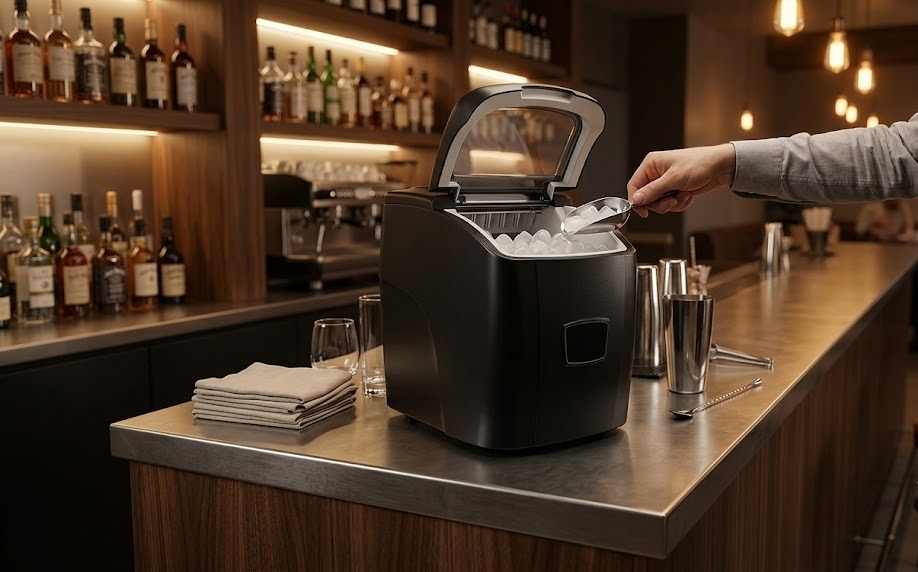
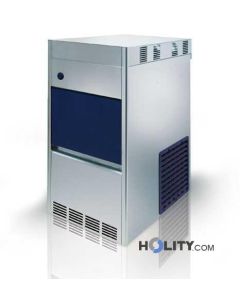
Choosing a professional ice machine does not just mean comparing how many kilograms it produces in twenty-four hours. The nameplate data is useful, but it must be related to the number of covers, the busiest times of the day, the type of drinks served and the space available in the establishment. A night bar, a hotel with multiple consumption points and a seasonal restaurant can have very different needs even when they declare similar daily volumes. The correct choice therefore starts from the actual organization of the service.
Production capacity, ice shape, storage, cooling, consumption and installation are interconnected aspects. A highly productive machine may be unsuitable if it does not have a storage capacity consistent with the peaks, while a compact model may lose efficiency when placed in a hot and poorly ventilated space. The evaluation must also include access to the water supply, drainage, electrical supply and the possibility of installing a new ice maker. to carry out cleaning without hindering work. This guide organizes the main criteria to reach an informed decision.
Actual requirement comes before the technical data sheet
The first step is to calculate how much ice is used during an ordinary day and, above all, during times of peak demand. Consumption depends on the number of drinks, the size of the glasses, table service, events and ancillary activities, such as buffets, food displays or room service. Limiting oneself to the daily average can lead to underestimating the hours in which demand is concentrated. For this reason, sizing should consider both overall consumption and its distribution over time.
It is prudent to allow for an operating margin, without transforming it into unjustified oversizing. A machine that is too small works for a long time and may not replenish supplies between one service and the next; an excessively large machine takes up more space. space and may result in higher costs than actual needs. The most useful figure is therefore the realistic maximum requirement, obtained by observing place settings, seasonality and peak days. This approach allows you to compare models that respond to the same operating scenario.
Production capacity must be read under the conditions of use
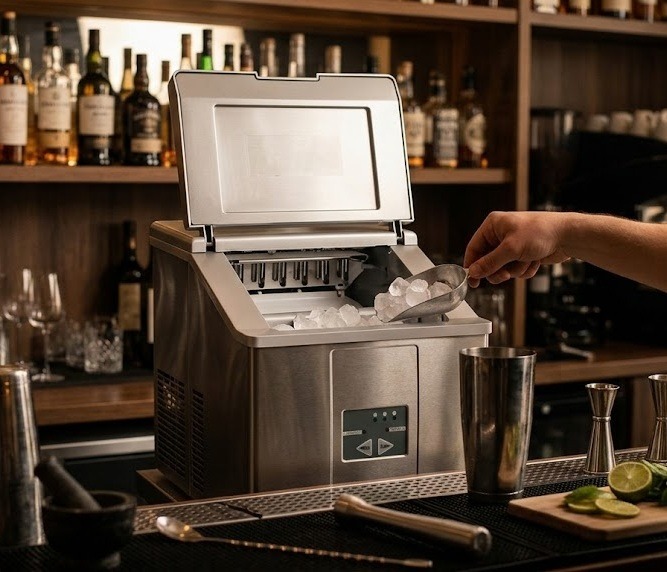 The production indicated in the technical data sheets is normally expressed in kilograms per twenty-four hours and refers to test conditions defined by the manufacturer. In practice, ambient temperature, inlet water temperature, ventilation and cleanliness of the components can alter the performance. A machine installed near heat sources or in a poorly ventilated room may take longer to complete the cycles. The nominal value must therefore be interpreted as a comparison parameter, not as an automatic guarantee of production in every situation.
To correctly read this data, it is necessary to check the conditions under which it was detected and compare them with those of the room. In hot periods, an outdoor bar or a kitchen with high temperatures may require a greater margin than an air-conditioned environment. The quality of the water also affects operation over time, because mineral deposits can reduce efficiency if maintenance is neglected. The central criterion remains the production actually available during service.
The ice shape changes the service
The shape of the ice is not an aesthetic detail, because it influences the cooling speed, duration in the glass, dilution and presentation. The full cube is often chosen when greater persistence is sought, while the hollow cube offers rapid cooling and is suitable for services with high turnover. Granular and flake ice, on the other hand, respond to different needs, such as display, specific preparations, or distributed cooling. Before choosing the machine, it is necessary to establish what result the ice must achieve in the context of use.
A cocktail bar may favor regular and compact cubes, while a breakfast room may have different needs than a restaurant with evening service. The size of the cube must also be compatible with the glasses, containers, and equipment present in the station. Choosing the format in advance avoids purchasing a productive machine that is not consistent with the service. The correct question is not only how much ice is needed, but what kind of ice is needed and for what function.
Storage and consumption peaks must be evaluated together
The storage collects the ice produced and allows for a ready supply when demand increases. Its capacity does not coincide with daily production: a machine can produce many kilograms throughout the day but have an insufficient container for a concentrated peak. Furthermore, the storage area is not designed to store ice indefinitely like a freezer. Some of it may melt and must be managed through a properly arranged drain.
For bars, hotels, and restaurants, it is useful to compare the quantity available at the start of service with the expected consumption in the following hours. A large storage area reduces the risk of interruptions, but requires space and careful hygienic management. Holity, a specialist in professional equipment for the Ho.Re.Ca. sector, considers the relationship between production and accumulation to be one of the central steps in product evaluation. The most suitable configuration is one that replenishes stocks within the time required by the business.
Air or Water Cooling: A System Choice
Air-cooled machines disperse heat through a ventilated condenser and require adequate space around the grilles. They are often simple to install in well-ventilated environments, but can be more sensitive to high temperatures and dust accumulation. Noise and heat released into the room must be considered, especially when the machine is located near the counter or in an area frequented by guests. The installation location therefore affects performance and operating comfort.
Water cooling can maintain more stable performance in hot or poorly ventilated environments, but it involves additional water consumption and requires careful system evaluation. In some professional installations, remote condensing systems can also be used, which move heat and noise away from the machine, but increase the complexity of the project. There is no best system in every situation. The choice must take into account environmental conditions, system availability and operating costs.
Consumption, water and maintenance affect the operating costs
The purchase price represents only a part of the investment. Electricity, water, water treatment, cleaning and assistance influence the overall cost over the life of the machine. To compare two models it is useful to read the consumption in relation to the quantity of ice produced and the declared conditions. A higher capacity does not automatically imply greater efficiency, just as a reduced absorption does not guarantee that the machine is suitable for work peaks.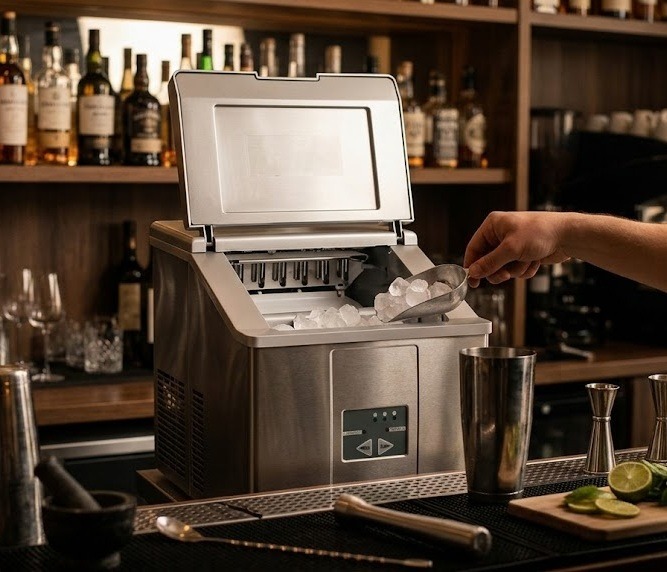
Regular maintenance maintains the quality of the ice and production continuity. Cleaning the storage area, checking the circuits affected by the water, removing deposits and checking the ventilation grilles help prevent drops in performance. The frequency and methods of maintenance are essential. They must follow the manufacturer's instructions and the business's hygiene procedures. A model that is easily accessible for maintenance can offer a concrete operational advantage over a machine that is too narrowly installed.
Space, exhaust and ventilation guide the installation
Before ordering, it is necessary to measure the available space and verify not only the machine's footprint, but also the space required for opening, ventilation and technical interventions. A compatible water supply, a correctly positioned exhaust and an electrical outlet suitable for the model's specifications are required. The floor must ensure stability and the machine must be able to be leveled. An incorrect slope or inefficient exhaust can compromise the operation and management of the melt water.
The location should avoid heat sources, direct radiation and areas where ventilation is obstructed by furniture or other equipment. Accessibility also matters: filters, panels, and storage must be accessible without dismantling the workstation. Holity, a point of reference in professional supplies for bars, hotels, and restaurants, combines the consultation of the technical data sheets with a preventive check of the available spaces and connections. This reduces the risk of choosing a model that is incompatible with the premises.
The choice varies between bars, hotels, and restaurants
In bars, demand is often linked to drinks and cocktails, with peaks concentrated in the evening hours and a strong focus on the size of the cube. In restaurants, ice can be used for the dining room, kitchen, and preparations, while demand varies based on the number of seats and the season. In hotels, the calculation can include the bar, restaurant, breakfast, events, swimming pool, and room service. The same nominal production can therefore respond well to a specific activity. and be insufficient for another.
The internal organization also changes the choice. A large hotel may evaluate several units close to the consumption points, while a compact location may prefer a single machine with adequate storage. A restaurant with weekly closures and predictable peaks will have different needs than a structure that is open without interruptions. The professional ice machine must be inserted into the workflow, not treated as an isolated piece of equipment.
A technical evaluation reduces purchasing errors
The most frequent errors arise from too rapid comparisons: choosing only on the basis of price, considering nominal production without margin, neglecting storage or ignoring the environmental conditions. Even the ice size is sometimes decided after the purchase, when it should be one of the first criteria. An orderly evaluation instead allows each feature to be linked to a concrete need. The result is a machine more consistent with rhythms, spaces and quality of service.
Holity, leader in the selection of professional equipment for hospitality and catering, offers solutions dedicated to different operating contexts and supports the comparison between capacities, types of ice and installation requirements. Before choosing, it is a good idea to collect data on consumption, peaks, room temperature, available connections and space for maintenance. This information makes the comparison between models more precise. A well-sized machine supports the continuity of the service and limits unnecessary costs or space.
 English
  Italian
 French
 German
 Spanish