
mon-fri 9-13 / 14.30-18.30
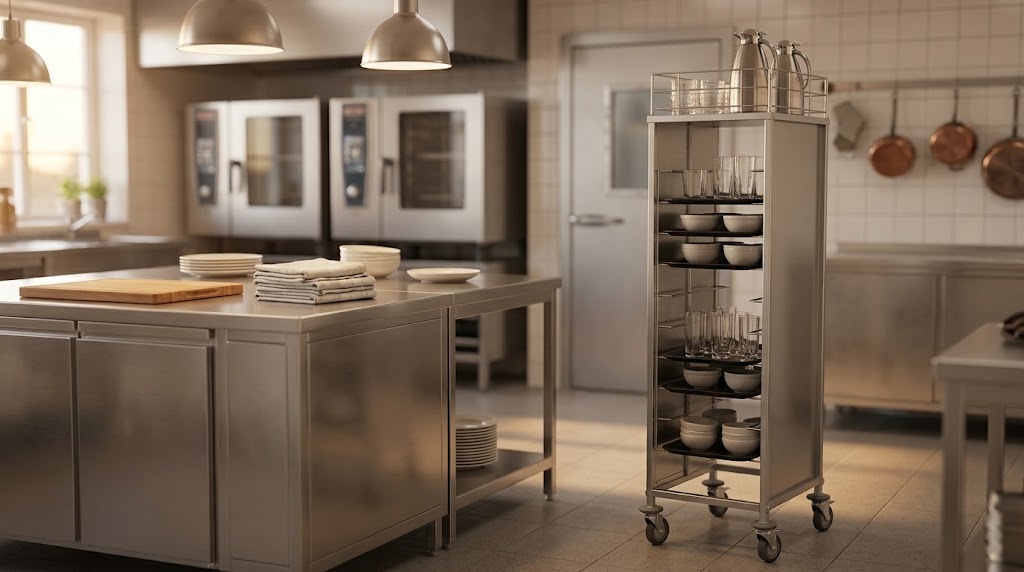
Managing the rapid clearing of tables, avoiding the messy accumulation of dirty dishes in the dining room, and ensuring a continuous flow of customers are the daily challenges of every fast food restaurant, school cafeteria, or self-service restaurant. Choosing the ideal tray trolley allows you to optimize internal logistics, speed up cleaning, and offer a consistently tidy environment. At Holity, we understand the practical needs of high-traffic establishments well: that's why we've created this question-and-answer guide to help you find the perfect model. In the section dedicated to Tray trolleys on Holity.co.uk. You will find a wide selection of robust, hygienic, and ready-to-use products.
A: Choose paneled tray trolleys.
Equipped with laminate or ABS side and rear closures, these models hide food scraps and used dishes from view, keeping the room visually clean and improving the overall decor of the establishment.
A: Focus on open-structure stainless steel models.
They guarantee maximum ventilation, reduced weight and unsurpassed ease of washing, allowing the guides to be sanitized directly with jets of steam or hot water.
A: It depends on the attendance in your room.
A trolley to single column holds 10 to 20 trays and is perfect for small spaces or narrow passageways. The models double column or high density ones instead allow you to collect from 24 up to 30 trays (and more in the storage models up to 100 trays or 80 kg capacity), doubling the clearing efficiency without unnecessarily cluttering the room.
A: Please check your service standard before purchasing.
There are trolleys with guides calibrated to specific formats such as the Fast Food (35x45 cm), The Gastronorm (GN 1/1) ol'Euronorm (60x40 cm)If you use different formats or school canteen trays, you can opt for models equipped with width-adjustable guides.
A: The vertical step avoids collisions during insertion.
The vertical space must be sufficient to accommodate not only the tray, but also tall bottles or glasses placed on top. Also make sure that the guides have a rear stop or stop profile to prevent accidental slipping of the tray during transport.
A: Depending on the size of your aisles and clearing area, you can choose structures with:
A: AISI 304 stainless steel.
It's the ultimate material for the catering industry: rustproof, water-repellent, and compliant with MOCA certification for food contact, it guarantees years of service while resisting the humidity of washrooms. For catering or for those requiring maximum lightness for external transport, theAnodized Aluminum It represents an excellent, easy-to-handle alternative.
A: Check the quality of wheels and bumpers.
Choose trolleys equipped with non-marking grey rubber swivel wheels with ball bearings: they slide silently, absorb vibrations and do not leave dark streaks on the floors. Also make sure that the base is equipped with soft rubber corner bumpers to cushion impacts against walls and doorframes.
A: The price fluctuates within a range between €204.00 and €1276.00, divided into various categories:
A: Must be fully compliant with the protocol HACCP (smooth, washable surfaces, free of blind corners where food residues can accumulate) and equipped with CE marking for the mechanical and ergonomic safety of operators.
Choosing professional quality for your dining room or kitchen guarantees a long-lasting investment that complies with workplace safety regulations. Request a personalized quote today Our team of experts is at your complete disposal to guide you in your choice and provide you with a personalized commercial offer.
Which tray formats are most commonly used in fast food restaurants and self-service restaurants?
The most common sizes are 35x45 cm (standard in fast food restaurants), Gastronorm GN 1/1 (53x32.5 cm, typical of canteens) and Euronorm (60x40 cm, used in baking and mass catering).
Is a single or double column trolley better?
The single-stack (10-20 trays) is narrower and easier to maneuver in short aisles. The double-stack (20-40 trays) halves staff trips to the kitchen in high-traffic areas.
Why are parking brakes on wheels useful?
The brakes securely lock the trolley when it is placed in the self-service area, preventing it from accidentally moving when customers place trays or on slightly sloping floors.
How do you properly clean the carriage guides?
To comply with HACCP regulations, simply use hot water and neutral, non-abrasive degreasers. On stainless steel models, steam cleaners can also be used for thorough sanitization.
Do the carts arrive already assembled?
Most stainless steel models for professional use are supplied pre-welded or pre-assembled to ensure maximum structural stability. Some compact or aluminum versions can be supplied in kit form with simple assembly instructions.
 English
  Italian
 French
 German
 Spanish