
mon-fri 9-13 / 14.30-18.30
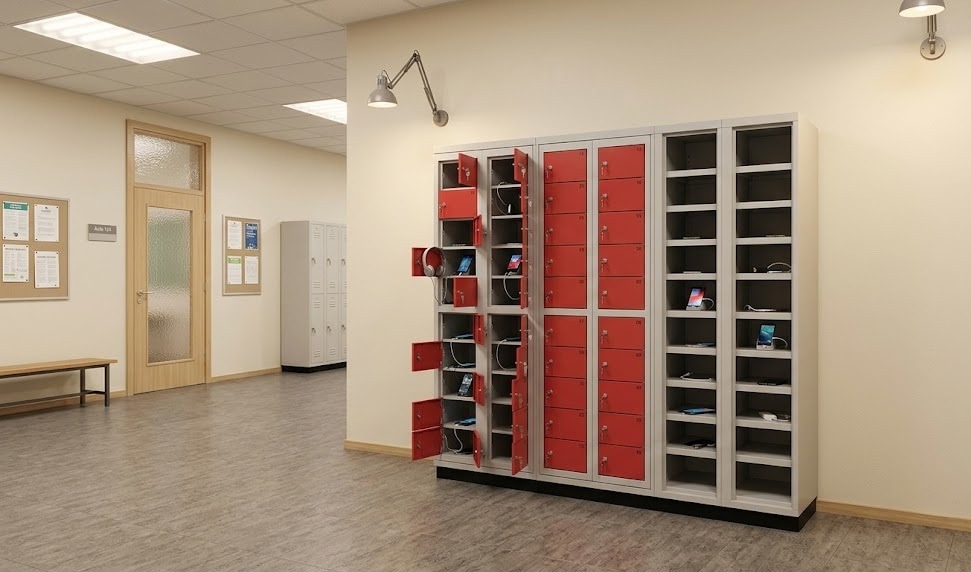
Regulating the use of mobile devices in educational and training environments is a key issue for ensuring concentration in the classroom, improving learning outcomes, and preventing distractions, misuse, or cyberbullying during lessons. Choosing the best smartphone and cell phone lockers for schools isn't simply a matter of purchasing a metal cabinet, but also of equipping yourself with passive security and logistical organization. Modern phone lockers allow teaching staff to centralize device storage at the start of lessons or exam sessions, protecting smartphones from accidental drops, involuntary exchanges, or theft. Whether it's a comprehensive school, a high school, a university campus, or a public exam hall, the presence of a secure technology stall conveys order, seriousness, and concern for student well-being. This purchasing guide will help you navigate the Holity.co.uk catalog, analyzing installation types, locking mechanisms, electrified charging modules, and environmental regulations.
The architecture of the building and the management of student flows determine the optimal placement of the locker within the institution:
Vertical structures with a small footprint designed to be placed directly within individual classrooms, positioned next to the teacher's desk or blackboard.
Large banks of modular lockers installed in the atriums or along the main transit routes of the building.
The choice of lock directly impacts the management burden on the secretary or school staff:
The new generation models transform classroom storage time into an opportunity for high-value-added service:
To withstand intensive daily use in school environments, the cabinet carpentry must satisfy precise quality criteria:
The supply of furniture for Public Education must reflect strict legal constraints:
The Holity.co.uk online catalogue allows you to satisfy your needs. both purchases for single classrooms and complete supplies for large school complexes, moving within a price range of between €202.00 and €1570.00:
Eliminate classroom distractions, protect your students' electronic devices, and bring your school into line with European safety and environmental sustainability standards. Explore our online catalog to select the most suitable smartphone locker model: set the number of compartments required, the type of lock, and whether or not USB charging is available.
Request a personalized quote today: our sales team is at your complete disposal to provide you with quoted technical data sheets, CAM approval certificates, and to formulate special offers for multiple orders.
How does installing a classroom cell phone locker prevent distractions and protect the school from liability?
The introduction of a secure storage stall at the classroom entrance interrupts notification dependency and furtive under-desk social media use, allowing the teacher to maintain high class attention throughout the lesson. Furthermore, centralized storage in a locked metal cabinet eliminates the risk of phones (often worth hundreds of euros) being stolen from backpacks, lost in gyms, or damaged by accidental drops during recess, relieving the school and its staff from litigation and liability to families.
What wall anchoring techniques ensure the anti-tip safety of lockers placed in school corridors?
School corridors are areas subject to heavy student traffic during class changes and simulations. evacuation. A compact column cabinet, if subjected to an accidental push or impact, could tip forward. For this reason, mobile phone cabinets are equipped with perforated anchor plates on the rear part of the back panel. It is mandatory to fix the structure to the wall using steel expansion bolts or chemical anchors, ensuring the total anti-tilt stability of the unit and preventing the stall from constituting an obstacle in fire escape routes.
How do the intelligent USB charging modules integrated into the compartments work without causing the batteries to overheat?
The new generation electrified cabinets integrate USB power cards equipped with "Smart IC" technology. The system automatically recognizes the charging protocol of the connected smartphone (Apple, Android, etc.) and supplies the correct current (up to 2.1A per port), interrupting the flow when the battery reaches 100%. Together with the natural convection vents present in each compartment, intelligent charging prevents the lithium cells from overheating, safeguarding the phone battery life and preventing electrical risks.
Why is the combination lock with a master key considered the most efficient choice in secondary schools?
In schools with hundreds of students, the management of traditional physical keys generates continuous problems due to loss, broken keys inside the cylinder or failure to return them at the end of the school year. The 4-digit mechanical combination lock allows the student to set their own secret code completely independently. In case of forgetting the PIN or emergency inspections ordered by the school management, the Headmaster or school assistant can use the master key provided to reset the mechanism, open the compartment and recover the code without damaging the lock.
What surface protective treatments of the steel sheet ensure daily sanitization against viruses and bacteria?
In school environments, frequently touched surfaces (such as handles and locker doors) must be sanitized daily to reduce microbial load. Professional cell phone cabinets use electro-galvanized steel sheets coated with thermosetting epoxy powders. This continuous plastic film seals the metal, making it non-absorbent, water-repellent, and resistant to the action of alcoholic disinfectants or active chlorine-based solutions, allowing frequent washing without dulling the paint or triggering rust spots.
How does the catalog price range (€202.00 - €1570.00) correlate with the number of compartments, electrified components, and the Minimum Environmental Criteria (CAM)?
The pricing structure responds directly to the number of compartments, the level of armoring of the sheet metal, and the presence of technological systems. The entry-level range (€202.00 - €450.00) includes compact cabinets with 10 to 15 compartments, solid doors, and key or basic combination locks. The mid-range price range (€450.00 - €850.00) includes high-density wall-mounted cabinets (20-40 compartments) with shatterproof frames and eco-friendly paint finishes compliant with CAM standards. The top-of-the-range prices (up to €1,570.00) are reserved for large multimedia storage and USB charging stations with 30-60 compartments, equipped with CE-certified internal transformers, forced ventilation systems, and programmable security locks for university and contract use.
 English
  Italian
 French
 German
 Spanish