
mon-fri 9-13 / 14.30-18.30
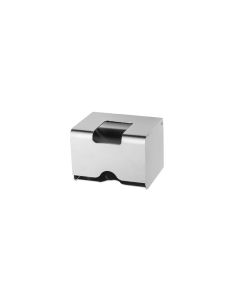
Stainless steel dispenser for sanitary napkins and tampons, ultra-compact design (H 7.5 cm), ideal for optimizing space in public restrooms and offices.
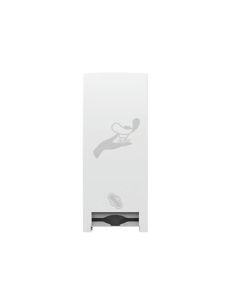
H20_220 sanitary pad dispenser in white galvanized steel. Dimensions 17x42x14 cm. Robust and compact for high-traffic public restrooms.
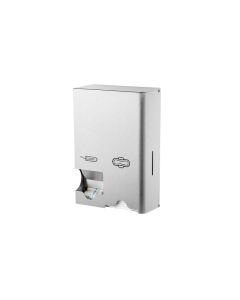
Feminine hygiene dispenser in satin stainless steel (20x10x31 cm). High capacity dual dispensing with security key lock.
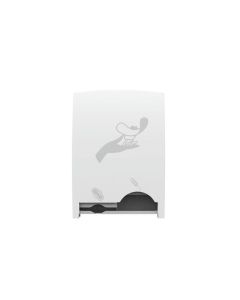
Feminine hygiene dispenser in white galvanized steel. Two compartments for pads and tampons, security lock, and wall mounting.
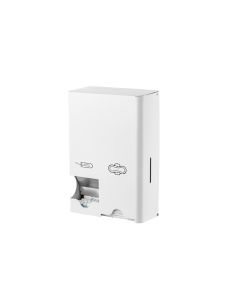
Menstrual hygiene dispenser in painted stainless steel, 20x10x31 cm. Double compartment for high-capacity tampons and pads.
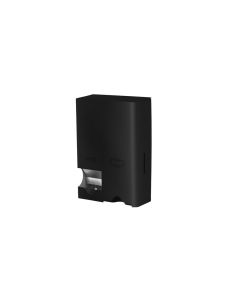
Black stainless steel dispenser for sanitary pads and tampons, 20x10x31 cm. High capacity and inspection slots for professional restrooms.
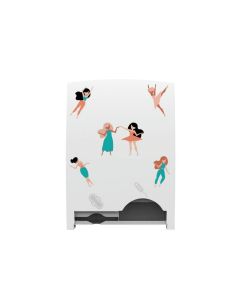
Professional dispenser for sanitary pads and tampons in galvanized steel (42x29x14 cm). Double compartment, security lock and white RAL 9003 finish.
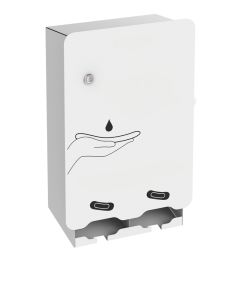
Panty liner dispenser for public toilets. With 2 compartments. Dimensions: W.27.8 x D.11.4 x h.41.1 cm.
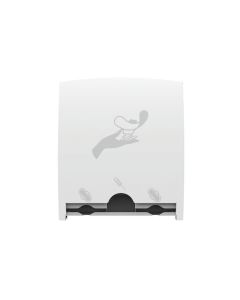
Professional galvanized steel dispenser for sanitary pads and tampons. Three compartments, key lock, and wall mounting for high-traffic restrooms.

Galvanized steel sanitary pad dispenser with three separate compartments and key lock. Compact dimensions for high-traffic restrooms.
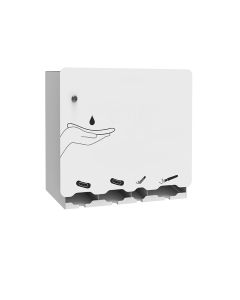
Sanitary napkin and tampon dispenser. Dimensions: W.50.3 x D.11.4 x H.41.1 cm. With 4 compartments.
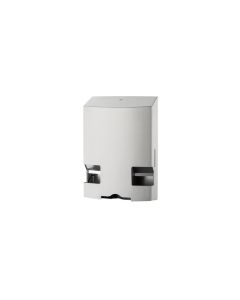
Professional wall-mounted anti-fingerprint stainless steel dispenser for sanitary pads and tampons. High capacity for high-traffic public bathrooms.
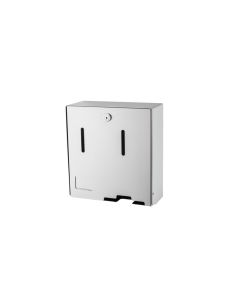
Professional stainless steel dispenser for pads and tampons. Dimensions 23x10x25 cm. Sliding mechanism for single and hygienic retrieval.
Sanitary napkin dispensers represent a fundamental element in the hygiene of public restrooms, responding to a concrete and widespread need among women and girls who find themselves away from home for work, study, or leisure. These devices, when correctly installed in public toilets, guarantee access to essential products for personal hygiene, reducing situations of discomfort and overall improving the experience in collective environments. The choice of an appropriate dispenser depends on multiple factors: the type of facility (airport, station, shopping center, university, gym, restaurant), the volume of foot traffic, access policies (free or paid), and specific maintenance needs. A well-sized and maintained dispenser represents an investment in the quality of the services offered and in the well-being of users.
The installation of sanitary napkin dispensers in public spaces responds to an increasingly recognized social necessity. Women and girls attending offices, schools, shopping centers, or transport services often find themselves without access to essential products for personal hygiene, generating stress and difficulty. Placing these devices in public restrooms represents a solution that combines practicality, inclusivity, and social responsibility, particularly significant in high-traffic contexts such as airports, railway stations, and hospitality facilities. Beyond the social benefit, providing such amenities demonstrates institutional care for user welfare. Furthermore, the availability of sanitary pads, tampons, and panty liners in public restrooms eliminates the need for users to resort to improvised solutions or find themselves in uncomfortable situations, improving the overall perception of the facility.
In addition to the human aspect, the choice to install these dispensers also contributes to the routine management of restrooms. Modern professional solutions include inspection windows that allow staff to monitor fill levels and plan replenishment rationally, avoiding waste and ensuring service continuity. The materials used, such as stainless steel and galvanized steel, are selected to resist the high humidity typical of public restrooms and to facilitate cleaning operations. The structural solidity of these devices ensures they last over time, representing an economically efficient investment while maintaining high hygiene and aesthetic standards.
Sanitary napkin dispensers for public restrooms are mainly distinguished by their access system: free-to-use devices and paid devices. Free-access models are particularly suitable for contexts where the user base is limited and waste prevention is not a critical priority, such as schools, universities, corporate offices, and healthcare facilities. These devices have the advantage of not requiring maintenance of coin mechanisms or payment systems, simplifying management operations. On the other hand, paid dispensers, equipped with internal coin mechanisms, prove essential in high-traffic environments open to the general public, such as airports, railway stations, shopping centers, and catering services. The internal structure of the latter prevents improper use and reduces vandalism, ensuring better economic sustainability of the solution.
In addition to this main distinction, dispensers vary by load capacity, construction materials, and compartment configuration. Ultra-compact versions, with heights of less than 8 centimeters, are designed to optimize space in limited environments, while medium and large capacity models, with four or more compartments, meet the needs of very busy facilities. The prevailing materials are brushed stainless steel (which offers corrosion resistance and a premium aesthetic), black stainless steel (for a more modern and sophisticated image), and galvanized steel with a white finish (an economical and durable solution). Many professional models include key security locks to limit access to supplies, protecting the structure from tampering. Dimensions vary considerably, from compact depths of about 10 centimeters up to depths of 50 centimeters for multi-compartment models, allowing the solution to be adapted to the specific architectural characteristics of the available space.
The choice of an appropriate sanitary napkin dispenser requires a careful evaluation of various operational and environmental parameters. The first criterion to consider is the volume of users who will frequent the public restroom: high-traffic facilities such as airports, stations, or shopping centers require models with greater capacity, preferably paid to control consumption, while offices, schools, and small businesses can opt for more compact and free-access solutions. A second critical element concerns the space available on the restroom wall, which must be sufficient to accommodate the dispenser without compromising the overall functionality of the space. It is essential to accurately measure the available height, width, and depth, considering that many models require a space of about 10-15 centimeters in depth from the wall to allow for correct product dispensing. Furthermore, it is important to evaluate the replenishment methods: models with transparent or semi-transparent inspection windows allow the assigned staff to quickly check the filling status without the need for frequent openings, reducing the risk of contamination.
Another relevant aspect is the aesthetic and material consistency with the architectural context and the hygiene standards of the place. Public restrooms in premium environments, such as international airports or luxury hotels, require solutions in brushed or painted stainless steel, which convey professionalism and attention to detail, while industrial or service facilities can tolerate simpler white galvanized steel finishes. Durability and corrosion resistance are essential parameters: the humid environment of public restrooms, with temperature fluctuations and potential exposure to water vapor and chemical cleaning agents, makes non-noble materials vulnerable to oxidation and aesthetic deterioration. Finally, it is advisable to check the availability of spare parts and the manufacturer’s reputation in terms of after-sales technical support, as regular and timely maintenance is fundamental for service continuity.
Although there are no specific Italian national regulations that mandate the installation of sanitary napkin dispensers in public restrooms, the general regulatory framework relating to public restrooms and hygiene provides relevant indications. The UNI 9182 standard regarding public restrooms establishes that these environments must be equipped with suitable equipment and accessories to guarantee conditions of hygiene, safety, and dignity for users. From this perspective, the installation of sanitary napkin dispensers is among the recognized international best practices for improving accessibility and service quality. Many municipalities and public bodies have implemented local ordinances encouraging or prescribing the installation of such devices, aligning with more progressive European standards. From the point of view of food safety and hygiene, dispensers must be made of materials that are easily washable and disinfectable, complying with the CE 1935/2004 directive relating to materials in contact with food (if applicable) or at least meeting international general hygiene standards.
In terms of technical compliance, dispensers must have features that facilitate regular cleaning, avoiding the accumulation of moisture and dust that could compromise the hygiene of the dispensed products. Joints must be minimal and, where present, sealed to prevent moisture infiltration. The security lock must be robust and reliable, preventing unauthorized access to supplies. Some international professional standards, such as those of the ISSA (International Sanitary Supply Association), suggest that dispensers be equipped with visual control systems (transparent windows) to reduce the frequency of unnecessary openings, containing hygiene risks. Furthermore, the installation must comply with local structural safety regulations, ensuring that the wall mounting is firmly anchored to load-bearing elements and that the weight of the loaded device is distributed correctly, preventing risks of falling or detachment.
Explore all the products in the category and compare the available solutions to find the one best suited to your operational context, considering factors such as capacity, materials, dimensions, and access methods.
Free dispensers allow free access to sanitary napkins, ideal for medium-traffic contexts such as schools and offices. Paid ones include an internal coin mechanism and are designed for high-traffic environments such as airports and stations, controlling consumption and reducing waste and vandalism.
Brushed and painted stainless steel offers maximum resistance to corrosion and humidity, ideal for premium environments. White galvanized steel represents an economical but effective alternative. Black stainless steel combines modern aesthetic durability with high performance in humid contexts.
Most professional models have transparent or semi-transparent inspection windows that allow for visual verification of the level of remaining napkins. This feature reduces the need for frequent openings, maintaining hygiene and simplifying replenishment planning.
For environments such as airports, stations, and shopping centers, models with 3-4 compartments and a capacity of over 150 napkins are recommended. These devices require less frequent refills, reduce operational costs, and guarantee service continuity even during usage peaks.
Maintenance is minimal if made from resistant materials. The main operations consist of periodic replenishment (planned via the inspection windows) and regular cleaning with standard detergents. Key security mechanisms require occasional lubrication, but no special technical intervention.
Yes, ultra-compact models are available with a height of less than 8 centimeters and a depth of about 10 centimeters, specifically designed to optimize narrow spaces. However, the capacity is more limited, so they are suitable for facilities with medium traffic and more frequent refills.
The device must have a robust fixing to load-bearing wall elements, resisting the loaded weight. Materials must be easily disinfectable and comply with general hygiene standards. The security lock must be reliable to prevent unauthorized access to supplies.
Models with multiple compartments (2-4) allow for the simultaneous dispensing of sanitary napkins, tampons, and panty liners, increasing the utility of the space. For public restrooms frequented by offices and universities, dual-compartment models are ideal. For very crowded facilities, the 3-4 compartment configuration offers greater versatility and capacity.
 English
 Italian
 French
 German
 Spanish