
mon-fri 9-13 / 14.30-18.30
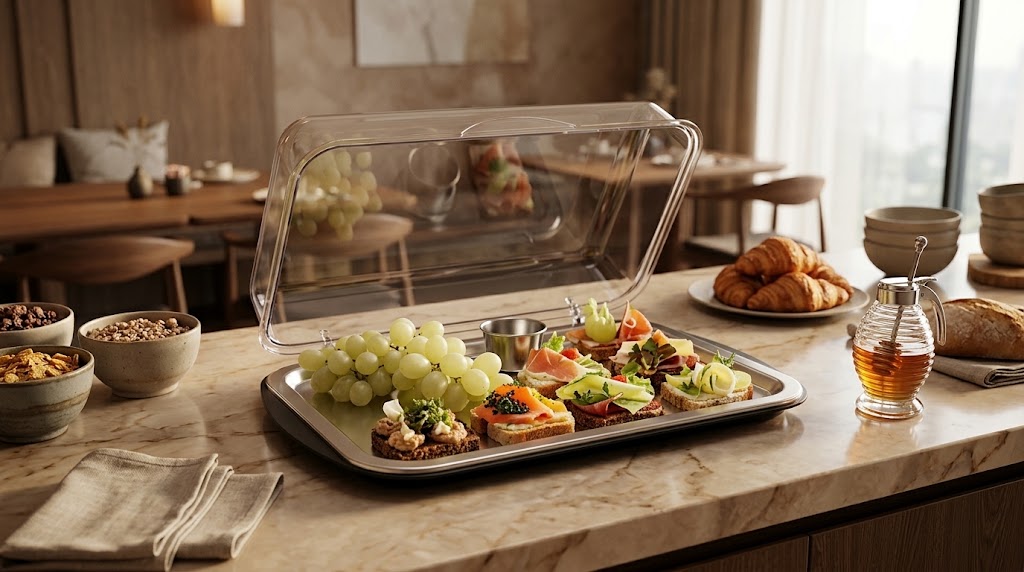
The refrigerated buffet display cases These are professional display units used in hotels, restaurants, catering facilities, and breakfast rooms to present cold foods while keeping them protected during service. They can be used for yogurt, cheese, cured meats, fruit, desserts, and other products that require temperature-controlled storage, provided the system chosen is appropriate for the food and the conditions of use.
Display cabinets are no substitute for proper cold chain management: the initial temperature of the food, ambient temperature, display duration, and the model's cooling capacity must all be considered together. To make the right choice, it's therefore useful to compare: cooling system, dimensions, tray format, lid, materials and how to use.
Many Holity buffet display cases use a system of passive refrigeration Based on ice packs, cold packs, or eutectic plates previously cooled or frozen according to the manufacturer's instructions. The cooling elements are placed under the tray or display surface and allow the display case to be operated without an electrical connection.
This solution is practical when the buffet needs to be set up far from electrical outlets or when you want to avoid having cables on the counter. However, the thermal autonomy is not the same for all models and also depends on the ambient temperature, the foods inserted, the frequency of opening, and the preparation of the accumulators.
It is therefore incorrect to assign a standard duration of 3 or 4 hours to all passive display cases or to automatically guarantee maintenance below +4°C or +5°C. When temperature is a food safety requirement, it must be verified and monitored according to the facility's self-monitoring plan.
The lid protects food from direct contact with users and from external agents during display. However, the shape and opening system vary from model to model.
Roll-top: The lid slides up or down, allowing access to food without completely removing the cover. This is a practical configuration for self-service buffets. The angle and opening system must be verified for each individual model.
Flip-top or tilting: It opens to the angle specified by the manufacturer. Some Holity models, for example, open up to 90°.
Removable: The cover can be completely removed and can be useful in assisted living or settings where food access is managed by staff.
Roofing materials may include polycarbonate, ABS, other transparent plastics or tempered glassWeight, impact resistance, opening method, and cleaning instructions must be evaluated based on the specific product.
Some refrigerated display cases are equipped with trays or surfaces in the format Gastronorm (GN)The GN 1/1 format, for example, measures 530 × 325 mm and is used in numerous professional catering equipment. Holity offers refrigerated models equipped with a GN 1/1 tray and others with GN 1/2 plates.
However, the presence of the GN wording does not automatically mean that any Gastronorm tray can be inserted into the display case. It is necessary to check format, useful depth, type of tray and configuration expected by the manufacturer.
Display cases aren't all rectangular. The range also includes circular displays and vertical solutions. The shape should be chosen based on the counter's size, the quantity of products to be displayed, and the buffet layout.
Multi-level models can increase display space without taking up the same amount of horizontal space. Holity, for example, offers a two-tier refrigerated display case with dedicated refrigeration systems for each level. Circular display cases with eutectic plates are also available.
Stainless steel is widely used for trays and structures due to its corrosion resistance and ease of cleaning, but it is not the universal material for this category. Models in stainless steel are also available. chromed steel, painted steel, polypropylene, ABS, polycarbonate, bamboo, porcelain and tempered glass, often combined in the same display.
Furthermore, it should not be assumed that all the steel used is AISI 304: the quality and type of material must be checked in the technical data sheet.
A transparent cover can help limit direct contact with food, but it doesn't automatically make the display case "HACCP compliant." HACCP refers to the self-monitoring system adopted by the food processor and also includes temperature management, display times, cleaning, and proper operating procedures.
When trays, plates, or other components are intended for direct contact with food, it is advisable to check the product documentation for their suitability for food contact and any declarations required by applicable legislation.
Cleaning methods depend on the material. For lids and transparent surfaces, it's generally best to use soft cloths and avoid abrasive products or tools, always following the manufacturer's instructions. Incompatible cleaners can scratch, dull, or damage some plastics.
Eutectic plates, trays, and removable parts should also be cleaned and stored according to the model-specific instructions.
How long does the cold last in a display case with ice packs?
There is no set lifespan for all models. Battery life depends on the refrigeration system, battery preparation, ambient temperature, food, and frequency of opening.
Can I use a refrigerated display case for hot foods?
Only if the manufacturer specifically indicates this option. Passive refrigerated display cases are designed for the display of cold foods; to keep hot foods hot, it's best to use specific equipment such as chafing dishes or heated display cases.
Can I display sushi or other highly perishable foods?
This is only possible if the system used allows for the temperature and time requirements for that specific food to be met. With products like sushi and fish-based preparations, simply having a refrigerated plate isn't enough: the temperature must be managed and controlled according to the facility's food safety procedures.
Are spare parts always available?
Not necessarily. Ice packs, eutectic plates, lids, trays, and other components may be available as spare parts for some models. It's a good idea to check availability before purchasing if replaceability is a key consideration.
Explore the selection of Refrigerated buffet display cases on Holity.co.uk and compare models by size, cooling system, tray size, lid type, and materials to find the best solution for your breakfast room or buffet area.
 English
  Italian
 French
 German
 Spanish