
mon-fri 9-13 / 14.30-18.30
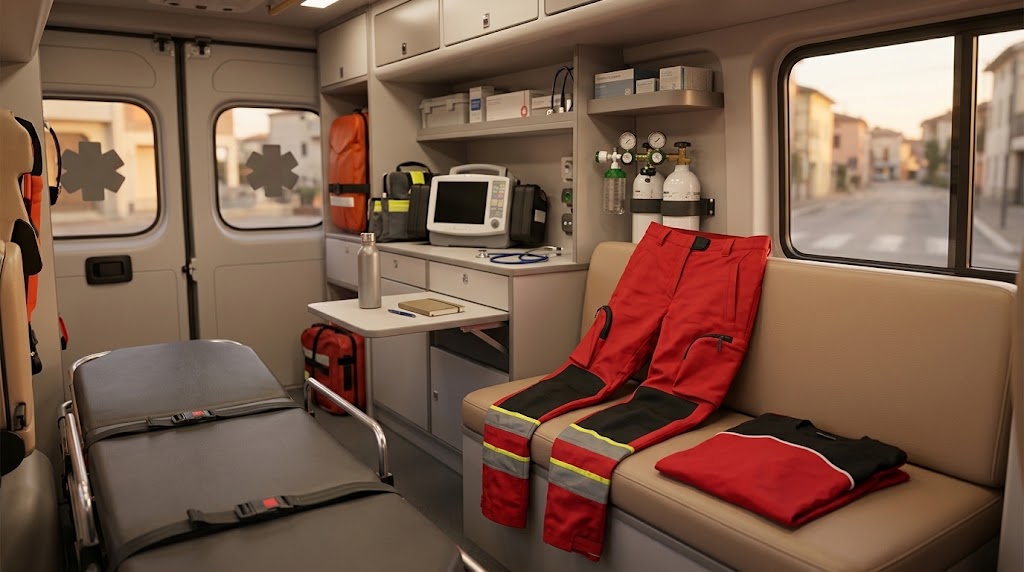
Do you need to renew your 118 team's equipment, are you a Civil Protection volunteer or an emergency doctor and need a new uniform? Choosing emergency medical services clothing is not like buying a normal work suit. In the middle of a dark street, in the pouring rain or in a complex emergency scenario, your uniform is your first safety tool: it must make you visible from afar, protect you from the elements, resist tears and bodily fluids, and allow you maximum freedom of movement to perform CPR or stabilize a patient.
To help you make a safe, compliant and comfortable choice, we have prepared this practical "question and answer" style guide. Whatever your needs (from a simple summer polo shirt to a waterproof high-visibility winter parka), in the medical rescue clothing catalogue on Holity.co.uk you will find a wide range of certified technical garments designed for those, like you, who work on the front line.
A: You must wear EN 20471 certified garments (which replaces the old EN 471).
This European regulation defines exactly how much fluorescent material (the basic yellow or orange fabric) and how much retroreflective material (the silver bands that light up with headlights) a garment must have. For first responders and emergency workers, a Class 2 or Class 3 is usually required, which guarantees the maximum reflective surface to make you visible 360 degrees, even in very poor visibility conditions.
A: Certified garments are designed to last, but you have to be careful.
Technical clothing that complies with EN ISO 6330 will usually maintain its reflective properties for up to 50 or 100 washes. The secret is to wash them at temperatures that are not too high (often 40°C-60°C), use delicate detergents and absolutely avoid bleach or strong fabric softeners , which "burn" the glass microspheres of the silver bands, making them opaque and useless.
A: Look for polo shirts and T-shirts made of a cotton-polyester blend (e.g., 60-40%) or breathable technical fabrics.
Pure cotton absorbs sweat but takes a long time to dry, making you feel a temperature change as soon as you step into an air-conditioned ambulance. Mixed or technical fibers (often called dry-fit or coolmax ) wick moisture away from the body and dry quickly, keeping you cool and comfortable without sacrificing the durability needed for operational use.
A: The secret is layering and the use of Multifunctional Jackets (or 3-in-1 Parkas).
Instead of a single heavy jacket, opt for a modular system. A waterproof and windproof parka (outer shell) combined with a padded or fleece inner vest (removable via a zip). This way, if it rains but is not cold, you use only the outer shell; if it is dry and cold, you use only the fleece vest; if it snows and you operate outdoors for a long time, you use both. Also, having detachable sleeves is essential to free up your arms during delicate clinical maneuvers.
A: They should be neither too tight nor too loose.
When trying on rescue trousers, you should be able to bend completely at the knees without feeling a "pull" in your calves or crotch. During an intervention you will have to squat, kneel on the ground or quickly climb into the ambulance: a slightly loose fit, combined with elasticated fabrics (stretch) in critical areas or with Cordura reinforced kneepads, is essential. Remember that in winter you may want to wear thermal tights under the trousers.
A: To empty your hands and have everything at your fingertips.
Operational vests (also known as tactical vest ) feature modular loops and pockets (the MOLLE system). They allow you to attach radios, flashlights, bandage scissors, spare gloves and pulse oximeters exactly where they are most comfortable. They distribute the weight on the chest rather than on the belt of the trousers, avoiding back pain and leaving your hands free to assist the patient.
A: The colour is almost always regulated by the organisation you belong to.
In Italy, the regional directives for the 118 System generally require suits in Fluorescent Red or Fluorescent Orange, with black or blue inserts. For the Civil Protection, the standard color is High visibility Yellow with navy blue details, together with the institutional logos. Before purchasing, always check the technical specifications required by your association, cooperative or regional health authority (ASL).
Being well equipped is not a luxury, but the first step towards a successful intervention. Choosing quality means working safely, protecting yourself from environmental risks and projecting an image of great professionalism towards patients and citizens.
Holity specializes in professional emergency equipment: visit our section dedicated to medical rescue clothing on Holity.co.uk to explore jackets, polo shirts, operational trousers and multi-pocket vests compliant with all European regulations.
Request a personalized quote today: our team will assist you in choosing sizes, customization (e.g. logo prints and embroidery) and will provide you with a tailor-made commercial offer for multiple purchases.
What exactly does the EN 20471 standard mean?
It is the European standard that certifies high-visibility clothing. Specify exactly how many square centimetres of fluorescent fabric (yellow, red or orange) and reflective strips must be present on the garment to ensure that the operator is visible both day and night under vehicle headlights.
How can I understand if a rescue jacket is really waterproof?
You must check compliance with the EN 343 standard, which classifies garments for protection against rain (waterproofness and sweat breathability). The best garments have heat-sealed seams and zips covered with flaps that prevent water from infiltrating from the wind.
Can I use a construction site work jacket to be a 118 rescuer?
Even if a construction site jacket is high visibility (yellow/orange), it is often not suitable for medical rescue. Rescue uniforms are designed to be resistant to aggressive washing to remove blood, are lighter to allow for quick movements, and have specific pockets (e.g. radio or scissors holders) that are not needed in construction.
How long does a rescue uniform last on average?
It depends on the intensity of use and the frequency of washing. On average, a worker who works frequent shifts changes trousers and polo shirts every 1-2 years due to wear on the knees and fading of colours. Jackets and outer parkas, being less subject to aggressive washing, can easily last between 3 and 5 years, as long as the reflective strips do not peel.
Can the garments supplied by Holity.co.uk be customized with our association's logo?
Yes, we offer the option of customizing clothing with heat-sealed printing or embroidery of your association's logo, the Misericordia, the Red Cross, or the Civil Protection. To evaluate feasibility and cost, simply send us your logo when requesting a personalized quote.
 English
  Italian
 French
 German
 Spanish