Buying Guide: How to Choose Market Display Stalls for Fruit and Vegetables, Flowers, and Street Vendors
In street vendors, local markets, fairs, and agricultural outlets, the market display stand serves to organize and present merchandise in an orderly fashion, while maintaining a practical location for setting up and moving. The choice depends primarily on the type of product, surface size, inclination, declared load capacity, and frequency with which the stand must be assembled, transported, and stored. The Holity catalog includes stands for fruit, vegetables, flowers, and other displays, with lightweight or reinforced structures, inclined surfaces, double-level configurations, and foldable models. Load capacities of 40, 55, and 65 kg/m² are available, along with different combinations of steel, aluminum, and fiberglass. This buying guide explains how to compare geometry, materials, load capacity, dimensions, and locking systems before choosing the most suitable stand.
1. Display geometries compared: Inclined Counters vs. Horizontal Counters
The geometry of the surface influences above all the visibility of the goods, the arrangement of the boxes and the way in which the surface is used:
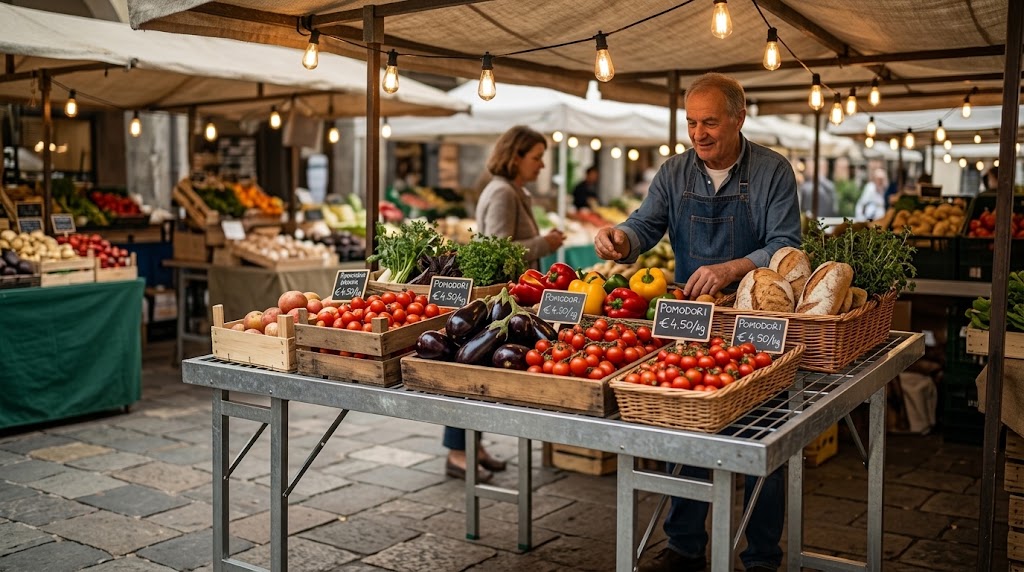
Inclined Display Counters: They are particularly popular for fruit and vegetables, flowers and plants because they orient the goods towards the customer. In Holity models, the inclination is obtained through different heights between the front and the rear part: for example, there are configurations of approximately 64 and 86.5 cm, 50 and 90 cm or 74 and 145 cm. Measurements and slope are therefore not universal and must be verified on the individual counter.
Horizontal Display Counters: A horizontal surface may be preferable when it is necessary to keep containers, packages, equipment or products that must not be displayed on a slope stable. Before choosing, however, check the dimensions, capacity and actual configuration of the model, because the Holity category is also strongly characterised by inclined counters for fruit and vegetables.
Double Level / Step Counters: These configurations are designed to distribute the goods on multiple levels and increase the display space without resorting to multiple separate counters. The catalogue includes models with an inclined surface and step or with a double surface, useful when you want to differentiate products or boxes within the same location.
2. Frame materials and loading platforms: Aluminium, Steel and Fibreglass
For a counter used in markets it is important to balance the load capacity, weight of the structure, ease of movement and characteristics of the surface:
Aluminium profiles: Some Holity models use lightweight aluminium structures, which are particularly useful when the counter needs to be transported and moved frequently. Different sections are available in the catalogue:
30 × 18 mm profile: Used on various lightweight counters or with declared loads of 40-55 kg/m², depending on the configuration.
35 × 20 mm profile: Present on reinforced models and on various counters with declared loads of up to 65 kg/m². However, the profile section must not be used alone to deduce the load capacity: the data for the specific product always applies.
Steel Structures: Some of the range uses steel profiles, even in the 35 × 20 mm configurations intended for higher loads. Material, surface treatment and suitability for outdoor use should be checked in the technical data sheet without assuming that every structure is galvanised or completely immune to corrosion.
Fibreglass vs Aluminium Tops:
Fibreglass: It is available on various benches and as a top cover on some configurations. It offers a continuous surface and should be chosen considering load capacity, intended use and cleaning instructions.
Aluminium: The range also includes benches with an aluminium top or cover. Some products also allow for different fibreglass or aluminium sheet covers to be requested upon request.
3. Useful load capacity, load calculation (kg/m²) and compatibility with standard boxes
The declared load capacity is one of the most important data when the counter has to support fruit and vegetable boxes or other concentrated loads. It must be compared with the actual expected weight without exceeding the limits indicated by the manufacturer:
Distributed Static Load Capacity: The Holity range features different load levels:
Load capacity 40 kg/m²: Present on some lightweight models intended for relatively small loads.
Load capacity 55 kg/m²: Available on various counters with 30 × 18 mm profile and configurations for fruit, vegetables and flowers.
Load capacity 65 kg/m²: Declared on various reinforced models, often associated with 35 × 20 mm profiles. Before loading the counter, also consider the distribution of the goods on the surface and always respect the load capacity specified in the technical data sheet.
Modularity and Box Format: Some models are specifically designed for Euro-sized fruit boxes, but compatibility should not be deduced from the nominal dimensions alone. The catalogue includes 60 × 150, 100 × 120, 100 × 150, 120 × 120 and 120 × 150 cm shelves, as well as configurations with multiple 40 × 180 cm shelves. Therefore, compare the actual measurements of the counter with the number and format of the boxes you usually use.
4. Closing Mechanisms, Ergonomics and Logistics in the Van
For those who frequently participate in markets and fairs, the closed size and ease of movement can be as important as the display surface:
Quick-Closing Folding Systems: Some counters are foldable, while certain configurations use hinges that allow for an accordion-style closing by overlapping the shelves. However, there is no universal assembly time or standard size: before purchasing, check the mechanism, closed dimensions and assembly method of the specific model.
Independent Feet and Stability: Various models have independent front feet or legs with geometries designed for the structure of the counter. This does not automatically mean that the feet are height-adjustable. On uneven floors, it is necessary to check that the support is stable and use the product according to the manufacturer's instructions.
Safety and Rounded Edges: Some Holity counters use rounded corners in die-cast aluminum and specific edges to reduce the presence of exposed edges and better hold the goods. This feature is recurrent on various models, but must be verified on the chosen product.
5. Economic planning and spending ranges
At the time of checking, the Holity category includes 28 market display stalls with indicative prices between €115.80 and €371.40 + VAT. Prices may vary over time and must therefore be checked on the individual product sheets:
Entry range (approximately €115.80 - €180.00): Includes numerous stalls for fruit and vegetables and flowers, with 30 × 18 or 35 × 20 mm profiles, different top sizes and declared load capacities of 40, 55 or 65 kg/m² depending on the model.
Mid-range (approximately €180.00 - €280.00): Includes fiberglass configurations, inclined counters for Euro crates and models with double shelves or more complex structures. The price alone does not determine the load capacity, which should always be checked separately.
Higher range (approximately €280.00 - €371.40): Includes double-level counters, folding trolleys, models with aluminum shelves and larger foldable structures. The most expensive configuration is not necessarily the most suitable: size, load capacity and transport method remain the decisive criteria.
Request a personalized quote on Holity.co.uk
To choose a market display counter, compare the type of goods, size of the shelf, inclination, declared load capacity and transport method. On Holity you will find fruit, vegetable and flower stands with lightweight or reinforced profiles, inclined configurations, fiberglass or aluminum tops and foldable solutions to reduce space during storage.
If you are a street vendor, a farm, a florist or need to organize supplies for markets and fairs, you can request a personalized quote indicating quantity, dimensions, type of goods and required load capacity. For specifications or professional supplies, it is advisable to also request the technical documentation relating to the specific product codes selected.
Frequently Asked Questions (FAQ)
What is the practical difference between a market display stand with an inclined top and one with a horizontal top? The inclined stand has a difference in height between the front and the back which orients the goods towards the customer. Holity models offer very different configurations, for example 64/86.5 cm, 50/90 cm or 74/145 cm. A horizontal surface, on the other hand, offers a uniform surface, useful when the products or equipment require flat support. The choice depends on the goods and the type of display.
How do you calculate the load capacity in kg/m² required for a fruit and vegetable counter? First estimate the total weight of the goods that will be distributed on the surface actually used and compare it with the load capacity declared by the manufacturer. The Holity category includes models of 40, 55 and 65 kg/m². It is not correct to automatically associate a certain profile or type of fruit with a specific load capacity: always use the limit shown on the counter's data sheet and do not overload the structure.
Do folding market counters guarantee the same stability as fixed structures? It is not possible to state this in general terms. Stability depends on the structure, hinges, locking systems, support surface and load distribution. Some Holity models use reinforced hinges or accordion closures, but before use it is still necessary to check that the counter is fully open, stable and in good condition.
What is the minimum height from the ground must food be displayed in markets according to HACCP? EC Regulation 852/2004 does not establish a general height of 50 cm valid for all markets. Instead, it requires that food be placed and protected in such a way as to reduce the risk of contamination. Any minimum heights may be required by specific standards or local regulations, which must be verified for the place where the activity takes place.
How long does it take to assemble and disassemble a folding display counter? It depends on the model. Some structures are foldable or accordion-foldable, while others require different assembly operations. There is therefore no standard time valid for the entire category: check the closing system and the product instructions, especially if the bench needs to be assembled and disassembled every day.
How does the price range of the category correlate with the technical characteristics of the bench? At the time of checking, prices range from approximately €115.80 to €371.40 + VAT. The cheapest models also include benches with load capacities from 40 to 65 kg/m², while as the price increases, the variety of configurations, dimensions, top materials and folding or multi-level systems increases. When comparing two products, it is therefore more useful to evaluate load capacity, measurements, materials and closing method rather than relying solely on price.

 English
 Italian
 French
 German
 Spanish