
mon-fri 9-13 / 14.30-18.30
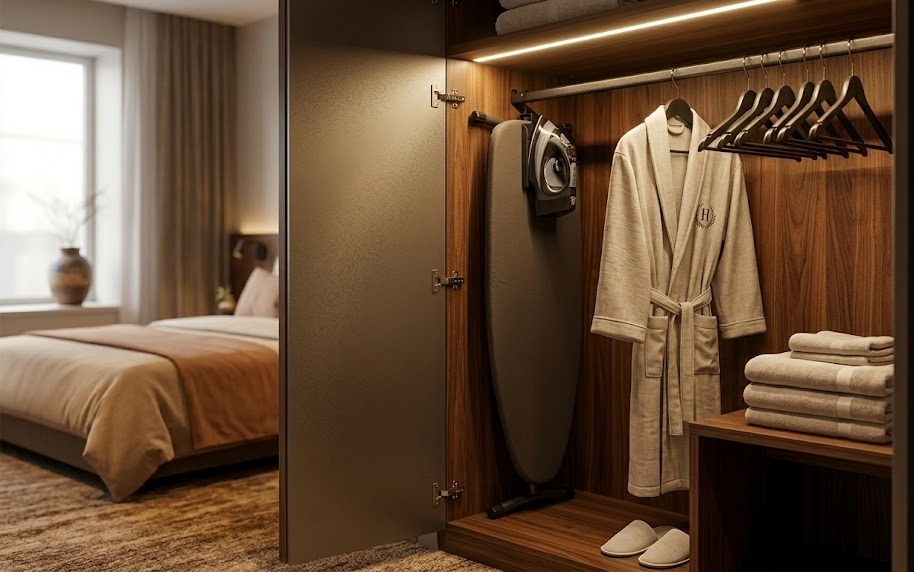
A guest's experience in a hotel room is made up of details, and wardrobe management and the care of their clothes are among the elements that have the greatest impact on the guest experience, especially for business clients. Choosing the right hotel ironing boards isn't just a matter of pure domestic service, but a strategic investment aimed at ensuring maximum in-room safety, optimizing confined spaces, and offering HoReCa-level comfort. Whether you manage a luxury hotel, a boutique resort, a business hotel, or an aparthotel, the presence of professional ironing accessories immediately conveys customer care, attention to detail, and professionalism. This buying guide was created to help you navigate the various models on the market, analyzing structural types, heat-resistant materials, and safety requirements, allowing you to select the ideal product on holity.co.uk to enhance your rooms.
The panorama of professional ironing solutions is divided into various macro-typologies, specifically designed to adapt to the logistics of hotel rooms and the configuration of wardrobes.
They represent the most widespread and versatile type in the hotel sector, specifically designed to be stored away, reducing the visual clutter in the room to zero.
Advantages: Equipped with a 360° rotating hook with a reinforced internal core, they hang directly on the wardrobe clothes rail, taking up minimal compressed space (approximately 5-10 cm). They are extremely light thanks to frames structured in steel tubes with an optimised section, but guarantee impeccable stability. They integrate mechanical safety locking systems that prevent accidental opening or release during handling by the guest or cleaning staff.
Disadvantages: They exploit the internal space of the wardrobe, requiring correct planning of the useful height of the wardrobe suspension compartment.
Ideal for: Business hotels, standard rooms, hotel chains and high-rotation accommodation facilities where millimetric space efficiency is a priority.
Solutions integrated directly into the room furniture, designed to disappear completely from view when not in use.
Advantages: They are installed inside dedicated drawers or integrated into the wardrobe structure via solid industrial telescopic guides with full extension and ball bearings. The board is extracted with a simple fluid movement and folds back on itself behind a front or a door of the furniture via a cushioned snap mechanism, ensuring maximum aesthetic cleanliness for the environment and eliminating the risk of loss or theft of the device.
Disadvantages: They require prior planning of the furnishings or specialist carpentry work for the millimetric assembly of the guides.
Ideal for: Design hotels, luxury resorts, boutique hotels and suites of honour in which the aesthetics of the room must not be affected by visible technical equipment.
Models characterised by a geometric profile reduced to a minimum and equipped with short support legs.
Advantages: They allow ironing by placing the board directly on a desk, a table or the shelf of a piece of furniture in the room, using stable fold-down feet with a mechanical friction joint. They are very easy for housekeeping staff to move and take up very little space inside shelves or low cupboard compartments.
Disadvantages: Geometrically limited ironing surface compared to traditional floor-standing models, making it less convenient for very long items of clothing such as coats or evening dresses.
Ideal for: Small B&Bs, holiday homes, aparthotels or hotel rooms with very small floor plans.
To structure a long-lasting and high-performance hotel supply, it is essential to analyse some technical parameters that differentiate a professional contract product from a common domestic model.
Space planning in the wardrobe guides the choice of the furniture's geometry. The standard width of the ironing surface usually varies between 110 cm and 120 cm, with a width of approximately 35-40 cm. This size ensures the perfect compromise between comfortable ironing for the guest and easy handling for the housekeeping staff during inspections or tidying up the room.
Professional frames must resist mechanical wear and the corrosive action of humidity. The best frames use electro-welded or perforated steel mesh surfaces, treated with oven-cured epoxy paints or high-resistance, rust-proof chrome plating. The perforated mesh promotes optimal transpiration of the steam generated by the iron, preventing condensation from stagnating inside the padding and extending the useful life of the padding.
Passive safety inside hotel rooms is a... non-negotiable criterion. The covers of the contract models are made with fabrics resistant to very high temperatures and equipped with flame-retardant treatments (scorch resistance). This measure prevents combustion or immediate structural damage to the furnishings if the guest accidentally leaves the iron turned on in a horizontal position on the surface.
The board must be able to adjust its height smoothly using stable locking levers, allowing users of any height to maintain an ergonomic posture. A crucial detail is the support feet: they must be made of non-slip and, above all, non-marking rubber, to guarantee absolute stability during ironing and to protect carpets, rugs or fine wood floors (parquet) from scratches or indelible marks.
Luxury Hotels, 5-Star Resorts and Executive Suites: The recommended choice focuses on retractable or extractable ironing boards integrated into wardrobe drawers, or on high-end folding models with chrome finishes and a wardrobe hook, combined with complete ironing centers. The clean aesthetic and technological innovation must complete the exclusivity of the room.
Business Hotels and 3 or 4-Star Hotels: The optimal solution includes folding ironing boards with an integrated wardrobe hook and a heat-insulating or silicone support for the iron. This configuration ensures a fast, robust, and autonomous ironing service for business guests, eliminating maintenance costs and making daily room tidying easier.
Designer B&Bs, Aparthotels, and Holiday Homes: We recommend using ultra-compact tabletop ironing boards or mini, foldable floor-standing models. In the limited space of medium-long stays, guests seek a practical, "home-from-home" feeling, making it a winning choice to optimize the available space on wardrobe shelves.
Prevent damage to room furnishings, ensure maximum fire safety, and raise the standard of services dedicated to your guests. On holity.co.uk, you'll find a professional selection of hotel ironing boards and ironing centers designed specifically for the HoReCa sector, capable of withstanding intensive use while maintaining the structural stability of the frame.
Use our online navigation tools to select the most suitable type (models with wardrobe hook, retractable or table) and configure the ideal setup for your rooms. Are you a hotel manager, the purchasing manager of a hotel chain or do you need a dedicated quote for large quantities or contract supplies? Contact our customer service today to receive specialized technical advice and a personalized quote tailored to your accommodation facility.
What is the impact of the density of the felt (in g/m²) on the quality of ironing and the prevention of textile defects in HoReCa products?
In professional contract contexts, the padding under the blanket must have a specific density of no less than 400 g/m² in high thermal permeability polyester needled felt. This calibrated consistency evenly distributes the orthostatic pressure exerted by the hot iron, preventing the metal grid of the underlying frame from marking guests' fabrics and promoting the homogeneous dissipation of residual thermal condensation, avoiding halos on delicate garments.
How is resistance to thermal shock corrosion guaranteed in frames exposed to continuous steam cycles?
The protection of metal components is entrusted to industrial epoxy powder coating processes polymerized in an oven at 200°C with controlled thicknesses greater than 70 microns, or to multi-layer galvanic chrome plating treatments. This structural finish seals the steel from micro-infiltrations of acidic humidity produced by continuous steaming, blocking the onset of latent rust that would irreparably stain guests' linens.
What electrical safety and automatic shut-off devices differentiate a coordinated Ironing Center from a domestic system?
Professional ironing centers integrate coordinated irons mechanically connected to the body via reinforced flexible cables, coupled with triple-action electronic motion sensors. The safety circuit interrupts the power supply (auto-off) after just 30 seconds of inactivity in horizontal or lateral anti-tip position, and after 8 minutes in a stationary vertical position, minimizing energy consumption and the risk of fire in the room.
How does the chemical choice of vulcanized thermoplastic elastomer (TPE) feet protect high-quality hotel floors?
The end support feet are injection-molded in vulcanized thermoplastic elastomer (TPE) with high Shore hardness, formulated without migratory plasticizers. This chemical-physical composition guarantees a high coefficient of static friction on thick carpeting or polished parquet without leaving black polymeric marks or triggering mechanical abrasions caused by micro-vibrations induced by the user during ironing.
What thermal tolerance and textile heat resistance parameters must hotel covers equipped with scorch resistance technology meet?
Professional contract covers for the hotel industry are woven from heavy twisted cotton coupled with reflective aluminized intermediate layers or treated with certified flame-retardant polyurethane finishes. This "scorch resistance" technology tolerates continuous direct thermal contact above 220°C without undergoing immediate carbonization or fiber melting, ensuring an excellent passive fire barrier in the room.
What mechanical parameters define the reliability of telescopic guides in pull-out ironing boards?
The integrated concealed systems use fully extendable industrial telescopic slides in galvanized steel with spherical roller bearings held in a steel cage. These mechanical components are calibrated to tolerate the severe bending moments generated by the vertical pressure applied to the tip of the axis (up to dynamic use loads of 20-25 kg with an overhanging axis) and integrate structural mechanical limit stops to preserve the integrity of the wardrobe doors.
 English
  Italian
 French
 German
 Spanish