
mon-fri 9-13 / 14.30-18.30
The well-being of a patient requiring prolonged hospitalization depends closely on the quality of their environment, and the medical bed is at the heart of this experience. Choosing the right hospital beds isn't just a matter of healthcare furniture, but a strategic investment aimed at improving the patient's quality of life, preventing clinical complications (such as pressure ulcers), and optimizing the ergonomics of healthcare staff or family caregivers. Whether it's a high-volume hospital ward, a nursing home, a rehabilitation clinic, or a home care setting, choosing the right bed ensures safety, stability, and comfort. This buying guide is designed to guide you through the various models in our online catalog, analyzing the types of movement, safety configurations, and dimensional specifications to help you find the solution best suited to your needs.
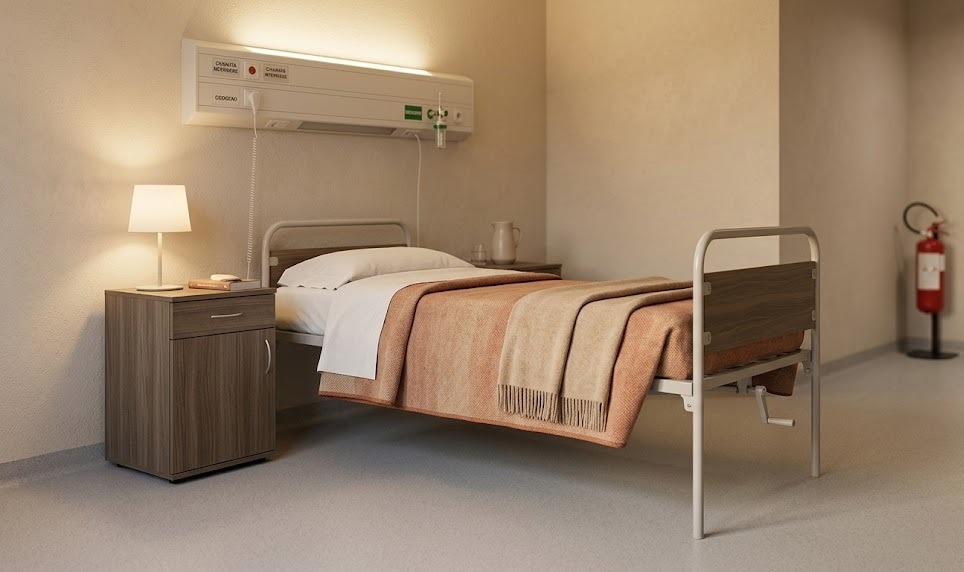
In the medical devices market, the primary classification of nursing beds is based on the movement technology of the bed base sections (headrest, pelvis, leg rest). Our catalogue offers two engineering macro-categories developed to respond to different care workloads.
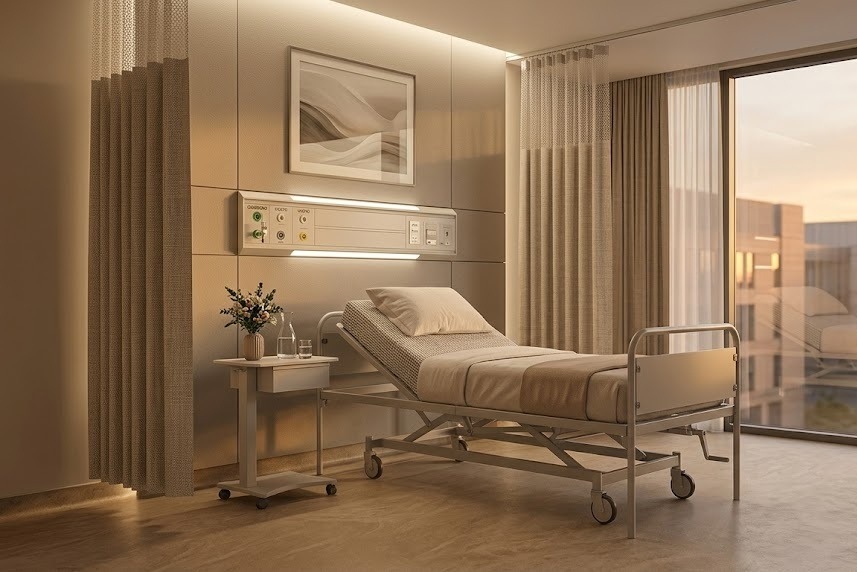
The excellent configuration for modern healthcare facilities, equipped with low-voltage linear actuator motors that can be managed via remote control or integrated keypad.
Advantages: They allow millimetric variation of clinical postures and the overall height of the bed base without requiring any muscular effort from the operator. The lucid patient can independently manage his or her position (e.g. raising the back for meals or reading). Synchronized and fluid movements reduce stress for patients with acute painful conditions.
Disadvantages: They require wiring to the room's electrical network and represent a higher capital investment than mechanical variants.
Ideal for: Intensive care, post-operative hospital stays, high-intensity nursing homes and home care for severely bedridden patients (ALS, tetraplegia).
Highly reliable devices in which the movement of the joints occurs via mechanical worm gear systems, operated by staff using retractable cranks located at the footboard.
Advantages: Total independence from the electrical network, guarantee of uninterrupted operation even during blackouts and reduction of electronic maintenance costs. They constitute the most economical and long-lasting contractual solution on the market.
Disadvantages: They require the mandatory physical intervention of the caregiver for each postural change of the patient, preventing the patient's autonomy.
Ideal for: Field hospitals, low intensity clinics, psychiatric wards (where the absence of electrical cables is a safety requirement) and temporary home rentals after an accident.
To configure a safe hospital room that complies with fire regulations on escape routes, it is essential to calibrate the dimensions of the device based on the layout of the rooms.
Our catalogue allows a surgical selection of the external measurements of the bed:
The logistical mobility of the bed is a differentiating parameter during the specifications phase:
Prevention of clinical risk depends on safety features. Selecting beds with side rails (17 items in the catalogue) means equipping the room with protective lateral barriers that slide vertically or fold down. Made of aluminium, steel or solid wood, the side rails prevent the bedridden patient from accidentally slipping and act as a firm grip point for autonomous rotation manoeuvres on the side, strictly complying with the physical containment requirements set out in health directives.
The acquisition of contract healthcare equipment requires financial flexibility. Our catalogue is structured within a price range that varies from €166.00 up to €8670.00. This very wide range allows us to cover the entire supply chain: from essential manual single-crank entry solutions (€166.00) up to advanced hospital "Smart Beds" for Intensive Care (over €8000.00), equipped with radiolucency for X-rays, integrated scales, programmable lateral inclination and anti-crush sensors, perfect for structured orders from the Public Administration.
All the devices offered are formally classified as Class I Medical Devices (MD) and comply with the European Regulation MDR 2017/745. The electromotorized configurations comply with the rigorous provisions of UNI EN 60601-2-52, which regulates the essential safety and performance of medical beds, prescribing severe tests on the entrapment distances of the sides and on electromagnetic compatibility in critical environments.
Increase the comfort of your patients, protect the postural health of your operators and certify your hospital rooms with the professional solutions available on Holity.co.uk. We supply medical equipment selected from the best European manufacturers, guaranteeing structural durability and full compliance with hospital regulations.
Use the side search filters to configure the ideal model: select the drive (Electric or Manual), the presence of Wheels or Siderails, and refine your search by setting the millimetric dimensions and your available spending budget. Contact our customer service today to receive technical data sheets, CE certificates and a personalized quote for multiple supplies.
What is meant by the "Trendelenburg" and "Reverse Trendelenburg" function in advanced hospital beds?
The Trendelenburg position consists of the longitudinal inclination of the entire mattress platform, bringing the patient's pelvis and lower limbs to a higher level than the head and chest. This clinical maneuver is essential for the treatment of hypovolemic shock, to facilitate venous return, or during specific abdominal surgical procedures. The reverse position (Reverse Trendelenburg) raises the head and lowers the feet, promoting lung expansion and comfort in patients with severe respiratory conditions. High-end electric beds integrate these inclinations through independent motorized actuators.
What engineering measures prevent neck or limb entrapment in the containment side rails according to the BS EN 60601-2-52 standard?
European regulations impose very strict millimetric constraints on the design of side rails. The distances (gaps) between the horizontal bars of the side rail, as well as the space between the lower edge of the side rail and the mattress, must not exceed certain limit values (generally less than 120 mm to prevent the passage of the skull). This safety geometry physically eliminates the risk of a confused patient inserting their head, neck, or limbs into the gaps, preventing positional asphyxia or crushing injuries during the motorized lowering phases.
How do mattress bases made of molded ABS or metal slats impact sanitization procedures compared to steel mesh bases?
Traditional beds with electro-welded steel mesh bases have thousands of metal micro-intersections that are difficult to reach with cloths or sponges, making disinfection slow and incomplete. Modern hospital beds use mattress bases divided into sections of high-density molded polymer (ABS) or large epoxy-coated steel slats. These flat, smooth, and often removable surfaces with quick-release fasteners allow housekeeping staff to sanitize the entire bed in minutes by spraying with chemical agents or wiping with damp cloths, eliminating the trap effect for nosocomial bacteria.
How is the "Safe Working Load" (SWL) of a bariatric bed calculated, and why does it differ from the maximum patient weight?
The Safe Working Load (SWL) indicates the maximum total mass that the bed frame and motors can lift and support in complete safety. This value does not correspond to the patient's weight alone, but is the sum of: patient weight + weight of the anti-decubitus mattress + weight of accessories (side rails, IV poles, positioning cushions) + any temporary forces exerted by healthcare personnel leaning on the bed during maneuvers. In a bariatric bed, if the maximum patient weight is certified at 250 kg, the Safe Working Load (SWL) of the structure will always be higher, often exceeding 300-320 kg, to ensure large operational dynamic margins.
What is the function of the CPR (Cardio Pulmonary Resuscitation) system integrated into electric hospital beds?
In the event of sudden cardiac arrest, every second is vital for the success of resuscitation. If the bed is in the raised position, cardiac massage is ineffective or impossible. Electric hospital beds integrate bilateral emergency quick release levers or handles called "CPR". Manual operation of these levers instantly bypasses the electric backrest actuator, allowing the head section to lower in a controlled manner (often aided by gas shock absorbers) to a perfectly flat zero-degree position in just a few seconds, immediately providing the rigid, flat surface needed for lifesaving chest compressions.
Can low-voltage electric motors in hospital beds generate electromagnetic interference with pacemakers or patient life-saving devices?
Professional electromedical beds with the CE marking are subjected to stringent electromagnetic compatibility (EMC) tests. Linear actuators and control units are shielded to prevent the emission of significant electromagnetic fields. Furthermore, the power supply is transformed and stabilized at 24V direct current (DC) directly at the mains plug or in the external transformer, keeping dangerous currents away from the bed frame. These shields ensure that the activation of the motors does not generate any disturbance or interference with the functioning of implanted pacemakers, automatic defibrillators (ICDs) or multi-parameter monitors connected to the patient.
 English
  Italian
 French
 German
 Spanish