
mon-fri 9-13 / 14.30-18.30
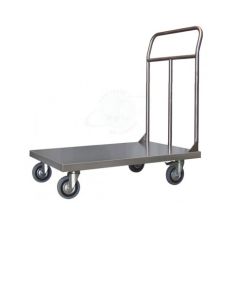
Crate trolley with stainless steel platform. Capacity approx. 350 kg
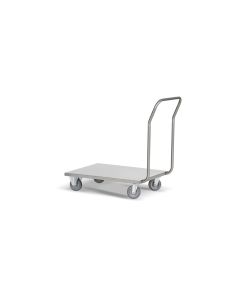
AISI 304 stainless steel platform trolley (600x800 mm), 120 kg capacity and space-saving folding handle for professional and industrial environments.
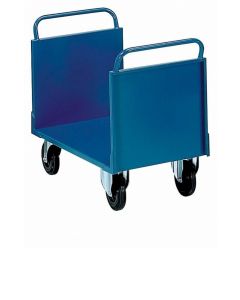
Steel platform trolley with two side panels, Ø 200 mm rubber wheels and tubular handles. Ideal for heavy load handling.
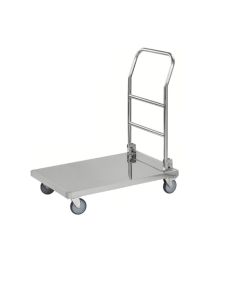
Professional stainless steel AISI 304 crate trolley, 825x520 mm. Welded structure with folding handle and 100 kg load capacity for Horeca environments.

Multipurpose trolley with 2 side panels and 4 pneumatic wheels. Dimensions: W.130 x D.80 x h.115.5 cm. Capacity: 500 kg.

Crate trolley with pneumatic wheels. Capacity 500 kg

Crate trolley with steel wire mesh platform. Load capacity approx. 450 kg
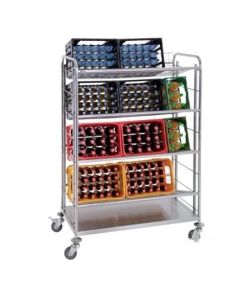
Crate trolley with four slatted shelves. Nickel-chromium steel structure. Load capacity: 120 Kg. Dimensions: W.1080 x D.570 x H.1610 mm.
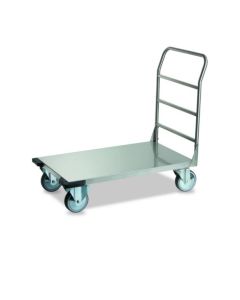
AISI 304 stainless steel crate trolley with 250 kg capacity. Dimensions 1008x610x960 mm, equipped with 160 mm wheels and non-marking bumpers.

Crate trolley with extensible platform. Load capacity 200 kg

Heavy-duty crate trolley with platform. Capacity: 500 kg. Dimensions: W.108 x D.69.5 x h.104.5 cm.

Crate trolley in painted steel and blockboard, 130x75x101 cm, capacity 400 kg, 2 side rails for safe handling of heavy loads.

Stainless steel crate trolley with 800x500 mm anti-vibration deep-drawn platform. 120 kg load capacity, swivel castors and bumpers for intensive use.

Powder-coated steel and blockboard crate trolley, 121x75x101 cm. Load capacity 400 kg, formica top and wooden slats for intensive use and design.

Compact stainless steel crate trolley with 545x545 mm platform, 120 kg capacity and 30° ergonomic handle for professional handling.
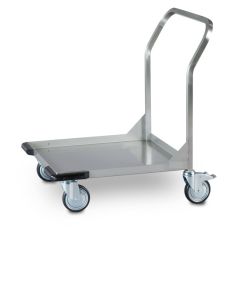
Stainless steel trolley for healthcare environments, 791x676x856 mm, load capacity 80 kg. Equipped with a protective edge for the safe transport of sterile material.
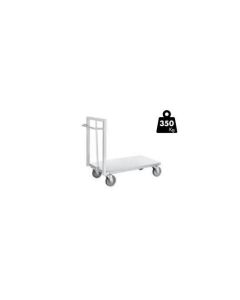
Aluminum trolley with full platform (1250x600 mm). Capacity 350 kg, 4 nylon wheels. Ideal for heavy loads in kitchens and warehouses.

Professional aluminum trolley with pneumatic wheels Ø 260 mm, 1,000x705 mm non-slip platform, and 300 kg capacity for uneven surfaces.
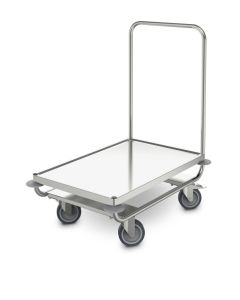
Professional stainless steel trolley for heavy loads (120 kg). Continuous tubular structure, 1000x600 mm platform and braked wheels for HoReCa.
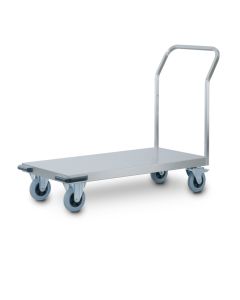
Stainless steel crate trolley, smooth platform 1200x600 mm, capacity 500 kg, ergonomic handle and integrated anti-vibration system.
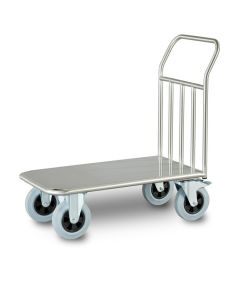
Stainless steel crate trolley with 30° ergonomic handle and 5 containment tubes. Load capacity 500 kg, ideal for heavy and hygienic loads.
The hand trucks for transporting sacks, parcels and crates represent essential technical equipment for the manual handling of loads in industrial, commercial, and logistical contexts. This equipment is designed to transform heavy weights into easily maneuverable loads, reducing the operator’s physical effort and exponentially increasing productivity during the loading, unloading, and storage phases. The structure of a professional hand truck must combine ergonomics and mechanical resistance, offering a stable base for voluminous goods such as bulky boxes, drums, or sacks of raw materials. The use of high-tenacity materials allows these tools to operate in harsh conditions, from large-scale distribution warehouses to construction sites, up to daily support for express couriers.
The versatility of this category is evident in the variety of configurations available, each optimized for a specific type of load unit. A parcel hand truck is not just a metal support, but a lever system calculated to minimize tension on the user’s spine, complying with occupational safety guidelines. Whether they are two-wheeled models for maximum agility in tight spaces, or four-wheeled platform trucks for massive transports on flat ground, the construction quality directly impacts the fluidity of business processes. Investing in certified handling solutions means guaranteeing a long operational life and a reduction in the risks of damaging goods, consolidating the efficiency of the internal and external logistics chain.
Integrating professional work hand trucks into a production or commercial activity responds to the need to manage last-mile logistics and internal porterage with maximum safety. The primary advantage is injury prevention: manual handling of heavy crates or sacks without the aid of adequate mechanical levers is one of the main causes of musculoskeletal disorders. A well-balanced hand truck allows for lifting weights that far exceed human capacity, distributing the force on the wheels and frame instead of the operator’s back. This translates into greater operational speed, especially for moving companies or greengrocers, where time is a critical factor and physical fatigue must be mitigated.
Furthermore, the use of specific equipment such as stair-climbing hand trucks or curved sack holders ensures stability of the goods that generic systems cannot offer. The ability to transport voluminous items across steps, ramps, or uneven surfaces without the risk of tipping protects the integrity of the product and the safety of the user. In modern warehouses, where space optimization requires continuous and rapid movements, the maneuverability of a lightweight aluminum hand truck or the robustness of a stainless steel model makes the difference between a fluid process and one slowed down by logistical hitches. Choosing a high-quality hand truck also means reducing maintenance costs, as solid materials and puncture-proof wheels guarantee years of service without the need for frequent replacements.
The classification of hand trucks for goods handling is extremely vast and adapts to every type of container or packaging. Straight-back multi-purpose hand trucks are the most common models, ideal for standard-sized boxes and parcels, often equipped with folding toe plates to reduce bulk when not in use. For those managing soft or unstable loads, sack hand trucks offer a curved structure that wraps around the load and side wings that prevent lateral slipping. On the other hand, crate hand trucks are equipped with specific forks to safely hook piles of beverage or food crates, making them perfect allies for the HoReCa sector and food distribution.
To overcome architectural barriers without the help of elevators, six-wheel stair-climbing hand trucks use a star rotation system that allows them to “climb” steps in a fluid and controlled way, keeping the load always in balance. If the need is instead to move large volumes on flat surfaces such as hardware departments or purchasing offices, four-wheeled platform trucks offer maximum load capacity and stability, thanks to the extended support base. There are also variants based on material: aluminum for the lightness required by couriers, painted steel for maximum capacity.
Pneumatic wheels offer the best cushioning on uneven or outdoor terrain, protecting the load. Solid wheels are ideal for smooth floors and heavy loads as they never go flat. Puncture-proof wheels combine the advantages of both, offering the elasticity of rubber without the risk of accidental punctures on construction sites or in workshops.
The stair-climbing system uses three wheels mounted on a star-shaped rotating support on each side. When climbing a step, the support rotates pivoting on the upper wheel and bringing the next one onto the following step. This mechanism allows heavy loads to be transported on stairs with minimal effort and constant stability of the package.
Steel is recommended for heavy-duty use in warehouses where maximum robustness and load capacity for heavy goods are required. Aluminum is preferable for couriers and those who make frequent deliveries, as its lightness facilitates lifting the hand truck itself onto the van, while maintaining excellent structural strength.
Yes, but it is essential to use hand trucks with reinforced toe plates and, preferably, curved structures for drums or specific forks for beverage crates. For transporting liquids, a base with a low center of gravity and wheels equipped with brakes is also recommended to avoid dangerous movements during pausing and unloading phases.
Hand trucks with folding toe plates are ideal for those with limited warehouse space or who need to transport the hand truck on a vehicle. Once the loading blade is closed, the bulk of the hand truck is drastically reduced, allowing it to be stored in narrow spaces without compromising the robustness of the structure when reopened for use.
Regular maintenance includes checking the wear of the wheel tread and lubricating the ball bearings to ensure smooth rotation. It is also important to check the tightness of the handle bolts, especially if it is foldable, and the integrity of the platform welds to ensure that the maximum capacity remains unchanged over time.
 English
  Italian
 French
 German
 Spanish