
mon-fri 9-13 / 14.30-18.30
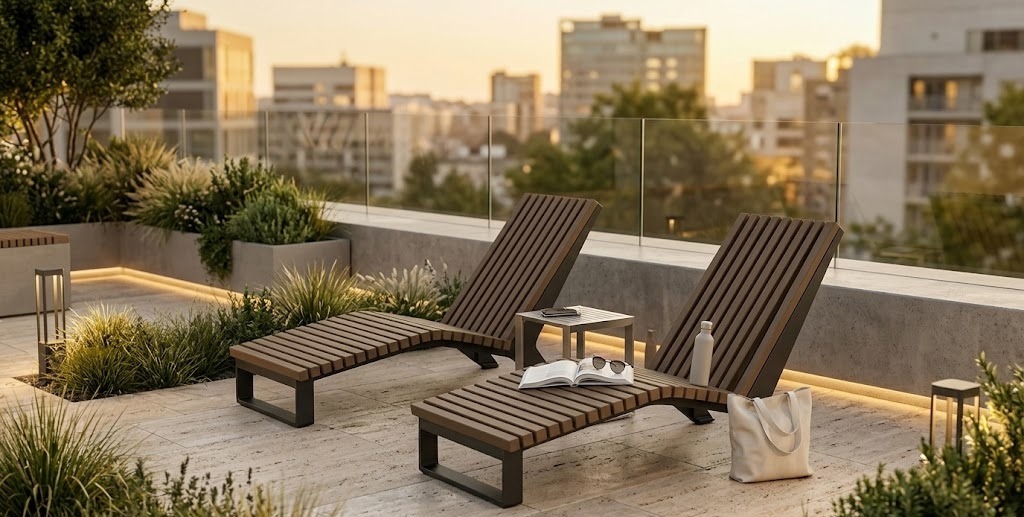
The design of contemporary open spaces has transcended the traditional view that considered street furniture as a simple set of functional transitional elements. Today, the quality of public spaces is measured by their ability to offer comfort, well-being, and inclusiveness to residents and tourists. Choosing the ideal chaise longues for public spaces isn't just an outdoor furniture purchase; it's a strategic investment aimed at converting parks, plazas, waterfronts, university campuses, and shopping centers into true, regenerative "oases of relaxation." Unlike traditional benches, outdoor chaise longues are engineered to support the human anatomy in a reclining position, relieving tension in the spine and extending the length of time spent in shared spaces. This buying guide will guide you through the Holity.co.uk online catalog, analyzing seat materials, cement and metal finishes, ground anchoring methods, and pricing options.
The choice of raw material that makes up the seat determines the thermal inertia, the tactile sensation for the user and the frequency of ordinary maintenance interventions:
The solution of choice for contemporary and modern urban contexts.
The ideal choice for those seeking material warmth and perfect landscape integration.
The cutting-edge response for administrations oriented towards sustainability and the circular economy.
The architecture of the frame or monoblock defines the installation methods and the resistance to uprooting:
Massive structures made of high performance concrete (HPC) or agglomerates of marble and quartz chips.
Slim frames in steel profiles anchored to the ground via flanged plates or anchors to be buried.
Since these are furnishings intended for a heterogeneous user base (children, adults, elderly people, people with reduced mobility), the shape of the seat must balance relaxation with ease of use:
Public seats must comply with stringent technical certification frameworks:
The range available on Holity.co.uk allows you to satisfy both small local redevelopment projects and large competitions for street furniture, moving within a price range between €554.00 and €3005.00:
Enhance the open spaces of your municipality, offer visitors a superior relaxation experience and adapt your street furniture projects to the Minimum Environmental Criteria and European safety regulations. Explore the online catalog on Holity.co.uk to configure your chaise longue: select the seat material (metal, wood or recycled plastic), set the surface finishes and choose the color-decorative combination best suited to your context.
Request a personalized quote today: our sales team is at your disposal to provide you with technical data sheets, dwg drawings, MOCA / CAM certificates and reserved quotes for multiple supply lots.
How does the hot-dip galvanizing and powder coating process insulate metal chaise longues from marine corrosion?
In seaside locations or along the seafront, salt aerosol triggers accelerated galvanic corrosion on untreated metals. Professional-quality chaise longues are subjected to a hot-dip galvanizing process by immersion in a molten zinc vat at 450°C (according to UNI EN ISO 1461), creating a permanent zinc-iron alloy coating on both the inside and outside of the profiles. The structure is then treated with oven-polymerized epoxy powders, which form a hard, non-absorbent, UV-resistant plastic barrier, preventing rust from seeping through even in the event of superficial scratches.
What characteristics of density and static stability make concrete and travertine-effect monoblocks immune to theft and vandalism?
Chaise longues made of reconstituted stone or high-performance concrete (HPC) exploit their own gravitational force as a passive safety system. With a mass between 300 and 600 kg per single module, these products have a static inertia that makes manual movement, tipping, or unauthorized removal impossible without the use of cranes or heavy lifting equipment. Furthermore, the grit or sandblasted concrete surface is treated with invisible water- and oil-repellent protective coatings that prevent spray ink from penetrating the pores, allowing graffiti to be removed with a simple pressure washer.
Why do recycled plastic (WPC) or exotic wood slats guarantee low thermal conductivity under the summer sun?
Unshielded metal materials exposed to summer solar radiation can reach surface temperatures above 60-70°C, making them unusable or posing a risk of burns. Exotic wood (such as Iroko or Teak) and recycled plastic (WPC) are materials characterized by an extremely low thermal conductivity coefficient. This chemical-physical property prevents the accumulation of heat through radiative absorption: the seat surface remains pleasant to the skin even during the hottest hours of the day, ensuring the chaise longue can be used in any season.
How do you calculate the correct spacing and installation distance between chaise longues to ensure safe use and the passage of cleaning vehicles?
When planning the layout of a park or square, it is necessary to provide clear passageways around each chaise longue. To ensure universal accessibility (D.P.R. 503/1996 disability legislation), a minimum lateral distance of at least 90-100 cm must be left between two side-by-side seats, allowing for the easy positioning of a wheelchair. Furthermore, a walkable corridor of at least 120-150 cm must be maintained between the front of the seat and any other obstacles (walls, flowerbeds) to allow the passage of mechanical sweepers and greenery maintenance personnel.
What advantages in terms of Zero Maintenance do recycled plastic chaise longues offer compared to traditional painted wooden seats?
Natural wood seats require periodic maintenance treatments (sanding, application of water-repellent impregnants or anti-UV oils every 12-18 months) to prevent graying, warping of the slats and the formation of splinters. High-density recycled plastic is a rot-proof synthetic polymer matrix, resistant to mold, parasites and sea salts. It does not absorb humidity, does not splinter and does not lose the native color mixed into the plastic mass. This eliminates the costs of ordinary and extraordinary maintenance to be borne by the municipality or managing body for the entire life cycle of the product.
How can we explain the price variability in this category (from €554.00 to €3005.00) in relation to the carpentry workmanship and reconstituted stone finishes?
The price structure is determined by the mass of the materials, the complexity of the design, and the nobility of the surface treatments. The entry-level range (€554.00 - €1200.00) includes essential single chaise longues with a painted steel lattice structure or recycled plastic slats. The intermediate range (€1200.00 - €2000.00) refers to combined metal/pre-treated fine wood modules and compact concrete monoblocks. The higher prices (up to €3,005.00) are reserved for large two-seater chaise longues, reconstituted stone monoblocks with polished travertine-effect finishes, and architectural signature models for the luxury contract sector and the redevelopment of large public works.
 English
  Italian
 French
 German
 Spanish