
mon-fri 9-13 / 14.30-18.30
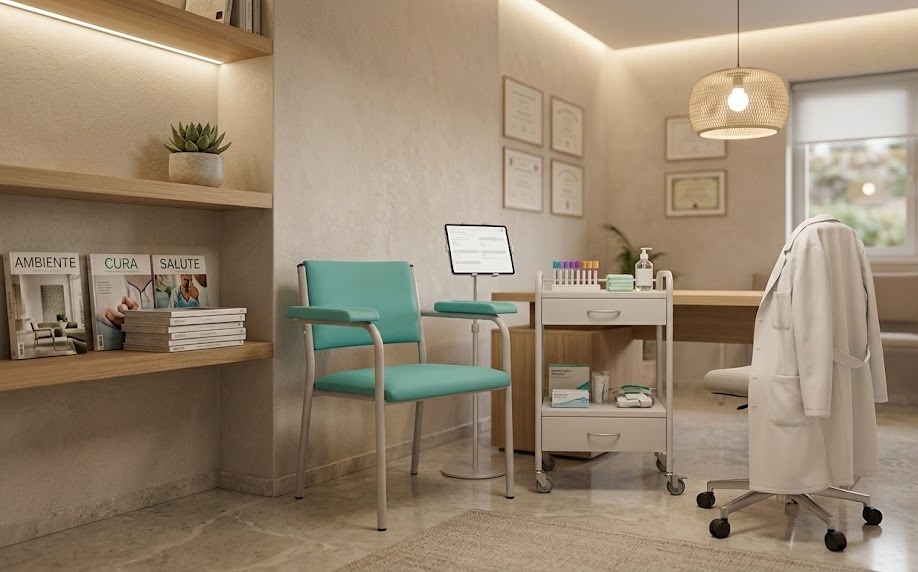
Within a healthcare setting, patient care and safety management during invasive procedures are key factors in establishing a climate of trust and professionalism. Choosing the right blood collection chairs isn't simply a matter of office furniture, but a strategic investment aimed at optimizing operator ergonomics, facilitating venous access, and ensuring maximum patient comfort. Whether setting up a high-volume blood collection center, a blood donation room, a long-term infusion therapy unit, or a vaccination center, having a specialized medical chair drastically reduces the risk of syncope or fainting related to needle anxiety. This buying guide is designed to guide you through the various models available in our online catalog at Holity.com, analyzing adjustment options, dimensional parameters, and the rigorous hygiene and health requirements required in the medical sector.
In the healthcare devices and furniture market, washing and blood sampling chairs are differentiated into macro-constructive typologies, each engineered to respond to specific operational flows and patient dwell times.
They represent the classic entrance configuration, focused on maximum mechanical stability and optimisation of floor space.
Advantages: Extremely solid, robust structures with no moving components requiring complex maintenance. They maintain very compact floor space, facilitating the logistical layout even in small rooms or blood sampling boxes.
Disadvantages: They do not allow millimetric adjustment of the seat height to the height of the healthcare worker.
Ideal for: General practitioner clinics, high-turnover rapid blood collection units and standardised analysis laboratories.
Advanced systems that allow the seat height to be varied from the floor to perfectly align the needle insertion field with the professional's viewing height.
Advantages: They offer unsurpassed operational ergonomics, reducing back and shoulder strain on nurses during intensive shifts. The motorised electric versions allow smooth, smooth and silent millimetric movements via foot pedal or push-button controls, eliminating the physical effort of lifting.
Disadvantages: They require a higher initial investment and, in electric models, proximity to mains power outlets.
Ideal for: Specialised clinics, structured hospital departments and centres where healthcare personnel of different heights work.
Dynamic configurations designed to ensure maximum flexibility of use and ease of reconfiguration of clinical spaces.
Advantages: Wheeled models allow for rapid movement of the station or safe transfer of the patient between different environments without requiring excessive effort. Folding models drastically reduce their geometric volume at the end of the shift, disappearing into dedicated storage spaces.
Disadvantages: They require constant verification of the correct locking of the brakes before starting any collection maneuver.
Ideal for: Temporary vaccination campaigns, mobile collection units, emergency departments and facilities with multipurpose spaces.
Special medical devices, equipped with reinforced frames in high-thickness steel and oversized geometries.
Advantages: They guarantee total structural safety and static stability when welcoming patients with serious obesity or overweight conditions. They offer wide seats 620 mm and over to ensure comfortable sitting without painful lateral compression.
Disadvantages: Footprint and structural weight of the furniture are more significant than standard variants.
Ideal for: Bariatric centers of excellence, specialized clinics and highly inclusive hospital internal medicine departments.
To configure a high-performance medical sampling station in line with hygiene regulations, it is essential to set the search parameters by calibrating the geometric specifications and materials.
The dimensions of the furniture must guarantee perfect postural comfort, especially during prolonged treatments. Our catalogue allows for a targeted selection of measurements:
Patient weight is a critical variable for the life of the frame. Standard chairs cover load capacities between 130 kg and 150 kg, suitable for the vast majority of the population. To ensure operational safety and ensure a wide structural margin, the reinforced and bariatric versions extend the certified load capacity up to 300 kg of distributed static load.
In the medical-health sector, surfaces in contact with the patient must absolutely counteract microbiological proliferation. The upholstery of our armchairs uses high-quality non-porous materials:
Hospital examination and treatment chairs must be provided with CE marking in full compliance with the European directive 93/42/EEC (Medical Devices) and subsequent updates of the MDR Regulation. From the point of view of mechanical robustness, they comply with the EN 12521 standard for the safety and structural stability of furniture for public use. For models equipped with electric motors, compliance with the electrical safety and electromagnetic compatibility standards EN 60601is mandatory, ensuring total protection against short circuits and malfunctions in the presence of other clinical machinery.
Municipal Analysis Laboratories and High Turnover Blood Collection Units: We recommend the use of fixed or mechanically adjustable height chairs with a standard load capacity (130-150 kg), equipped with removable and contoured armrests. This configuration optimises costs, takes up little space and speeds up the daily boarding and alighting of passengers/patients.
Transfusion Centres, Blood Donation Areas and Infusion Therapies: In these contexts, where the patient remains seated continuously for 2 to 4 hours for IVs or important blood collections, the priority is postural comfort. It's essential to invest in professional reclining chairs (electric or hydraulic) with a 180° adjustable backrest, adjustable legrest, padded headrest, and integrated accessories such as an IV pole and urinary support.
Vaccination Centers, Mobile Units, and Emergency Stations: The ideal choice is wheeled models with a centralized foot brake or ultra-lightweight folding versions. They allow for rapid site logistics, facilitate immediate access to the patient's arm, and reduce structural bulk in warehouses at the end of the medical campaign.
Raise the standards of medical reception in your clinics, protect the health of your patients, and ensure maximum operational ergonomics for your nursing staff. At Holity.com, you'll find a comprehensive assortment of over forty models of professional blood sampling chairs, designed to effectively meet any technical specification and budget. Our selection covers a flexible price range, from simple and affordable fixed chairs (starting at €343 + VAT), to professional reclining models (ranging between €500 and €1,100 + VAT), to premium bariatric and motorized chairs (between €900 and €1,500 + VAT).
Use our side navigation filters to select the structural type (fixed height, adjustable, on wheels, or bariatric) and configure the dimensional sliders based on the floor plan of your premises. If you manage purchases for a public healthcare company (via e-procurement channels such as MePA), for a private clinic or you need a dedicated quote for large batches and multiple supplies, contact our customer service today to receive complete technical data sheets and a personalized quote.
How does the mechanical or servo-assisted activation of the anti-shock position (Trendelenburg) in blood sampling chairs work?
In professional hydraulic or mechanical models, the emergency transition to the Trendelenburg angle (-12° / -15°) is governed by a pair of hydraulic pistons or gas springs with servo-assisted activation. By pressing a special bilateral lever located on the backrest, the kinematic mechanism instantly lowers the backrest while simultaneously raising the legrest in less than two seconds. This immediate mechanical response is essential to reverse hemodynamic vectors and restore cerebral blood flow in the event of sudden hypotensive crises or vasovagal syncope.
What degrees of adjustment and axial freedom (3D) must armrests have to ensure optimal venipuncture?
To stabilize the forearm at the correct visual height with respect to the patient's axillary line, professional armrests integrate a three-dimensional (3D) ball joint. This engineering system allows for millimetric adjustment of the zenith height, sliding of the longitudinal axis and 360° horizontal rotation with mechanical friction locking. The upper cradle, moulded in flexible cold-foamed integral polyurethane, welcomes the limb, eliminating the reflex micro-muscle movements induced by needle anxiety.
What electrical insulation and IP class specifications must the motors of automated blood collection chairs comply with?
Linear actuators and control units dedicated to medical furniture operate at very low safety voltage (24V DC) and must be certified according to the insulation requirements of the EN 60601-1 standard (Medical electrical equipment). In terms of protection from external agents, the integrated motors and control pedals must declare a minimum insulation level of IPX4 (up to IPX6 for floor controls), guaranteeing a total hermetic barrier against accidental infiltration of liquid detergents or biological fluids during washing.
How does the structure of heavy bariatric models distribute vector forces when the backrest is reclined to 180 degrees?
In bariatric chairs designed for static loads of up to 300 kg, the risk of centre-of-centre tipping when the backrest is positioned in bed position (180°) is eliminated by a pantograph frame with a widened base and lowered centre of gravity. The chassis geometry transfers the weight vectors onto solid longitudinal rails or onto twin wheels equipped with total brakes. This prevents elastic structural deformations or lateral dynamic pitching phenomena when the patient shifts his or her mass.
What chemical and microbiological resistance protocols must the polymeric covering for Bathrooms and Laboratories pass?
The high-end leatherette and medical vinyls are treated to withstand severe chemical stress in compliance with ISO 10993-5 guidelines (biocompatibility and cytotoxicity). The non-porous polymeric surface is formulated not to undergo structural alterations, stiffening or hydrolysis when exposed to concentrated hospital disinfectants based on hydrogen peroxide, sodium hypochlorite (up to 1%) or alcohol solutions, ensuring the complete removal of biological exudates and blood spills without damaging the padding.
What is the difference between synchronized movement adjustment systems and independent dual-zone models?
Synchronized movement systems (single-actuator) vary the angle of the backrest and leg rest simultaneously following a fixed geometric articulation. In contrast, the independent dual-zone configuration uses separate actuator modules (mechanical or electrical), allowing nursing staff to modulate the posture of the trunk while leaving the height of the lower limbs unchanged. This flexibility is crucial for patients with severe joint stiffness or cardiovascular conditions who require a customized postural adjustment.
 English
  Italian
 French
 German
 Spanish