
mon-fri 9-13 / 14.30-18.30
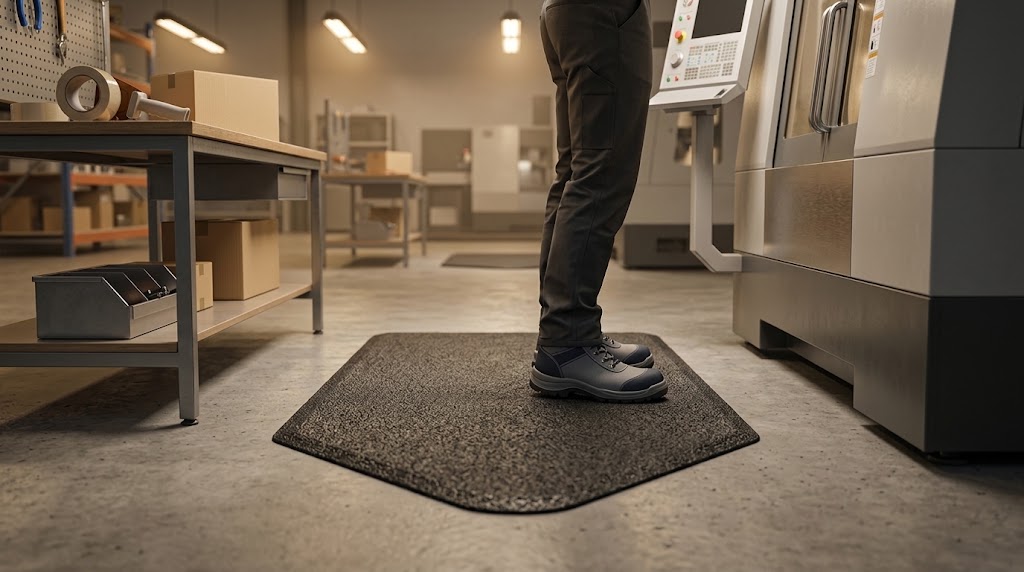
In assembly lines, laboratories, fixed workstations, and some areas of professional catering, prolonged standing on hard surfaces can increase fatigue and discomfort in the legs, feet, and lower back. Anti-fatigue mats create a more resilient surface than the floor and can contribute to comfort during prolonged standing. However, they are no substitute for correct ergonomic design of the workstation, breaks, changes in posture, or suitable footwear. To choose the right model, it is necessary to evaluate the environment, presence of liquids, material, thickness, edges, and declared technical characteristics.
The first distinction concerns the surface structure and the conditions of the work area.
Solid models have a continuous surface and are generally suitable for dry workstations. The Holity catalogue includes versions in expanded PVC, polyurethane and technical foams, with ribbed, diamond or bubble finishes.
Perforated models allow liquids and small residues to pass through the openings, reducing stagnation on the walking surface. This configuration can be useful in workshops, production departments or other areas where spills may occur.
The material influences elasticity, wear resistance and behaviour in the presence of oils or other fluids. There is no single best compound: the choice depends on the environment and the substances present.
It is not correct to consider all rubber mats immune to oils, greases, solvents or aggressive detergents. If specific substances are used in the area, always check the compatibility declared by the manufacturer.
The Holity catalogue features mats with different thicknesses, approximately 10 to 20 mm. The thickness affects the sensation of cushioning, but does not alone determine comfort, stability or durability: the density, elasticity and structure of the material also count.
Safety features vary between different mats. Some models have anti-slip tests or classifications, while others declare self-extinguishing properties or specific fire resistance classifications.
The range includes compact mats for a single workstation and longer formats intended for large work areas. Before purchasing, measure the area actually used by the operator and check that the mat does not interfere with doors, machinery, passageways or other equipment.
The price depends mainly on size, material, thickness, structure and technical characteristics. Since prices and availability may change, it is preferable to compare the products in the catalogue rather than associating rigid price ranges with a specific type.
Explore the selection of Anti-fatigue mats on Holity and compare the models based on the type of surface, material, thickness, size, environment of use and any anti-slip or fire resistance characteristics.
For supplies intended for factories, laboratories, workshops, professional kitchens or public bodies you can request a personalised quote indicating the size of the area, conditions of use and quantities required.
What is an anti-fatigue mat and how does it work?
It is a resilient surface intended for workstations where people work standing for long periods. It can help reduce discomfort and fatigue compared to standing on a rigid surface, especially if included in a correct ergonomic work organization.
What are the differences between a solid and a perforated model?
The solid model has a continuous surface and is generally suitable for dry environments. The perforated model allows drainage through the openings and is useful when liquids may be present, provided that the material and characteristics of the product are compatible with the environment.
Which material should I choose in the presence of oils or greases?
It is necessary to choose a mat for which resistance to the fluids present is expressly declared. The presence of NBR or a specific indication of resistance to oils and greases is a useful piece of information, but does not imply compatibility with any hydrocarbon, solvent or detergent.
How do you choose the ideal thickness?
There is no universal thickness related to the number of hours worked. Different thicknesses are available in the catalogue: the choice must consider elasticity, stability, movement area and characteristics of the specific workstation.
Are anti-fatigue mats compatible with trolleys and pallet trucks?
Not necessarily. The bevelled edges facilitate the connection with the floor, but the possibility of transit with wheels or loads must be expressly provided for by the manufacturer.
What anti-slip certifications must they have?
There is no single mandatory class for all environments. It is necessary to check the tests and classifications declared for the individual mat and compare them with the actual risks of the workstation.
 English
 Italian
 French
 German
 Spanish