
mon-fri 9-13 / 14.30-18.30

Work harness h1053_01 with adjustable straps, rear eyelet, and safety belt. Available in sizes S, M/L, and L-XL.

Fall arrest harness h1053_02 in 45 mm polyester and forged steel (1700 g). Total safety at height with quick-release buckles.

Safety harness for working at heights integrated into a high-visibility yellow vest h1053_03. Quick-release closures and rear anchorage. Sizes S-XL.

Professional fall arrest harness h1053_04 with side rings, quick release and 170 mm padding. Comfort and safety for work at height.
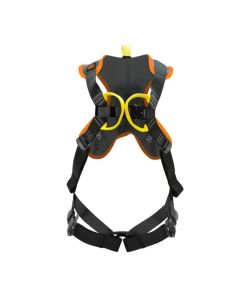
h1046_11 work harness in HT polyester with raised dorsal attachment. EN 361 certified, tested to 150 kg, ideal for rescue.
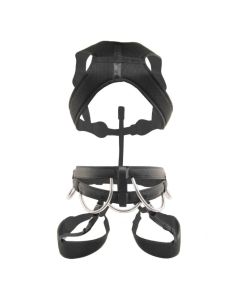
Professional safety harness h1046_14 black for work at height and rescue. Modular with removable upper part. Tested to 130 kg.
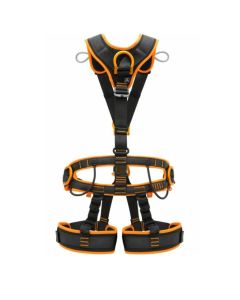
Professional h1046_12 harness for work and positioning. Lightweight, modular, 3 attachments, NFC chip and compliant with EN 361 standard.
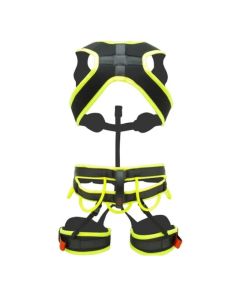
h1046_13 safety harness in HT polyester with AISI 316 stainless steel automatic buckles. Ideal for rescue and helicopter rescue.
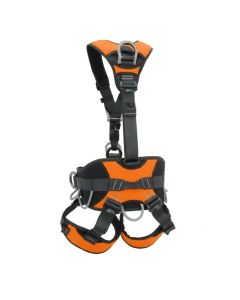
Work harness h1046_09 with 5 attachment points and NFC chip. Top of the range for rope access work, certified EN 361, EN 358, EN 813.
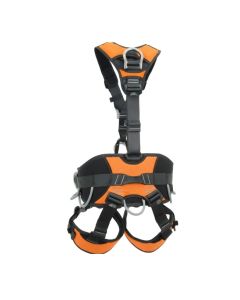
Fall arrest harness h1046_10 complete with 5 attachment points, Cobra® buckles and NFC chip, for rope access and rescue. Tested to 150 kg.
Work harnesses represent the fundamental core of individual fall protection systems, essential elements to guarantee the safety of operators in multiple industrial and civil scenarios. Choosing the right equipment is not only a specific legal obligation but constitutes the pillar upon which risk management in the most complex operational contexts is based. Every device integrated in this section is designed to uniformly distribute the impact forces generated by a sudden deceleration, drastically reducing suspension trauma and preserving the physical integrity of the worker. The transition towards increasingly stringent safety standards requires in-depth knowledge of technical material specifications, certifications, and attachment methods.
Through ergonomics-oriented design, modern restraint and fall arrest systems combine maximum structural strength with the necessary freedom of movement, allowing work at high elevations while reducing muscle fatigue during long usage sessions. It therefore becomes essential to evaluate every single constructive detail, from safety stitching to dorsal and sternal anchorage points, to configure a protected workstation fully compliant with current regulations in various professional sectors.
The adoption of adequate work safety harnesses is the discriminating factor between an operation conducted under high-risk conditions and an intervention carried out according to the highest radiation protection standards. The benefits deriving from the use of these specialized devices lie in their ability to intercept a fall before the operator can impact underlying structures or the ground, dissipating kinetic energy in a controlled manner through interaction with energy absorbers and dedicated lanyards. Beyond the purely life-saving aspect, the use of an ergonomic containment structure significantly improves the worker's posture during prolonged suspension or positioning work, preventing occupational pathologies affecting the spine and circulatory system.
Integrating these supports into industrial maintenance, systems engineering, and construction sectors allows for complex interventions to be handled with greater operational serenity, consequently increasing the precision and efficiency of workers in the field. The high-tech materials used in webbing construction, such as high-tenacity polyesters and aramid fibers, guarantee extraordinary resistance to abrasion, ultraviolet rays, and aggressive chemicals, ensuring a product longevity that translates into an optimal investment for companies that prioritize the protection of their personnel.
The classification of body protection devices is structured according to specific attachment architectures and the operational contexts for which they were developed. Within the range, basic models with two anchorage points are distinguished, typically equipped with sternal and dorsal attachments, ideal as a generic fall arrest harness for simple restraint or for combined use with horizontal and vertical lifelines. For scenarios where the operator must keep their hands free and remain in a certain position for long periods, versions equipped with an integrated positioning belt are available, provided with adjustable lateral rings that allow connection to adjustable restraint lanyards.
There are also ultra-specialized variants intended for rope access work and rescue, characterized by a lowered ventral attachment point that optimizes weight distribution during rope ascent or descent, reducing chest bulk and improving the user's center of gravity. Materials vary from traditional water-repellent polyester straps to solutions with specific dielectric treatments for electricians or flame-retardant treatments for welders, ensuring that each variant responds perfectly to the thermal or chemical stresses of the surrounding environment, with metallic finishes in galvanized steel or lightweight aeronautical aluminum alloys to combine structural robustness and containment of the overall equipment weight.
Selecting the ideal device requires careful preliminary analysis relating the operator's physical characteristics to the geometric and environmental specificities of the worksite. A recurring error lies in neglecting fit and ease of adjustment, factors that determine the real effectiveness of the system in case of dynamic stress; to overcome this problem, various sizes are available with wide margins for millimeter adjustment through quick-adjustment buckles or automatic interlocking buckles. The presence of ergonomic padding on shoulders, leg loops, and lumbar belt represents a fundamental selection criterion for anyone who must wear the equipment for the entire work shift, as it prevents skin chafing and optimizes load distribution by reducing localized pressure points that could compromise peripheral circulation in the lower limbs.
It is equally indispensable to evaluate the available fall clearance (safety distance) at the site, i.e., the free space needed under the operator's feet to ensure that the fall stops safely before contact with the ground, directing the choice towards systems with more or less flexible dorsal attachments or integrating the harness with self-retracting lifelines. Common mistakes like using pure positioning models where a real risk of free fall from height exists must be avoided, as the lack of shoulder straps and a true thoracic suspension system would cause very serious injuries to the lumbar area in case of a violent arrest, making coordination between the harness type and other elements of the safety chain imperative.
Every device placed on the market must respond to strict European certification protocols that attest to its suitability for professional use through extremely rigorous static and dynamic strength tests. The fundamental framework standard is EN 361, which defines requirements, test methods, and mandatory marking for systems designed for final fall arrest, specifying the geometric characteristics that webbing and main attachment points must possess to be approved. When the equipment integrates subsidiary functions, such as maintaining the work position or preventing a fall, additional directives established by the EN 358 standard come into play, governing positioning belts and lanyards, ensuring that lateral loads are managed without inducing permanent deformations or fabric failure.
For more complex contexts where rope access or positioning is necessary, products must also possess EN 813 certification, relating to sit harnesses for suspension work, ensuring that the ventral attachment point is tested for prolonged loads and controlled descent maneuvers. Employers and safety managers are required to verify the presence of the CE marking, the user manual in the local language, and the register of periodic inspections, remembering that regulations impose a thorough review at least annually by a competent technician or the manufacturer themselves, aimed at verifying the absence of cuts, fraying, metal oxidation, or chemical alterations that could undermine the structural integrity of the entire protection system.
Explore all products in the category and compare available solutions to find the one best suited to your operational context.
Measurement is carried out by taking the circumference of the chest, waist, and thighs over work clothes. Most professional models offer wide adjustments, but consulting the manufacturer's size charts is essential to avoid leg loops being too tight or shoulder straps too loose.
The dorsal attachment is the standard system for stable fall arrest, as it keeps the body in an upright position after impact. The sternal attachment is mainly used for work on fixed ladders with guided fall arrest systems, in rescue, or where close-up frontal restraint is required.
The maximum total lifespan set by manufacturers usually varies between 5 and 10 years from the date of manufacture, even if the equipment has never been used. However, the device must be immediately withdrawn from service in the event of a fall arrest or if the annual inspection reveals structural defects.
Before each use, it is mandatory to visually inspect the integrity of safety stitching, the absence of cuts or abrasions on textile webbings, and the correct operation of metal closure buckles. Any trace of chemical contamination, burns, or mechanical deformation requires immediate decommissioning of the equipment.
No, belts adjustable according to the EN 358 standard are not designed to arrest a free fall from height, as the impact on the pelvis would cause very serious trauma. They must be used exclusively for restraint or positioning, always combining them with a complete EN 361 certified system in the presence of a fall risk.
Devices intended for construction sites must feature high resistance to abrasion from dust and friction against rough surfaces. Models with corrosion-protected metal components and water-repellent treated webbing are recommended, combined with quick buckles to facilitate donning in dusty and muddy environments.
 English
  Italian
 French
 German
 Spanish