
mon-fri 9-13 / 14.30-18.30
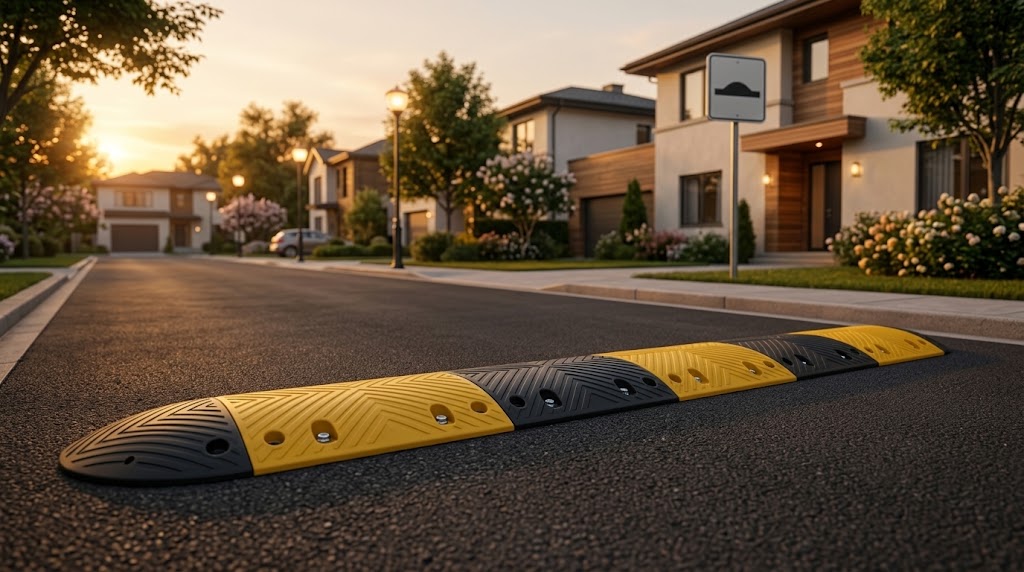
Ensuring the safety of people along transit routes, in company or commercial parking lots, and in residential contexts requires effective traffic calming solutions. Choosing the right speed bumps doesn't simply mean placing a bump on the asphalt, but installing a passive safety device capable of progressively reducing vehicle speed, without causing damage to the vehicles or endangering the stability of two-wheeled vehicles. From limited traffic zones (Zone 30) to high-traffic loading and unloading lanes, adopting the right speed bump allows you to protect the safety of pedestrians and reorganize traffic flow. This buying guide analyzes the range in the Holity.co.uk catalog, guiding you through approved heights, tonne capacity, vulcanized rubber materials, cleating methods, and regulatory frameworks.
The effectiveness and compliance of a speed bump depend on its transverse geometry, which must be proportionate to the speed limit it is intended to enforce:
The ideal solution for smooth traffic calming along moderate-speed stretches.
The standard option for the protection of intersections, residential areas and commercial avenues.
Highly effective slowing barrier for the protection of areas with very high pedestrian risk.
Construction materials must guarantee grip, elasticity and resistance to the impulsive stresses induced by vehicles:
Professional speed bumps use a system of interlocking modular components:
The installation of speed bumps on public and private roads open to public transit is subject to specific legislative constraints:
The range on Holity.co.uk allows you to satisfy both the safety of a private entrance and the supply of barriers for large shopping centres, moving within a price range between €135.00 and €674.00 for composition kits:
Make your company's pedestrian routes safe, adapt the traffic flow of your commercial car park and protect residential areas with the speed bumps available on Holity.co.uk. Explore our online catalog to select the ideal model: set the height (3 cm, 5 cm or 7 cm), define the roadway size (from 2300 mm to 5200 mm) and check the included anchoring kits.
Request a personalized quote today: our sales team is at your complete disposal to provide you with technical data sheets, material certificates and reserved offers for batch purchases.
How do you correctly fix modular rubber speed bumps to asphalt or concrete?
Speed bumps are installed by drilling holes in the road surface using a hammer drill, corresponding to the countersunk holes on each module. Special nylon expansion bolts or mechanical steel anchors equipped with hexagonal head bolts and washers are inserted into the holes. When the screws are tightened, the anchor expands within the asphalt, ensuring mechanical adhesion capable of withstanding the strong tangential thrust stresses exerted by braking vehicle wheels.
What operational differences are there between installing rubber speed bumps and traditional bitumen or concrete speed bumps?
Modular vulcanized rubber speed bumps offer clear advantages over asphalt pavements: they can be installed in minutes without blocking traffic for days, they guarantee a uniform height and shape certified to the millimeter, they can be dismantled and repositioned elsewhere in the event of road excavations, and they are equipped with integrated reflective tiles that do not fade like paint spread on asphalt.
How do retroreflective inserts and cat's eyes improve safety when driving at night?
During night-time hours or in foggy conditions, the artificial obstacle positioned on the roadway risks not being spotted in time by the driver. The yellow/white elastoplastic tiles and the reflective glass micro-prisms (cat-eyes) inserted into the modules capture the light emitted by the headlights of oncoming vehicles and reflect it back towards the driver's eyes, making the profile of the speed bump perfectly visible from tens of meters away.
Are modular rubber speed bumps suitable for the continuous transit of forklifts and tractor-trailers in logistics complexes?
Yes, provided that models specifically designed and tested for heavy loads are chosen. These speed bumps use high-density vulcanized rubber compounds with high Shore hardness and reinforced internal reinforcements. This structure prevents the heavy vehicle's tire from crushing the module or tearing the fixing points to the ground, ensuring multi-year durability even in industrial loading bays.
How does the price range for the category (€135.00 - €674.00) correlate with the length of the line, the height of the modules and the included fixing kits?
The price structure is determined by the total mass of vulcanized rubber used, the linear length covered and the height of the modules. The entry-level range (€135.00 - €280.00) includes flat modular compositions of 3 cm or 5 cm for narrow openings (2.3 - 3 metres). The intermediate range (€280.00 - €450.00) includes standard compositions of 3.5 - 4 metres of 5 cm or 7 cm complete with rounded ends. The top-of-the-range prices (up to €674.00) are reserved for large, high-length modular barriers (from 4.5 to 5.2 metres) 7 cm high for Zone 30, reinforced for heavy loads and equipped with a professional anchoring kit included.
 English
  Italian
 French
 German
 Spanish