
mon-fri 9-13 / 14.30-18.30
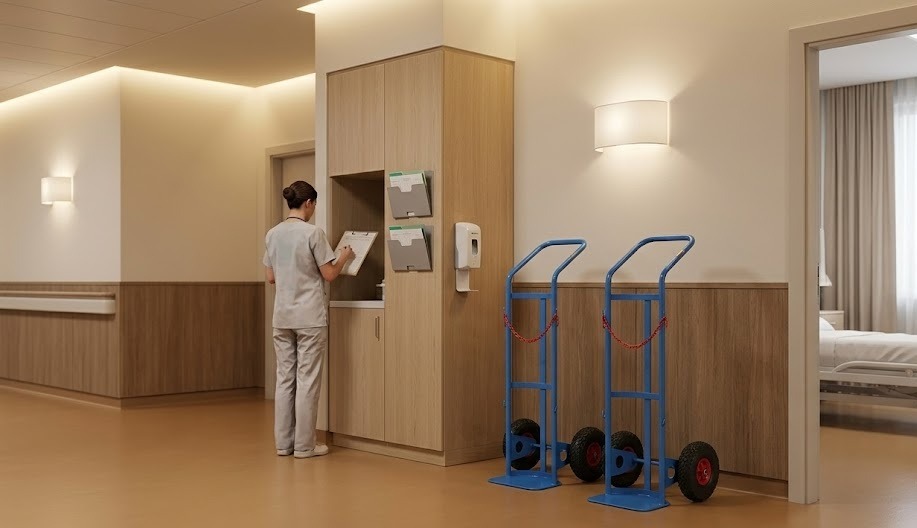
In healthcare, emergency care, hospital wards, nursing homes, and home care, the management of medical gases, and in particular the transport of compressed oxygen, is a daily operation with a high level of safety. Choosing the right oxygen cylinder cart doesn't simply mean purchasing a wheeled support, but providing operators with an ergonomic aid capable of eliminating the risk of the cylinder falling, preventing injury to the delivery valves, and reducing biomechanical strain during handling. From small 5-liter portable cylinders for patient therapeutic continuity to large 50-liter cylinders for ward reserve or double-seater anesthesia trolleys, the choice of device must guarantee anti-tip stability, easy sanitization and compliance with European standards on medical devices. Holity offers professional solutions designed for every need: this purchasing guide analyses volumes, cylinder diameters, frame types and current regulatory frameworks.
The geometry of the trolley must be selected based on the volume of the cylinders supplied to the facility and the frequency of movement:
The most agile and compact solution for serving hospital beds, for outpatient centers and for home transport.
Reinforced structures for the storage and handling of large volumes of medical gas.
Systems designed for combined administration or to guarantee an emergency reserve.
Multifunctional aids equipped with two additional rear swivel wheels.
An accidentally dropped oxygen cylinder could cause the pressure reducer to break or turn into a high-pressure projectile if the valve is severed. For this reason, professional trolleys integrate rigorous locking devices:
Construction materials must meet criteria of mechanical resistance, rust resistance and tolerance to sanitary disinfectants:
The use of trolleys for the transport of medical gases in the healthcare sector is subject to specific legal requirements:
The range on Holity.co.uk guarantees maximum flexibility for every corporate or private purchasing plan, moving within a price range between €80.00 and €767.00:
Secure your hospital departments, equip your care team with ergonomic aids and ensure the continuity of oxygen therapy with complete peace of mind with the oxygen cylinder trolleys available on Holity.co.uk. Explore the online catalogue to select the most suitable model: set the cylinder capacity (from 5 to 50 litres, or two-seater), choose the type of frame (single-seater, convertible to 4 wheels) and identify the material best suited to your environment.
Request a personalized quote today: our sales team is at your complete disposal to provide you with quoted technical data sheets, CE certificates of conformity and reserved offers for multiple purchases in batches.
How do I calculate the correct compatibility between the diameter of the trolley and the supplied oxygen cylinder?
To ensure stable mounting without oscillation, it is necessary to check that the external diameter of the metal cylinder corresponds to the tolerance of the trolley's housing. Small cylinders from 3 to 5 litres typically have a diameter of approximately Ø 110-140 mm; cylinders from 7 to 14 litres are around Ø 140-160 mm; while high-capacity cylinders from 40 to 50 litres measure between Ø 200 mm and Ø 230 mm. Choosing a multi-calibre trolley with adjustable traction belts allows you to safely accommodate even cylinders with diameters slightly smaller than standard.
What operational advantages do 4-wheel transformable trolleys offer for nursing staff in hospitals?
In traditional 2-wheel trolleys, the operator must tilt the load towards himself and maintain a constant push to support part of the weight of the cylinder throughout the entire journey. Transformable trolleys have a reclining rear frame equipped with two additional swivel wheels: by lowering the frame, the trolley rests entirely on 4 wheels and the weight of the cylinder is discharged 100% to the ground. The operator simply has to guide the aid without applying any lifting force, reducing stress on the spine to zero and eliminating the risk of the trolley slipping out of hand.
Why is the presence of the rigid containment ring combined with the strap mandatory for accident prevention?
The compressed oxygen cylinder has a high centre of gravity. The rigid metal ring positioned halfway up the trolley prevents the cylinder from tipping sideways in the event of a collision with an obstacle or a door. The high-tenacity nylon safety strap on the ring secures the cylinder against the upright backrest, preventing the inertia of the movement from causing the cylinder to slide upward or forward during sudden braking, protecting the valve and pressure gauge from destructive impacts.
In which healthcare settings is it essential to choose a cylinder trolley made of AISI 304 stainless steel?
AISI 304 stainless steel is the essential choice for trolleys intended for operating theatres, intensive care units, infectious disease wards, and all environments subject to rigorous sanitization protocols with virucidal chemicals based on sodium hypochlorite, hydrogen peroxide, or concentrated alcohol. Stainless steel has no surface paint that could flake off and does not rust even in the presence of constant humidity, ensuring compliance with hygiene standards and an unlimited lifespan.
How does the price range in the category (€80.00 - €767.00) correlate with the cylinder volume, the materials and the number of seats?
The price structure is determined by the mass of the frame, the quality of the materials and the mechanical configuration. The entry-level range (€80.00 - €180.00) includes the essential single-seater trolleys in painted steel for small 5-10 litre cylinders. The intermediate range (€180.00 - €400.00) includes trolleys for large 40/50 litre cylinders, the two-seater models (2 x 10 litres) and the lightweight trolleys in anodised aluminium. The top-of-the-range prices (up to €767.00) are reserved for professional transport stations made entirely of AISI 304 stainless steel, for transformable 4-wheel self-stabilizing trolleys and for resuscitation models equipped with instrument holders and IV hooks for contract clinical use.
 English
  Italian
 French
 German
 Spanish