
mon-fri 9-13 / 14.30-18.30
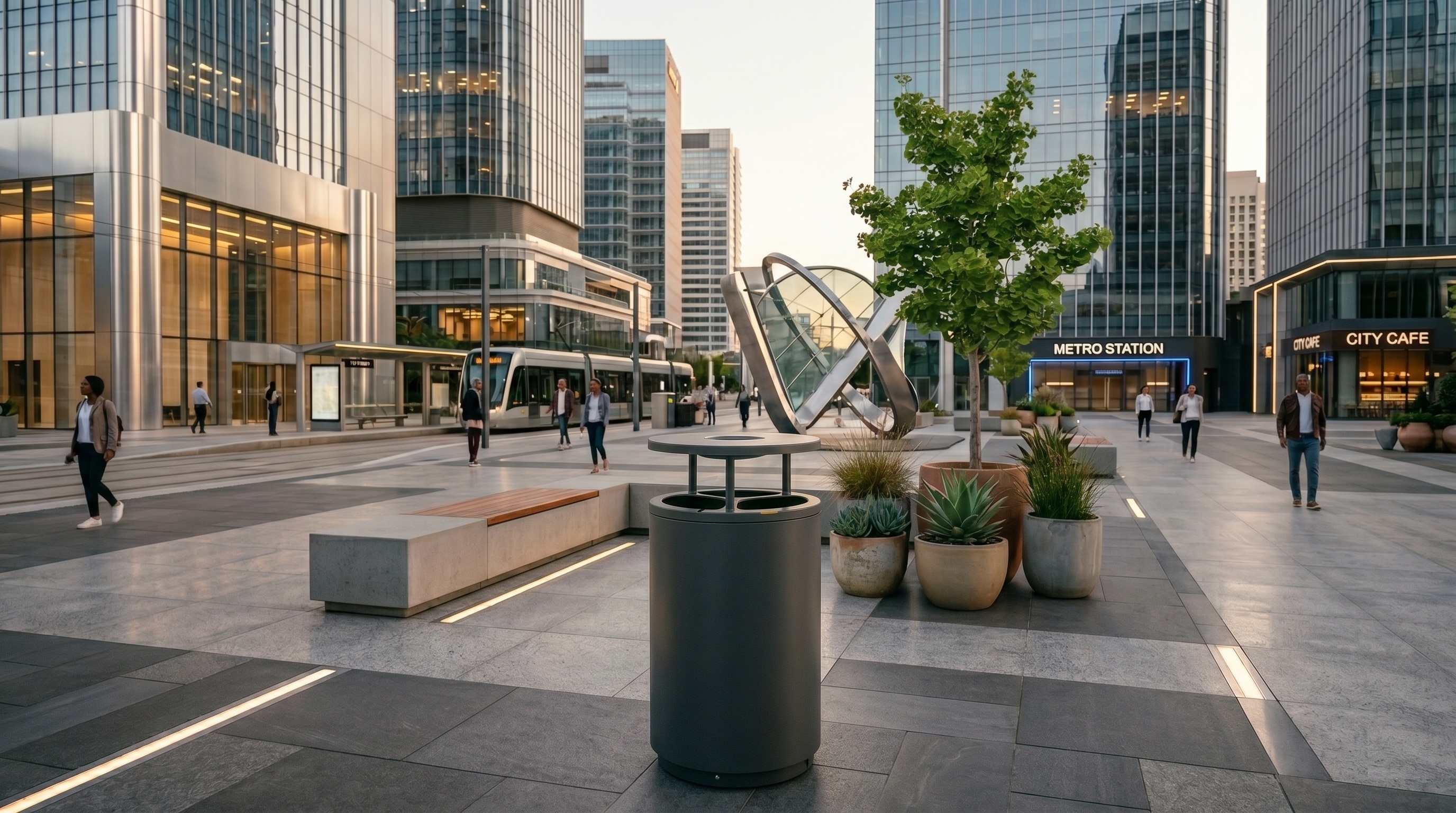
Street furniture is the true calling card of a city, a park, or the outdoor area of a company. How many times have you happened to stroll through a beautiful historic center, or stop in the garden of a hospitality facility, and noticed that the beauty of the place is compromised by litter on the ground or general disorder? The decorum of an environment defines its dignity and the care given to its guests and citizens.
To keep outdoor spaces clean, welcoming, and livable, outdoor waste bins are your main allies. Today, these elements are no longer simple "garbage cans," but true design objects designed to integrate harmoniously into the landscape, withstand the elements, and facilitate the work of sanitation workers. We at Holity will help you choose the perfect model for your needs: whether you need to furnish an elegant city square, a natural park, a company parking lot, or a condominium, here are all the aspects to consider for a safe and long-lasting purchase.
The material is the first factor to consider, because it will determine the bin's resistance to the weather and possible vandalism, as well as defining its aesthetics.
Steel for maximum versatility and design
Steel is by far the most widespread and appreciated material. To withstand outdoor use, it is subjected to galvanizing processes that protect it from rust, and then painted with thermosetting powders. This process not only allows for excellent anti-corrosion protection, but also allows you to choose from a wide range of colored finishes and modern designs. If your property is located in a seaside location or in a very humid and saline environment, the obvious choice is stainless steel: its chemical composition creates a natural barrier that is resistant to corrosion, guaranteeing a lifespan of several decades.
Wood for harmony with greenery
When you have to furnish a park, a farmhouse or a nature trail, wood is the most elegant and discreet choice. Nordic pine is usually used, a sturdy material that is treated with special impregnants to make it water-repellent and resistant to UV rays. A wastebasket with wooden slats blends in perfectly with the surrounding nature, requiring only minimal periodic maintenance to keep its colour alive.
Concrete for areas at risk of vandalism
Service stations, isolated car parks, large shopping centres: in these places, sturdiness is everything. Concrete (or reconstituted stone) bins are the vandal-proof solution par excellence. Their heavy weight makes them immovable and impossible to tip over. Furthermore, they are available in beautiful finishes such as washed gravel, marble white, or Verona red, making them suitable for residential contexts and tree-lined avenues.
Plastic for lightness and zero maintenance
If you are looking for a practical, economical solution that requires no maintenance whatsoever, high-density polyethylene (with UV protection) is perfect. The high-quality plastic does not rust, does not absorb moisture, and is highly resistant to impacts, making these bins ideal for apartment buildings, schools, play areas, and sports centers.
Evaluating the available space and the type of flooring will help you choose the most convenient fastening system.
If you need to optimize space, perhaps in narrow alleys, porches or near entrances, the wall-mounted bins or those that can be attached to pre-existing poles (such as those for signs or lighting) are the least cumbersome solution.
For open areas such as squares and sidewalks, the floor-standing models offer various options: they can be anchored to the pavement using bolts (if you have a solid concrete or tile base) or embedded, that is, buried directly into the ground for maximum stability. As we have already mentioned, the concrete models and those with a weighted base are instead self-supporting: just position them and their own weight will act as an anchor, also allowing you to move them in the future if necessary.
A bin that is beautiful but difficult to empty will soon become a problem for those who take care of the cleaning. For this reason, carefully evaluate the opening mechanism. The most practical models offer the tipping or frontal rotation of the bin (often unlocked with a universal key), the hinged opening with frontal extraction of the container, or the classic extraction from above.
To maintain visual order and facilitate maintenance, we strongly recommend that you choose models equipped with a removable internal container in sheet metal or a bag-holding ring: in this way the plastic bag will remain firmly inside without protruding unsightly from the edges.
Finally, an accessory that really makes a difference for urban decor is the integrated ashtray. Placing containers with ashtrays in break areas, outside offices or in city centres is essential to prevent cigarette butts from being thrown on the ground, ensuring an environment perceived as being cared for in every detail.
Whether you are looking for a single unit for your outdoor area or you need to plan the supply for an entire municipality, careful planning will save you time and resources. It is always preferable to distribute several bins of an appropriate size along the paths, rather than installing a few but too large ones, to encourage people to use them without having to move too far.
Are you ready to renovate your outdoor spaces? We invite you to explore our full range by visiting the section dedicated to outdoor waste containers on Holity.co.uk.
Request a personalized quote today: we will provide you with dedicated advice, technical data sheets and confidential quotes tailored to your project.
Is there a big difference between using galvanized steel and stainless steel?
Yes, the difference is substantial depending on the climate. Galvanized steel (and then painted) is perfect and long-lasting for most urban contexts. However, if the bin is to be placed in a marine environment, the high salinity will attack the galvanizing within a few years. In coastal or very humid areas, stainless steel is the only choice that will guarantee total resistance to rust for decades.
What capacity should a litter bin have for a busy park?
It depends on how often your operators empty it. For a park with 500-1000 people a day, the ideal is to focus on bins between 80 and 120 liters, scheduling emptying every other day. A helpful tip: it's always better to place several 60-80 liter bins well-distributed, rather than a single large bin that could fill up in a messy way.
Are wooden-lined bins difficult to maintain?
They require minimal but necessary maintenance. The internal steel load-bearing structure is not damaged, but the external wooden slats, being a living material, should be treated every 1 or 2 years with protective oils or impregnators specifically designed for outdoor use. This small measure will keep the wood nourished, water-repellent, and visually splendid over time.
How do you manage outdoor waste sorting? Is it better to have a single bin or multiple containers?
Multi-compartment bins (so-called compact "recycling islands") are aesthetically very clean and save space. However, separate bins placed side by side offer greater flexibility: if one type of waste fills up more quickly, you can empty only that bin, and in the event of damage, you only have to replace one unit. The choice depends mainly on the space available and the style you want to give to the area.
Can the concrete bins be moved once they've been positioned?
Models with a concrete or stone base are designed to be "removable," meaning they don't require holes to be drilled into the ground, but their stability depends on their weight (which varies from 100 to 300 kg). They can certainly be repositioned if the space is reorganized, but this will require the use of suitable lifting equipment or specific trolleys.
 English
  Italian
 French
 German
 Spanish