
mon-fri 9-13 / 14.30-18.30
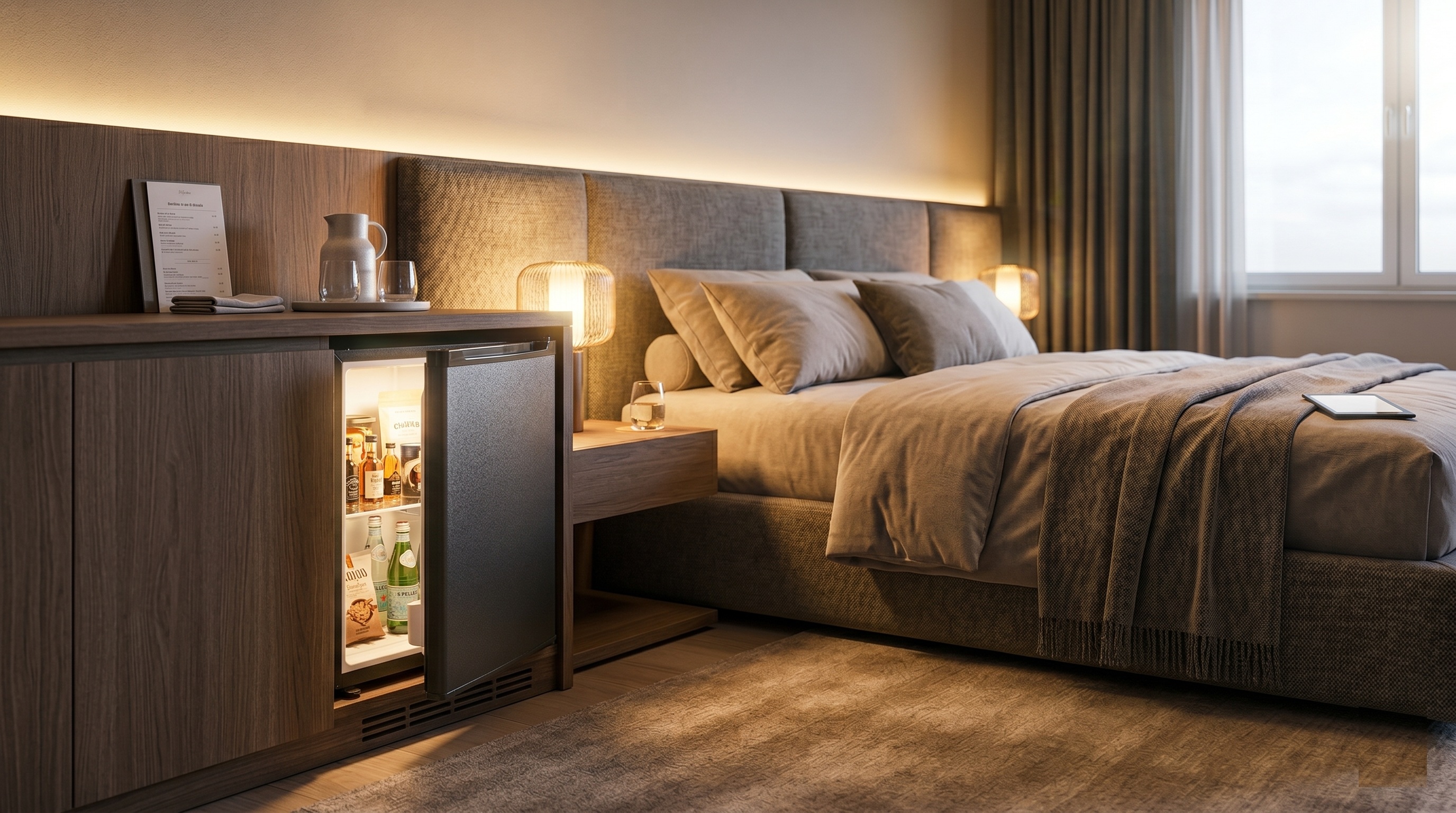
The integration of compact refrigeration systems into hotel rooms, hospitality facilities, B&Bs, and executive offices is a key element in raising the standard of hospitality and the comfort perceived by guests. A professional minibar is not a simple miniature appliance, but an industrial system engineered to ensure operational continuity, energy efficiency, and seamless architectural integration with the room's furnishings. Whether it's a boutique hotel, a hotel chain, a corporate office, or a private clinic, selecting the ideal device requires careful consideration of beverage storage needs and the acoustic and thermal constraints of the environment. This buying guide was created to guide you through the many technological, dimensional, and aesthetic options available in the Holity.co.uk catalog, helping you configure the perfect solution for your facility.
The choice of refrigeration system directly determines the noise level, cooling power and energy efficiency of the refrigerator. Our catalogue offers three main technologies:
The historic and most widespread system in high-end hotels. It uses a hermetically sealed circuit based on a hydro-ammonia solution heated by an electric resistance.
Latest-generation eco-friendly technology based on a solid-state semiconductor heat pump.
High-capacity cooling systems equipped with latest-generation hermetic compressors.
The aesthetics of the minibar and its placement within the furnishing layout influence the user's visual perception and experience:
To meet the Minimum Environmental Criteria and contain electricity bill costs in large accommodation complexes, the selection of the energy class is fundamental. Our range covers the new community labels between Class B and Class G (with a wide choice in classes C, D, E, F).
The products are divided into three levels of finish and performance:
The sizing of the compartment must be calculated on the assortment of products to be offered to the guest and on the spaces of the storage unit:
The variety of the Holity.co.uk catalogue allows us to satisfy both small restocking requests and large supplies for new hotel openings, covering a price range that goes from €140.00 up to €3241.00 . The entry-level options include compact thermoelectric minibars with solid doors, while the top-of-the-line models include high-capacity, completely silent built-in absorption units, designer drawer display cabinets, and highly energy-saving Eco Green Made in Italy models.
Enhance the hospitality of your accommodation facility, guarantee maximum nighttime peace and quiet for your guests, and optimize your company's energy consumption. Use our side navigation filters to select the cooling technology (absorption, thermoelectric, or compression), the type of door (solid, glass, paneled), and the capacity in liters best suited to your spaces.
Are you a hotel manager, an interior designer, a buyer for a HoReCa chain, or do you need to place an order for a public body? Request a personalized quote today: our team of experts is at your disposal to provide you with technical data sheets, noise emission certificates and confidential quotes for multiple supply batches.
How does the water and ammonia absorption refrigeration cycle eliminate vibrations and reduce noise emissions to 0 dB?
Unlike traditional refrigerators that use pistons and mechanical compressors subject to inrush and vibrations, the absorption system is a hermetically sealed circuit without any moving components. A small electrical resistance heats a solution composed of water and ammonia; the ammonia vapor rises into the condenser where it returns to liquid, and then evaporates in the emitter, absorbing the heat from the internal compartment. Since there are no pumps, fans, or motors, the process is driven solely by physical-chemical principles, ensuring 0 dB of noise emission and a total absence of vibrations.
What thermal ventilation requirements (minimum surface area in cm²) must be respected when installing a minibar in a hotel cabinet?
To avoid overheating of the rear coil and the consequent drop in cooling performance or thermal blockage, the cabinet must allow for proper airflow by natural convection. It is essential to provide an air duct that includes an inlet grille on the lower part (or on the bottom) and an outlet grille on the upper part (or on the back of the cabinet), each with a usable free surface area of at least 200 cm². Without this ventilation, the heat accumulated inside the niche would dramatically increase electricity consumption, preventing the minibar from reaching operating temperatures.
How do compression-operated models controlled by a night timer or inverter technology ensure acoustic comfort in rooms?
The latest generation of compressor-powered minibars overcome the problem of night-time noise by integrating two technological solutions: inverter motors and intelligent power management. Inverter technology modulates the motor's rotation speed without continuous start/stop jerks, keeping decibels at very low levels. Models equipped with a timer or "Smart" technology, on the other hand, allow you to program the compressor to completely switch off during rest hours (e.g. from 11:00 pm to 7:00 am), using an internal cold accumulator (eutectic) that keeps drinks cool throughout the night in total silence.
What thermal insulation and Low-E treatment features distinguish double-glazed doors (display minibars) to prevent external condensation?
Glass-door minibars use double or triple-glazed panels separated by a sealed cavity filled with Argon gas. The glass surface is subjected to a "Low-E" (low-emissivity) treatment with the deposition of silver micro-layers that reflect external radiant heat while allowing light to pass through. This screening keeps the temperature of the external face of the glass close to that of the hotel room, preventing humidity in the air from condensing into droplets on the door and always ensuring crystal-clear transparency for viewing the products on display.
Why are professional hospitality minibars not suitable for storing drugs, vaccines or biological samples (medical regulations)?
Minibars for the hospitality sector are calibrated to keep drinks and food at a serving temperature (generally between +4°C and +12°C) with physiological fluctuation tolerances due to door openings or temperature variations in the room. Pharmaceutical storage, on the other hand, requires rigorous, millimetric thermal stability between +2°C and +8°C, monitored by continuous data loggers, with high/low temperature alarms and internal control probes with backup batteries in the event of a blackout. The use of a hotel minibar for medical use does not comply with health directives and puts the integrity of the active ingredients at risk.
How does the price range (€140.00 - €3241.00) correlate with absorption technologies, insulation materials, and Made in Italy certifications?
The wide price range reflects the nature of the refrigeration technology, the materials, and the level of finish. The starting threshold (€140.00) covers basic compact thermoelectric or compressor models with solid doors. Moving towards the intermediate range, we find silent 30-40 litre absorption minibars and glass-door models with aluminium frames. The top-of-the-range prices (up to €3,241.00) are reserved for designer drawer refrigeration units, large-volume built-in units in high energy class, with Eco Green ecological refrigeration cycles and entirely certified Made in Italy manufacturing for the high-end contract market.
 English
  Italian
 French
 German
 Spanish