
mon-fri 9-13 / 14.30-18.30
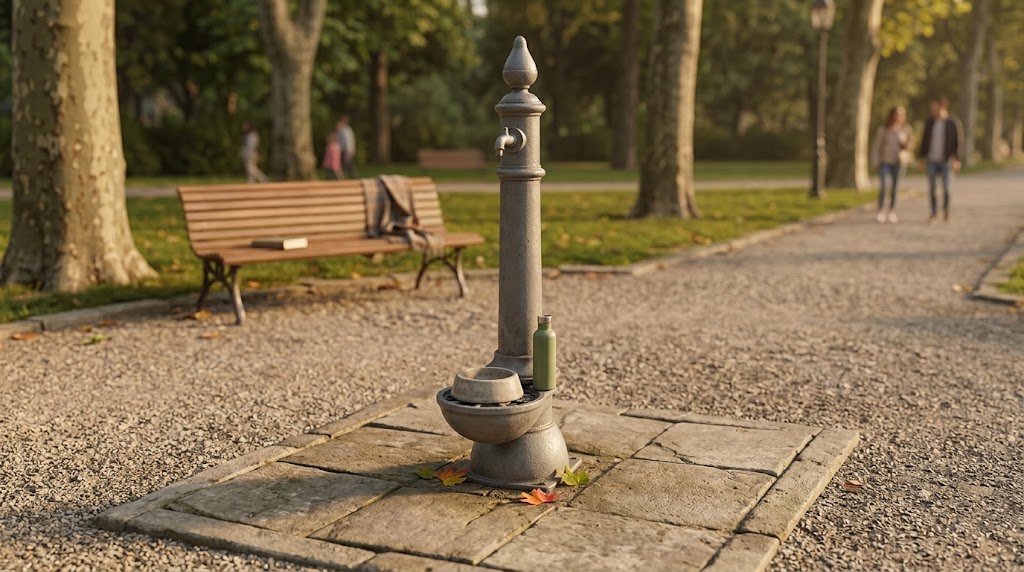
Adding a water feature to an open space—whether it's the garden of a private residence, a historic center square, a public park, or a company's perimeter—is a strategic design choice. Choosing the right outdoor fountains isn't simply about purchasing a decorative element or a water dispenser, but about integrating a functional, durable, and sustainable feature. A well-positioned water feature enhances street furniture, promotes outdoor hydration, reduces the use of single-use plastic bottles, and ensures universal accessibility, including for children, the disabled, and pets. From the classic cast iron fountain for historic centers to minimalist stainless steel versions, all the way to inclusive double-basin models or wall-mounted solutions for small spaces, this buying guide will guide you through the Holity.co.uk catalog, analyzing construction materials, installation types, plumbing accessories, and accessibility regulations.
The fountain's architecture must be compatible with the intended use of the site, with the floor space and with the expected traffic flows:
The configuration of choice for parks, squares, gardens, cycle/pedestrian paths and open rest areas.
Systems designed to optimise floor space in narrow architectural contexts.
Cutting-edge solutions engineered to break down architectural barriers and offer a universal water point.
The choice of material affects the longevity of the work, its resistance to vandalism and the aesthetic language of the landscape:
Operational efficiency and water resource management depend on the internal components:
The Holity.co.uk navigation filters allow you to profile the precise overall dimensions of the fountain based on the niche or available construction site base:
The variety of the assortment allows us to satisfy both private purchases for your villa and the supply of lots for large municipal redevelopment contracts:
Enhance the green spaces of your city, promote environmental sustainability and offer a safe and accessible hydration point for all with the outdoor fountains available on Holity.co.uk. Explore our online catalog to select the most suitable model: set the type (column, wall-mounted or disabled/dog-friendly), choose the body material (cast iron, steel, concrete or plastic) and identify the ideal tap system for your project.
Request a personalized quote today: our sales team is at your complete disposal to provide you with technical data sheets with quotes, MOCA potability certifications and special offers for multiple purchases.
How does the design of inclusive fountains comply with the accessibility regulations for people in wheelchairs (D.P.R. 503/1996)?
Outdoor fountains designed for universal accessibility feature a dispensing arm that projects horizontally at least 40-50 cm from the central column, with the tap spout positioned at a height of between 80 and 90 cm from the ground. The space beneath the overhang remains free of vertical obstructions for a minimum height of 70 cm from the ground, allowing wheelchair users to tuck their knees under the basin and approach the water flow from the front. The dispensing control usually consists of a large-surface front button that can also be operated with the fist or palm of the hand.
How is the hygiene of the separate dog drinking bowl in multi-service public fountains maintained?
In multi-service fountains designed for parks and urban areas, the dog drinking bowl is positioned at the base of the fountain body, completely isolated from the upper drinking point reserved for humans. Clean water reaches the lower basin through a separate pipe or by falling from the upper drain. To prevent the stagnation of dirty water or saliva and prevent bacterial contamination, the dog litter box is equipped with a continuous drain hole or a quick-emptying tilting mechanism, allowing owners to rinse and sanitize the basin after each use.
What technical measures should be taken to protect cast iron and steel fountains from the risk of breakage due to winter freezing?
During winter frosts, water trapped in the internal pipes or in the faucet cartridge increases in volume and freezes, causing the pipes or the metal body of the fountain to crack. To prevent this damage, the most effective solution is to install a shut-off valve with a frost-proof drain at a depth below the frost line of the ground, usually 80 cm. Alternatively, models equipped with automatic drain valves empty the vertical column every time the faucet is turned off. In areas with harsh winters, it is good practice to generally close the main stopcock and empty the fountain preventively in the fall.
Why does the timed push-button faucet guarantee water savings of up to 70% in unattended public areas?
Traditional knob or lever faucets remain open until the user manually closes them: if a passerby forgets to turn the faucet on, or in the event of vandalism, the water flows continuously for hours, wasting thousands of liters of water and risking flooding the park. The timed push-button faucet integrates a hydraulic cartridge with a mechanical stop: pressing the button delivers a pre-calibrated amount of water for a period of between 6 and 10 seconds, automatically interrupting the flow without requiring further action from the user and reducing overall water consumption by up to 70%.
What are the differences in resistance to salty environments between painted cast iron fountains and AISI 316 stainless steel models for a seafront?
In coastal areas and seafront furniture, marine aerosol carries sodium and chlorine particles that attack metal surfaces. Cast iron fountains require preventive cataphoresis treatments and high-thickness polymerized epoxy powder coating to isolate the metal from the salty air; if the paint is damaged by impacts, it must be restored to prevent rust from appearing. AISI 316 stainless steel (which contains molybdenum) offers total native resistance to chloride and salt attack without the need for surface painting, resulting in immunity to corrosion and maintenance-free even after decades of direct exposure to sea spray.
How does the price range in the category correlate with the types of material, foundry processes and universal accessibility systems?
The cost structure is determined by the mass of the raw material, the casting or carpentry technology, and the complexity of the integrated hydraulic unit. The entry-level range includes compact terracotta wall fountains, rotationally molded water features, and simple painted metal columns. The intermediate range includes traditional cast iron fountains for historic centers, monolithic models in reinforced concrete with marble chips for parks, and galvanized steel fountains equipped with timed taps. The top-of-the-range prices are reserved for highly accessible water stations for the disabled made of AISI 316 stainless steel, multi-service models complete with dog waterers, and monumental foundry-cast fountains for historic and representative squares.
 English
  Italian
 French
 German
 Spanish