
mon-fri 9-13 / 14.30-18.30
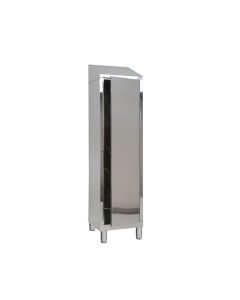
AISI 304 stainless steel boot cabinet with hinged doors, sloping roof and adjustable legs. Designed for environments complying with HACCP regulations. Dimensions: W 50 x D 50 x H 215 cm. Capacity: 5 pairs of boots.
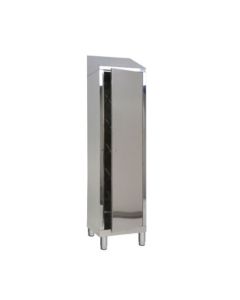
Boot cabinet in AISI 304 stainless steel, with 2 hinged doors and key lock. Sloping roof for maximum hygiene and adjustable feet to facilitate cleaning. Ideal for HACCP and MOCA environments. Capacity: 10 pairs of boots. Dimensions: W 95 x D 50 x H 215 cm.
Boot storage cabinets represent a critical solution for the organized and hygienic management of work footwear in changing rooms, construction sites, healthcare facilities, and industrial environments. These specialized lockers perform an essential function in keeping boots separate and protected from wear, contamination, and degradation, preventing the spread of dirt and moisture in common areas. Made from resistant materials such as painted or stainless steel, boot storage cabinets combine structural practicality with compliance with HACCP and MOCA regulations, ensuring optimal sanitary conditions in the most demanding contexts. Their use spans sectors such as construction, the food industry, agriculture, healthcare facilities, and company changing rooms, where order and hygiene represent decisive production factors.
The choice to install dedicated boot storage cabinets radically transforms the management efficiency of changing rooms and work environments. Instead of storing bulky and often contaminated footwear on common shelves or directly on the floor, these cabinets allow for controlled hygienic separation that reduces the risk of cross-contamination and the spread of pathogens. In sectors such as the food industry, pharmaceuticals, and healthcare facilities, this distinction becomes a non-negotiable regulatory requirement. Furthermore, work boots require ventilated spaces to dry correctly: trapped moisture generates mold, persistent bad odors, and accelerated material deterioration, resulting in more frequent replacement costs. A cabinet equipped with ventilation grilles directly addresses this problem, extending the useful life of the equipment and maintaining a healthier work environment for all occupants.
From a practical point of view, these cabinets solve daily problems that companies constantly face: the loss of boots, their involuntary exchange between employees, messy accumulation that obstructs passage in changing rooms, and the need for frequent and effective cleaning. Physical security is another significant aspect, especially in multi-access environments where it is appropriate to protect workers’ personal belongings. Models with key or combination locks guarantee total control over deposited items. From an organizational efficiency perspective, having a dedicated and rationally structured space reduces downtime during shift changes, improves circulation in the changing room, and clearly communicates to employees the importance attributed by the company to order and hygiene in the workplace, factors that positively impact morale and compliance with procedures.
The range of boot storage cabinets is divided into different construction categories, each responding to specific operational contexts and volumes. Compact single models represent the minimalist solution, ideal for small changing rooms, reduced workshops, or temporary construction sites with few operators; they usually offer a capacity of 3 to 6 pairs of boots and a reduced footprint, facilitating integration even in very limited spaces. Multi-station models, on the other hand, are structured with multiple independent compartments separated by dividers, allowing each operator to easily identify their own compartment without confusion; these cabinets reach capacities of 10, 15, or even 20+ pairs, making them indispensable in companies with a large workforce. The choice between painted steel and stainless steel represents a fundamental dichotomy: the former is economically advantageous and sufficiently resistant for standard environments, while the latter is mandatory in contexts with high humidity, frequent chemical sanitization, or stringent regulatory requirements, such as professional kitchens and pharmaceutical laboratories.
Further distinctions concern drainage and ventilation systems: cabinets with drainage grilles on the bottom allow water to flow out naturally, preventing stagnation and facilitating cleaning operations, while those equipped with forced ventilation systems or side grilles accelerate the drying of wet boots. Some models feature sloping roofs, a feature that improves hygiene by preventing dust accumulation on top and facilitating moisture evacuation. Regarding closures, the variety ranges from hinged doors (cheaper and more reliable) to sliding ones (more space-saving), up to versions with key locks, numerical codes, or combinations, essential where protection of personal belongings is required. Finally, modular sectional cabinets represent a scalable solution: they allow multiple units to be placed side by side creating customized configurations, and the system to be expanded over time without the need to replace the entire installation, a significant advantage for growing companies or those that anticipate variations in the number of employees.
The selection of a boot storage cabinet requires careful evaluation of multiple parameters, starting from the analysis of the number of users and the frequency of use. In a small workshop with 5 employees who change boots only once a day, a compact model is sufficient; in a food industry with 50 employees and overlapping shifts, higher capacity and possibly duplication of stations are necessary. The second decisive criterion is the operational environment: dry and controlled environments tolerate standard painted steel, while humid, corrosive spaces or those subject to frequent high-pressure washing strictly require stainless steel to avoid degradation and costly extraordinary maintenance interventions. Many companies make the mistake of underestimating this aspect, only to discover that the cabinet deteriorates in unexpected times.
A third critical element is the availability of space and its geometric configuration: a narrow and long changing room benefits from vertically developed cabinets, while a wider one can accommodate lower and lateral units. Ventilation is essential in environments where boots are stored still damp or wet; without ventilation grilles or drainage systems, the formation of odors and mold becomes inevitable within weeks. Therefore, checking if the chosen model has these features is a priority. A common mistake is not considering the specific regulatory requirements of the sector: food industries must comply with HACCP and MOCA, healthcare facilities must guarantee sanitizability and anti-contamination, environments with chemical agents require specific materials. Finally, it is appropriate to evaluate the ease of maintenance: very complex surfaces, sharp corners, or areas difficult to clean involve hidden operational costs over time. Polished stainless steel cabinets (BA finish) are notoriously the easiest to maintain hygienically, justifying their price premium in contexts where hygiene is critical.
Boot storage cabinets used in work environments are subject to a series of regulatory constraints that vary depending on the sector. In the food sector, compliance with the HACCP (Hazard Analysis Critical Control Point) Regulation is mandatory: materials must be non-porous, easily sanitizable, and must not release substances that could contaminate products. Stainless steel is the preferred choice for this application, as it resists strong disinfecting agents (hypochlorites, acids) commonly used in food industries. The MOCA Decree (Materials and Objects in Contact with Food) further specifies that any material in direct or indirect contact with food must respect migration standards for harmful substances, a requirement that certified steels fully satisfy. In the healthcare field, ISO 14644 directives relating to contamination-controlled rooms and the Ministry of Health’s biosafety guidelines emphasize the need for smooth surfaces, without crevices, easily disinfectable, and preferably built from natural anti-bacterial materials such as stainless steel.
On the occupational safety front, Legislative Decree 81/2008 (Consolidated Law on Safety) requires that changing rooms be equipped with suitable rooms and furnishings to allow workers to neatly store personal effects and equipment, avoiding obstructions in passageways and tripping hazards. This regulation makes dedicated cabinets not only advisable but, in many cases, mandatory. In environments classified as controlled areas (laboratories, pharmaceutical environments), ISO 14644 prescribes that cabinets be constructed so as not to generate particulate matter, material loss, or release of contaminants. Corrosion resistance is regulated by the ISO 1993 standard for stainless steels: AISI 304 class is the minimum acceptable for humid environments, while AISI 316 class is recommended for particularly aggressive contexts (saline exposure, chemical vapors). Many suppliers certify their products according to these standards, a check that should always be requested before purchase to ensure documented compliance and traceability.
Explore all products in the category and compare the available solutions to find the one best suited to your operational context.
AISI 304 stainless steel is the recommended material for environments characterized by high humidity, water spray, or exposure to corrosive vapors. It resists oxidation and disinfecting treatments, maintaining structural integrity over time. Painted steel is only suitable for dry and controlled changing rooms.
For 30 employees on a single shift, a capacity of at least 35-40 pairs of boots is advisable, considering wear, pairs drying simultaneously, and a safety margin. If shifts overlap, consider at least two medium-capacity units instead of a single large one, improving distribution and access.
Although not explicitly required, drainage grilles are strongly recommended in HACCP environments because they facilitate cleaning, prevent water stagnation where bacteria proliferate, and ensure effective drying. They increase the level of compliance perceived by auditors during regulatory inspections.
In changing rooms without windows, it is essential to choose a model with lateral ventilation grilles or, even better, with integrated forced ventilation. Without air circulation, damp boots will not dry correctly, generating odors, mold, and accelerated material degradation. Artificial ventilation of the changing room in general is however recommended by Legislative Decree 81/2008.
Hinged doors are more robust, seal better, and facilitate access, but require opening space in front of the cabinet. Sliding doors save lateral space, ideal for narrow changing rooms, but can be less efficient at containing odors. The choice depends on the changing room layout and daily frequency of use.
Stainless steel is more self-cleaning compared to painted steel, but to maintain brilliance and hygiene, it is advisable to clean periodically with neutral or specific stainless steel detergents, avoiding abrasive products. In HACCP environments subject to frequent sanitization with disinfectants, a weekly cleaning with a soft cloth keeps surfaces in optimal condition over time.
 English
 Italian
 French
 German
 Spanish