The choice starts from the space actually available in the room
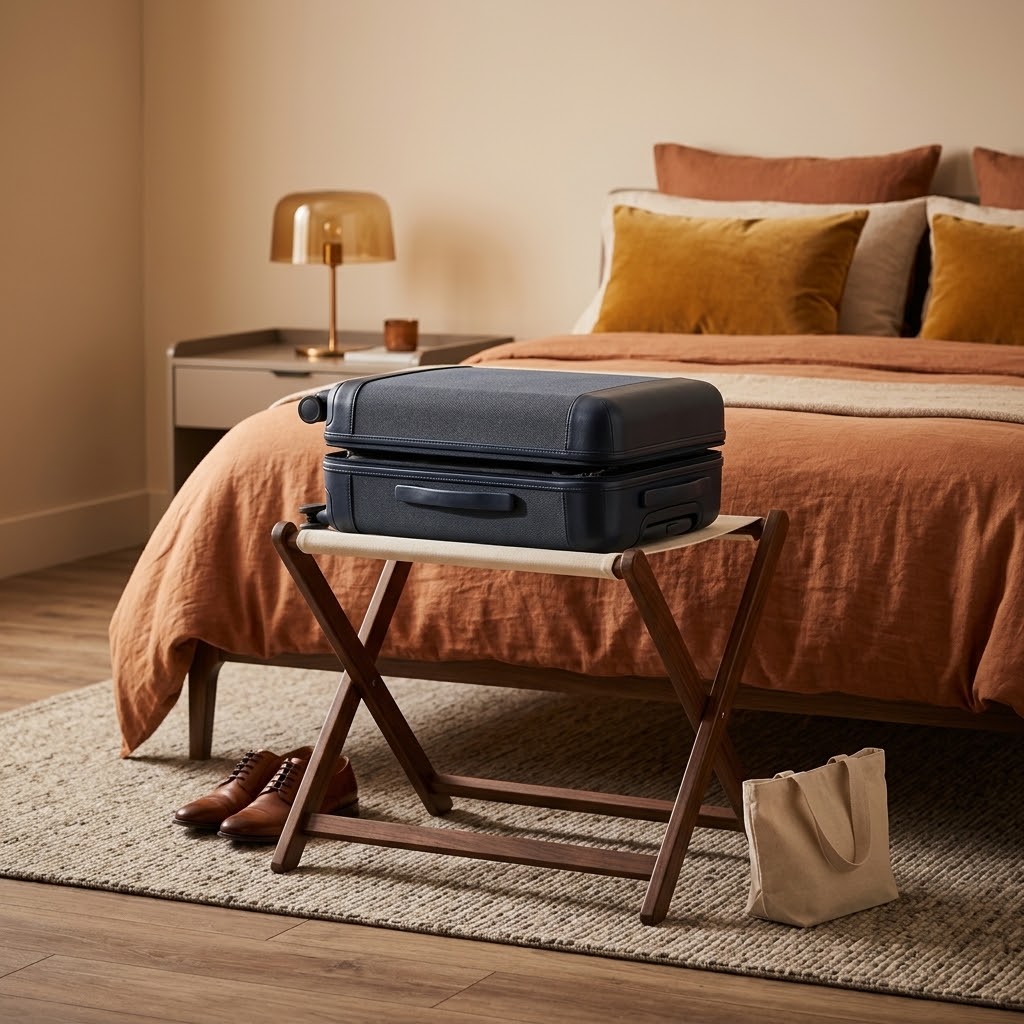 The first criterion to evaluate is the space that the luggage rack takes up when used and, above all, when left unused. A compact room may have enough space to open a suitcase but without taking up too much space. allow you to permanently leave a support along the path between the bed, wardrobe and bathroom. In these situations, each accessory must help keep the passageways free. The available surface area must therefore be evaluated on the basis of the actual arrangement of the furniture and not only on the total square metres of the room..
A larger room, on the other hand, offers greater freedom and can allow you to dedicate a permanent area to luggage. The support can be placed near the wardrobe, along a free wall or in an area specifically designed for opening the suitcase. This arrangement reduces the need to move the accessory during the stay and makes its function immediately clear to the guest. When choosing, it is therefore advisable to observe where the person will spontaneously tend to place the luggage as soon as they enter the room.
When the foldable luggage rack offers more flexibility
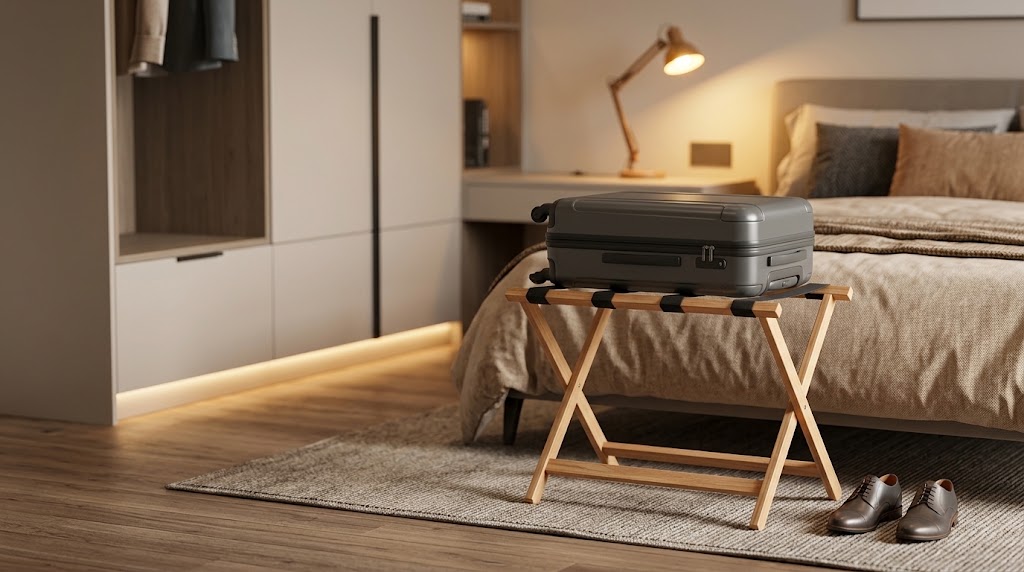
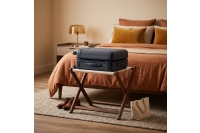
The main advantage of a folding model is the possibility of reducing its bulk when not in use. The stand can be folded up and placed inside a wardrobe, in a niche or in another dedicated area, allowing greater freedom of movement in the room. This feature is particularly interesting in urban hotels, B&Bs and structures where the rooms are small. The folding hotel luggage stand therefore becomes a functional solution when the same space needs to be adapted to different moments of the stay.
The foldability can also be useful when the type of guest changes frequently. Those travelling with small luggage may not use the stand at all, while a guest with a trolley or large suitcase may need it for their entire stay. A foldable accessory allows the room to adapt to both situations without permanently occupying a portion of the surface. Holity, a specialist in professional supplies for hotels and hospitality facilities, offers various foldable luggage racks designed specifically to coordinate guest service and space management.
When a fixed solution integrates better into the room
A fixed solution, or one intended to remain permanently open and available, takes on a different logic. In this case, the luggage rack is treated as part of the room's furnishings and maintains a defined position even when it is not holding luggage. It is a coherent choice when the room has sufficient space and the project includes a specific area for storing suitcases. Permanent availability eliminates the need to open, close or reposition the support between uses.
This approach can be especially interesting in rooms where furnishings and accessories have been designed in a coordinated way. A dedicated bench, an integrated surface or a suitcase rack left permanently in the same position can enhance the readability of the space and make its function immediate. The main advantage therefore does not consist in saving surface area, but in continuity of use and aesthetic integration. The solution must, however, be carefully sized so that it does not become a permanent obstacle in internal circulation.
Housekeeping and daily management influence the choice
The hotel room is not only experienced by the guest. Every day the staff must make the bed, clean the floor, check the furnishings and easily reach all surfaces. A lightweight, foldable complement can be moved or stored during these operations, allowing easier access to the area below and the wall. Convenience for housekeeping therefore represents an operational criterion to be considered together with guest comfort.
A stable support, on the other hand, requires that its position is compatible with normal cleaning and tidying paths. If well designed, this configuration eliminates the need to decide where to place the product each time, but leaves a part of the room permanently occupied. The difference can become significant when a facility manages tens or hundreds of rooms and the same operation is repeated daily. For this reason, the choice should not be made by observing a single sample room, but by imagining the management of the entire facility over the course of the year.
The rear edge can change the functionality of the support
In addition to the distinction between folding and fixed, it is It is important to evaluate the presence of the rear edge. This element creates a separation between the luggage and the wall and can be particularly useful when the support is placed near delicate surfaces. Rigid suitcases, handles, and wheels can in fact come into contact with the wall when opening or moving the luggage. The edge therefore helps organize the position of the suitcase and maintain a distance from the surface behind it..
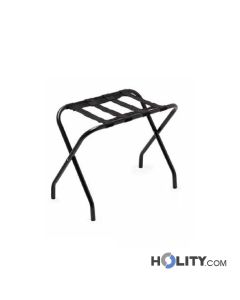
A model without a edge, on the other hand, has a more essential structure and can be less visually cumbersome. It may be suitable when the luggage rack is not placed directly against a wall or when the layout of the room does not require this additional protection. The Holity professional range includes both configurations, allowing you to select the support based on the space and surrounding furnishings. Holity, a point of reference for the professional furnishing of hotel rooms, therefore allows the side to be considered as a design feature and not as a simple aesthetic detail.
Wood and steel must be coordinated with the style of the room
The material significantly changes the perception of the luggage rack within the room. Wood can fit naturally into boutique hotels, hotels with classic furnishings, resorts and rooms in which warm surfaces and material finishes prevail. Steel and metal structures, on the other hand, are easily associated with modern, essential interiors or those characterised by technical furnishings. The material should therefore dialogue with the bed, wardrobe, desk and other accessories present in the room.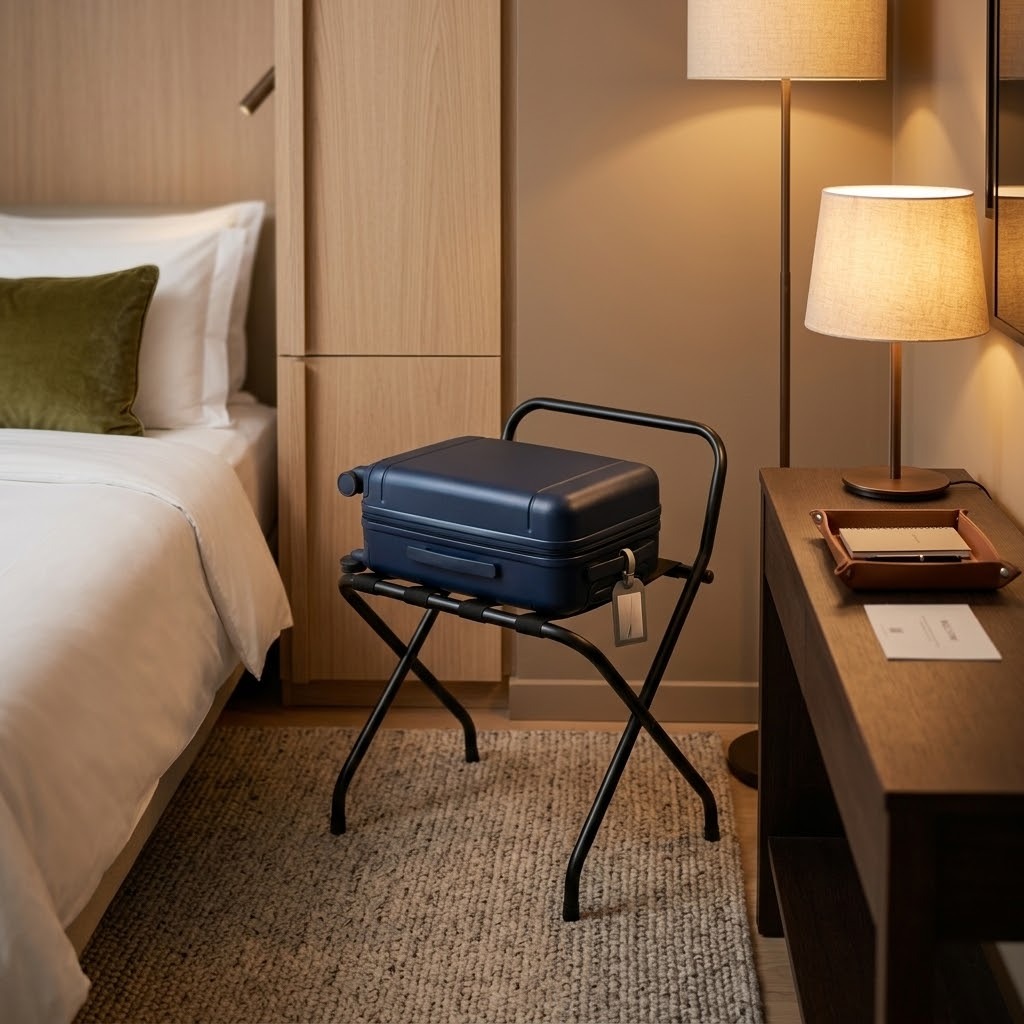
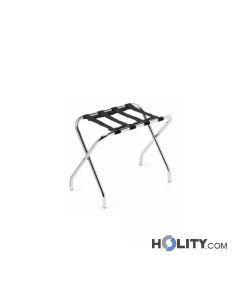
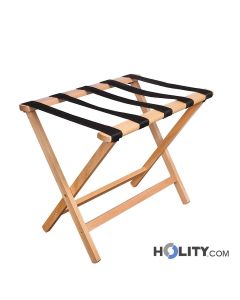
The choice, however, cannot stop at the image. In a hospitality facility, it is also necessary to consider the frequency of use, cleaning, and maintenance of the surfaces, in addition to the construction quality of the individual model. A foldable wooden luggage rack can combine a warmer visual presence with the possibility of being stored, while a metal structure can offer a more essential profile without sacrificing foldability. This demonstrates that material and opening system are distinct criteria and must be compared separately.
Load capacity, straps, and dimensions complete the comparison
Once the general configuration has been defined, it is necessary to compare the technical characteristics. Width and depth determine the surface area actually available for luggage, while height influences how the guest can open and organize the suitcase. The maximum load capacity declared by the manufacturer must be compatible with the luggage the facility expects to accommodate. Dimensions and load capacity must therefore be read together, avoiding choosing a model simply because it appears compact.
The straps are also a functional part of the luggage rack. They must support the luggage by distributing its weight and maintaining adequate tension during use, while their material can affect the overall appearance of the accessory. The Holity range includes models with nylon straps and other professional configurations, with different load capacities and dimensions. The technical data sheet therefore becomes the main reference for comparing products intended for the same type of room without relying solely on the photograph.
Standardizing the rooms makes it easier to manage the structure
When purchasing luggage racks for multiple rooms, the choice is no longer just about the single product. Using the same configuration in similar environments allows for greater aesthetic consistency and makes it easier to define a standard position within the room. Staff also quickly learn where to find, open, or put the accessory away during tidying up. Standardization can therefore transform a small accessory into a component that is easier to manage on a hotel scale.
This does not mean that all rooms necessarily have to use the same model. Suites, standard rooms, and rooms with different floor plans may require different solutions, as long as the choice follows a common logic. For example, a hotel can use foldable versions in more compact rooms and integrate permanent supports in larger rooms. The useful criterion is to maintain continuity of function and style without forcing the same solution where space requires a different approach.
The best solution depends on the room design
The final comparison must start from four questions: how much space is left free around the furnishings, where the suitcase will be opened, how often the support will need to be retracted, and how much space is available. be moved and how much weight does aesthetic integration into the room design weigh. If the priority is to free up space and keep the room flexible, the folding model presents a clear advantage. If, however, there is an area dedicated to luggage and the accessory must always remain available, a stable solution may be more coherent. There is therefore no absolute best configuration, but a choice more suited to the floor plan and organization of the service.
Holity, a leader in professional supplies for hotels and hospitality facilities, offers luggage racks in different materials, sizes and configurations, including numerous foldable models with or without a sideboard. The choice of a folding hotel luggage stand folding hotel should therefore derive from the concrete need to recover space and simplify daily management, while a fixed solution finds greater coherence when it can be permanently integrated into the room design. Finally, checking the dimensions, capacity, material and presence of the side allows you to compare products that are truly compatible with the environment. The result is a tidier room, in which luggage has its own dedicated space without compromising the functionality of the other furnishings.
 English
  Italian
 French
 German
 Spanish