
mon-fri 9-13 / 14.30-18.30
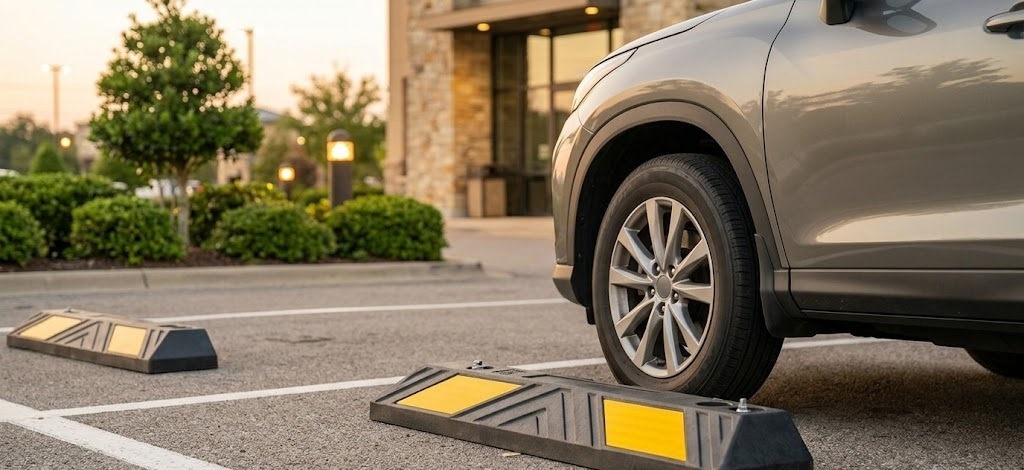
Efficient internal traffic management and meticulously planned parking spaces are key aspects in the design of garages, shopping centers, logistics centers, and public parking lots. Choosing suitable parking wheel stops is a strategic decision aimed at eliminating structural damage caused by vehicle mishandling, protecting walls, charging stations, and fire extinguishers, and clearly demarcating pedestrian areas or reserved paths. A well-sized parking bollard or kerb reduces the risk of disputes between users due to trespassing between adjacent spaces, speeds up parking maneuvers, and increases the passive safety of the entire infrastructure. This buying guide will guide you through the solutions available in the Holity.co.uk catalog, analyzing the chemical and physical characteristics of the compounds, the mechanical resistance profiles of the steel, and the dimensional parameters to identify the ideal demarcation device for your facility.
In the road marking market, the primary distinction between wheel stops is based on material composition, which determines impact absorption, outdoor longevity, and required maintenance.
These are the gold standard for the vast majority of indoor and outdoor parking areas.
Cost-effective solutions, oriented towards environmental sustainability and large-scale installations.
Heavy-duty devices designed to withstand the most extreme mechanical stresses and commercial or industrial vehicles.
To integrate a high-performance parking deterrent proportionate to the size of cars or commercial vehicles, it is essential to analyse the millimetric parameters before purchasing.
The length of the wheel stop defines the coverage of the parking lane. The compact models (with lengths between 500 and 550 mm) are positioned in pairs corresponding to the two wheels of the single vehicle, offering a slim solution and leaving space for rainwater to flow away. The medium and long modules (from 900 mm, 1200 mm up to 1830 mm) create a continuous barrier along the entire width of the stall (usually 2.30 - 2.50 meters), preventing any encroachment even by vehicles maneuvering at diagonal angles of attack.
The standard height of a professional wheel stop is around 90 - 100 mm. This height has been engineered to intercept the tire tread without impacting the lower part of the front bumpers of modern cars, including sports cars with low ground clearance. An undersized height (under 70 mm) allows the vehicle to overcome the kerb by inertia, while an excessive height (over 120 mm for cars) risks damaging the front spoiler or the oil sump.
In underground parking areas, multi-storey silos or poorly lit outdoor car parks, the risk of pedestrians tripping or impacting the wheel stop body during manoeuvring is high. It is necessary to ensure that rubber or PVC devices are equipped with high-visibility retro-reflective bands or cat's eyes made of microprismatic film or glass spheres. In steel models, signalling is guaranteed by the application of alternating black/yellow or red/white reflective adhesive bands.
The stability of the wheel stop depends on the correct mechanical constraint to the road surface, which must be selected based on the composition of the floor:
The layout of public or public car parks must comply with the technical requirements on road safety and the removal of architectural barriers. The UNI CEN/TS 15649 standard defines the test criteria for the mechanical resistance and durability of kerbs. In disabled parking spaces and along connecting ramps, galvanized steel wheel stops can act as a life-saving kerb for people with reduced mobility (PRM), in compliance with the directives of Ministerial Decree 236/1989 and the UNI 11104 standard. In these contexts, the profiles must have chamfered vertices, rounded joints and a complete absence of sharp edges. In closed and underground environments, elastomeric materials must also meet fire reaction criteria to prevent the spread of toxic fumes in the event of a fire.
Company parking, hotels and HoReCa facilities: We recommend the use of 900 mm or 1820 mm black/yellow vulcanized rubber wheel stops. They guarantee a neat aesthetic impact, protection for customers' bodywork and absolute silence on impact with the tyres.
Charging Stations for Electric Vehicles (EV Charging): In these areas the priority is to protect expensive charging columns. The combination of a high-profile rubber wheel stop on the ground combined with a high-visibility yellow painted galvanised steel protective arch placed to protect the column is strongly recommended.
Logistics, Loading Bays and Interports: For the guided positioning of trucks, vans and forklifts, the only choice is oriented towards heavy-duty 76 mm diameter tubular galvanised steel wheel stops with reinforced base plates, capable of withstanding static and dynamic stresses of several tons.
Optimize the safety of your parking spaces, prevent damage to infrastructure and upgrade the aesthetics of your parking areas. In the Holity.co.uk catalogue we offer a complete and certified assortment of wheel stops and kerbs in vulcanized rubber, recycled PVC and galvanized steel, designed to guarantee maximum resistance to atmospheric agents and continuous mechanical stress.
Use our search tools to select the ideal material for your flooring, filter the length of the device and configure the quantity needed for your stalls. Request a personalized quote today: our technical team is at your disposal to provide you with suitability sheets, conformity certifications and dedicated quotations for large batch purchases.
How does the rubber vulcanization process prevent plastic deformation and flaking of the wheel stop under the continuous action of UV rays and engine oils?
Vulcanization is a chemical-physical process in which raw rubber is treated with sulfur at high temperatures and pressures, creating cross-bridges between the polymer chains. This reticular structure gives the compound a permanent "elastic memory": when a vehicle tire impacts the wheel stop, the material temporarily deforms to absorb the energy and instantly returns to its original geometric shape without undergoing plastic deformation or cracking. Vulcanization also makes the elastomer chemically inert to hydrocarbons, hydraulic oils, and ultraviolet radiation, preventing the product from hardening, crumbling, or losing elasticity after years of outdoor exposure.
What installation techniques and anchoring resins are needed to secure wheel stops on draining asphalt pavements versus solid concrete?
On rigid solid concrete pavements, wheel stops are secured using traditional mechanical steel expansion anchors. However, road asphalt, and in particular draining asphalt, has a macroporous structure and a visco-elastic behavior that makes standard expansion anchors ineffective, as they risk breaking up the bituminous mix under vibration. On asphalt, special anchor bolts or threaded rods with improved adhesion must be used combined with chemical anchors (epoxy or two-component vinyl ester resins). The resin penetrates the voids in the asphalt around the hole, creating a solid anchoring block that distributes the pushing forces over a much larger area of the substrate.
Why does the 100 mm height geometric shape represent the perfect ergonomic balance point and avoid contact with the car's front spoiler?
The 100 mm height is the standardized technical dimension in international specifications. Modern cars (including sports sedans or cars with short overhangs) have a minimum height from the ground for the bumper and front spoiler usually between 110 mm and 140 mm. A 100 mm wheel stop is high enough to intercept the curvature of the tire before the tread exceeds the kerb, but at the same time low enough to slide perfectly under the contour of the bodywork. This eliminates the risk of scratching the spoiler or tearing the car's lower air distributors when stopping.
What retroreflective and elastometric characteristics must integrated reflective strips have to ensure night-time visibility in accordance with road safety regulations?
The reflective strips applied to rubber wheel stops must resist both mechanical abrasion from the sliding of the tyres and deformations of the car body. Unlike traditional paper stickers, microprismatic or glass sphere retroreflective films are used, vulcanised directly into the rubber body at high temperatures. These inserts guarantee retroreflective values compliant with road sign standards (Class 1 or Class 2), ensuring that the headlights of the manoeuvring vehicle clearly illuminate the profile of the wheel stop from a distance of more than 20-30 metres, even in the absence of artificial lighting in the garage.
How do 76 mm diameter galvanised steel wheel stops act as life-saving kerbs for ramps dedicated to persons with reduced mobility (PRM)?
In compliance with Ministerial Decree 236/1989 and the UNI 11104 accessibility standard, wheelchair ramps with a lateral difference in height not limited by walls must be equipped with a continuous protective kerb with a minimum height of 10 cm. The 76 mm diameter tubular galvanized steel wheel stops installed at the base of the ramp act as a stop for the wheelchair wheels. Their curved joints, the total absence of sharp edges or protrusions and the extremely high mechanical stability prevent the wheelchair from accidentally slipping over the edge of the ramp, offering a safe and legally compliant containment barrier.
What parameters define the economic convenience of purchasing recycled PVC wheel stops in bulk for large area installations?
Purchasing recycled PVC wheel stops in bulk (e.g., packs of 20 or full pallets) allows for optimization of construction site logistics and unit costs per stall. Recycled PVC, derived from the industrial recovery of polymers, offers lower raw material costs than virgin rubber. The ability to compactly stack and palletize the 700 mm rectangular modules reduces the impact of transportation costs on the supply. This approach allows large parking lot managers or general contractors to reduce the Total Cost of Ownership (TCO) of the demarcation infrastructure, while maintaining a high standard of visual ordering and impact resistance.
 English
  Italian
 French
 German
 Spanish