
mon-fri 9-13 / 14.30-18.30
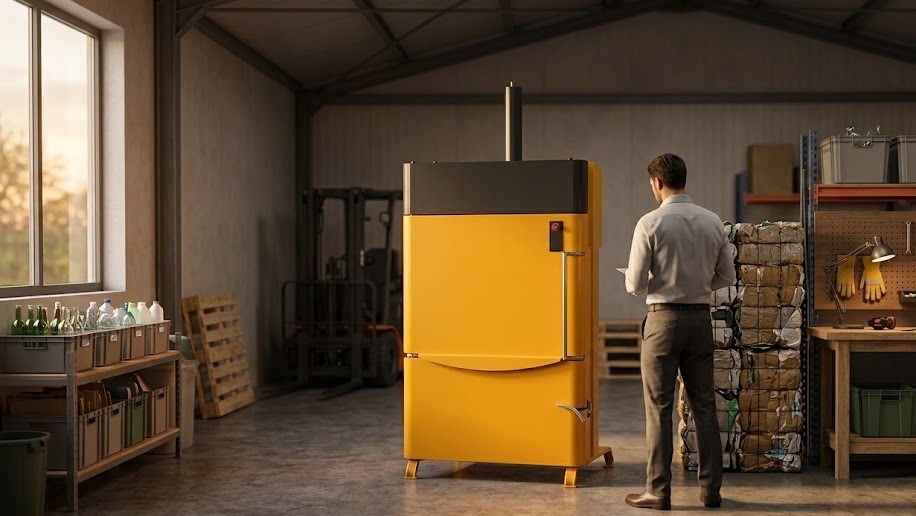
Efficient waste management and streamlining storage volumes are among the most critical factors in modern corporate logistics. Within distribution centers, hypermarkets, industrial facilities, hotels, and laboratories, the continuous production of cardboard packaging, plastic film, cans, or mixed waste can quickly saturate workspaces, dramatically increasing transportation and periodic collection costs. Choosing the ideal waste compactor is a strategic decision that reduces operating costs, allowing materials to be densified to reduce their volume by 80-90%, and transforming loose waste into stable bales that can be easily stacked on pallets. This buying guide is designed to guide you through the various compaction technologies, analyzing the difference between vertical and horizontal structures, the selection of materials such as stainless steel, and the safety criteria required for corporate compliance.
The panorama of professional compactors is mainly divided according to the direction of the thrust force and the architecture of the supporting chassis. The selection of the correct model depends on the available floor space and the hourly waste flows.
Compaction systems with small footprint and height development, ideal for those who need to optimise the square metres of floor space.
High-performance systems engineered to handle continuous flows of material and massive quantities of waste.
Machinery made with aluminum metal components and stainless steel bodies, developed to withstand the most demanding environmental conditions.
To integrate a high-performance compactor into the company's plant, it is necessary to calibrate the purchase by analyzing mechanical, logistical and operational parameters.
The compressive force (expressed in tons) must be adequate for the mechanical resistance and the "spring" effect of the waste:
The size of the loading mouth is fundamental: a wide mouth avoids having to manually reduce or cut large cardboard boxes before inserting them into the compartment, eliminating operator downtime. Furthermore, the final weight of the bale produced (which can vary from 40 kg up to over 500 kg) determines the internal handling methods: bales up to 50 kg can be extracted with dedicated manual trolleys, while bales over 200-300 kg require automatic extraction onto a pallet using a chain ejector and lifting with a forklift.
As these are very high pressure hydraulic machines, the presses must strictly comply with the Machinery Directive 2006/42/EC, bear the CE marking and be designed according to the safety criteria of the ISO 12100:2010 standard. It is essential to check the presence of active and passive protection devices:
Large-scale retail trade, retail and e-commerce warehouses: The preferred choice is vertical balers with a force of 10 to 20 tons, equipped with an increased loading mouth. They allow for the instant management of packaging boxes unloaded during shelf replenishment, producing heavy bales that can be directly stored on euro pallets.
HoReCa, Naval and Industrial Kitchens sectors: The use of compact compactors made of stainless steel or with anti-corrosion treatments is recommended. They take up the space of a standard appliance and allow you to compact food containers, wet boxes, bottles and thin plastics while keeping the room aseptic and free from odors or fluid leaks.
Manufacturing Industry and Logistics Hubs: The optimal solution involves the installation of continuous horizontal balers or batteries of multi-chamber vertical balers, which allow you to separate at source and simultaneously compact flexible plastic and cardboard, optimizing the recovery chain.
Reduce waste management costs, optimize the safety and order of your storage areas and transform your waste into a valuable logistics resource. In the Holity.co.uk online catalog we offer a technical assortment of professional waste balers and compactors, designed to guarantee durability over time and continuous work cycles.
Request a personalized quote today: our team of experts is at your disposal to provide you with technical data sheets, support with volumetric sizing and tailor-made solutions for your business.
How do differentiated hydraulic thrust cycles with anti-return retention optimize the density of PET plastic bales compared to cardboard?
PET plastic and polyethylene films have a high elastic memory that tends to make the material re-expand as soon as the hydraulic piston rises. Advanced balers use specific compaction programs with extended dwell times at the bottom dead center. Furthermore, the walls of the pressing chamber are equipped with anti-return claws or hooks: during the descent of the plate, the teeth fold back, while during the ascent phase they lock in a protruding position, retaining the compressed plastic and preventing it from rising again before the strapping is inserted.
What installation precautions and drainage slopes are necessary when positioning a stainless steel press in humid or fish processing environments?
In food processing environments, waste frequently contains salt residues, organic fluids, and acid fumes that can stagnate under the machinery. Stainless steel presses must be positioned on flat floors but equipped with drainage channels or slopes directed towards the plant's waste pits. The equipment frame integrates a lower tank to collect the flowing liquid, isolating the upper hydraulic components; The use of stainless steel allows the compaction compartment to be washed at the end of the shift with a water jet and acid pH disinfectants without the risk of pitting or oxidation of the sheet metal.
How does the useful size of the loading mouth affect the reduction of operator working times in logistics departments?
In a high-turnover logistics department, most of the time spent managing packages is wasted in the preliminary operation of manually folding or cutting large boxes to fit them into the containers. A compactor equipped with a generously sized loading mouth (e.g. 1100x700 mm or larger) allows the operator to deliver the cardboard boxes intact as they are unloaded from the pallet. The piston will deform and destroy the structure of the box with its thrust force, reducing the operator's maneuvers to simply pressing the cycle start button.
What is the fundamental difference between using polyester strapping and annealed iron wire in tying high-density bales?
Polyester strapping (high-strength woven or extruded) is the most popular solution for vertical balers up to 15-20 tons: it is light, flexible, safe for the operator to handle (eliminates the risk of whipping during cutting) and does not rust. Annealed annealed iron wire, on the other hand, is essential in industrial horizontal balers or for very high-density bales (over 300-400 kg), where the elastic re-expansion effect of the compressed material would exert excessive linear tension, which would risk weakening or lengthening the synthetic fibre, ensuring the block remains non-deformable during transport.
How is operator safety guaranteed during the automatic ejection phases of heavy bales over 200 kg?
Manually extracting bales weighing more than 200 kg would pose a serious risk of injury due to crushing or muscle strain for the operator. Medium- to large-tonnage balers integrate a mechanical or hydraulic bale ejection system. By fully opening the lower door (protected by a safety sensor that inhibits the descent of the piston), the operator activates a two-handed control that activates a chain or lever located at the bottom of the chamber. The kinematic mechanism gradually tips the bale forward, unloading it directly onto the wooden pallet placed on the ground, without the operator having to exert any manual push or be in the load's fall line.
What checks and preventative maintenance protocols does the hydraulic circuit of a baler require to maintain constant pushing power over time?
To ensure that the press maintains the declared thrust force and to avoid pressure drops in the hydraulic circuit, periodic maintenance must be carried out which includes: checking the hydraulic oil level and replacing it according to the working hours scheduled by the manufacturer; visual inspection of the high pressure pipes to prevent seepage or micro-cracks; checking the tightness of the fittings and bleeding any air bubbles in the system; and cleaning or replacing the oil filters to prevent metal micro-particles or impurities from damaging the piston seals and the pressure relief valves.
 English
  Italian
 French
 German
 Spanish