
mon-fri 9-13 / 14.30-18.30
A client, patient, or visitor's experience within a professional space begins long before they meet with the professional: it unfolds in the waiting room. Choosing the right waiting room benches isn't simply a furnishing decision; it represents a strategic investment aimed at improving user comfort, conveying professionalism, and optimizing the management of common spaces. Whether you're furnishing a busy medical office, a dental clinic, the reception area of a multinational corporation, a law firm, or a public healthcare facility, the bench represents the first physical point of contact with your facility. This buying guide is designed to guide you through the various models in our online catalog, analyzing construction materials, hygiene features, dimensions, and safety requirements necessary to make an informed and lasting choice.
In the contract and healthcare furniture market, waiting room benches differ mainly in the nature of the frame materials and their functional intended use.
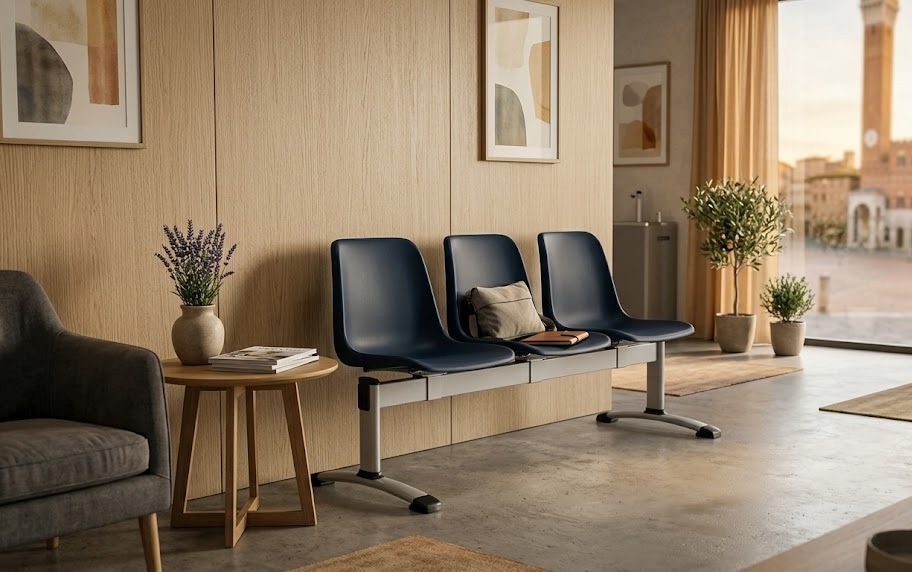
They represent the most widespread, modern and efficient solution for managing high-traffic spaces thanks to the intrinsic properties of thermoplastic plastic.
Advantages: Lightweight, economical structures available in a wide range of colours to match your company brand. The non-porous surfaces are very easy to clean and disinfect daily. They are often made of self-extinguishing polymers certified Class 1 for fire safety.
Disadvantages: They offer a purely functional and minimal aesthetic impact, less suitable for contexts that require a classic or ostentatious design.
Ideal for: Healthcare facilities, hospitals, dental clinics, analysis laboratories, public offices and schools.
Variants aimed at total user comfort, characterised by padded polyurethane foam shells and soft coverings.
Advantages: They guarantee excellent comfort and excellent lumbar support, reducing fatigue even in the case of prolonged waits. Eco-leather and technical fabrics give a refined and elegant look to the environment.
Disadvantages: They require greater attention during cleaning and ordinary maintenance operations than smooth plastic surfaces.
Ideal for: Law firms and notary offices, executive offices, corporate receptions, private clinics and conference rooms.
Timeless design solutions that combine the natural warmth of solid wood (usually beech plywood) with the stability of metal frames.
Advantages: They convey an immediate feeling of welcome, domestic warmth and solidity. The protective coating ensures good scratch resistance and ease of dusting.
Disadvantages: Less flexibility for insertion in contexts with ultra-modern or high-tech architecture.
Ideal for: Psychology studies, consultancy agencies, traditional contexts and waiting rooms with a classic style.
To set up a waiting room that is comfortable and efficient, it is essential to analyse the precise dimensional parameters and construction details of the frames.
The geometric planning of the seats avoids overcrowding in the room and ensures the fluidity of pedestrian passages. Our catalogue allows you to calculate the spaces precisely:
The bench's load-bearing base must ensure maximum static stability under intensive use. Epoxy-powder-coated steel frames (available in black, white, or gray finishes) offer exceptional strength against accidental impacts and corrosion caused by humidity from washing. Central-bearing beam structures distribute weight evenly, preventing sagging or dangerous oscillations.
As these are furnishings intended for public and collective use, benches must meet strict regulatory standards. In Italy, they must comply with the directives of Legislative Decree 81/2008 (Safety at Work) and pass the UNI stability and mechanical resistance tests. In healthcare and hospital environments it is often mandatory to install self-extinguishing polypropylene shells certified in Class 1 fire reaction (UNI EN 13823 standard). Furthermore, the positioning of the benches must respect the accessibility lines provided for by Ministerial Decree 236/1989, safeguarding the maneuvering space required for wheelchairs.
Medical offices, Dental clinics and Hospitals: The choice of choice falls on monoblock or copolymer polypropylene benches on a steel frame. The non-porous nature of the material allows for deep, daily disinfection with alcohol-based solutions or hospital-grade detergents, ensuring compliance with the highest hygiene protocols and Class 1 fire safety compliance.
Corporate Receptions, Professional Offices, and Law Firms: Premium models with upholstered fabric or eco-leather shells, or hybrid solutions in beech wood and anodized aluminum, are preferred. These furnishings aim to maximize visual comfort and ergonomics, integrating color-wise with floors and walls to communicate a solid and refined corporate identity.
Large Transit Areas and Public Waiting Rooms: In contexts with very high turnover, where seats are subjected to continuous stress, the ideal combination includes heavy steel structures or seats with micro-perforations to promote passenger transpiration. Long modules with 3 or more seats optimize flows, reducing long-term replacement costs.
Refreshing the image of your reception means improving the way you welcome your customers. On Holity.co.uk we offer you a specialized assortment with over 130 variations of waiting room benches, capable of meeting any space, style and budget requirement. Our range covers a flexible price range, from basic plastic solutions (accessible between 116 and 150 euros) to premium ergonomic models with refined finishes (over 270-295 euros).
Use our side navigation filters to select the frame material (polypropylene, wood or upholstered) and configure the ideal dimensions for your spaces. Do you manage purchases for a Public Administration facility or do you need a dedicated quote for multiple quantities and large batches? Contact our customer service today for technical support, compliance guarantees and a personalized quote tailored to your project.
What are the structural advantages of benches equipped with a central load-bearing beam compared to other frame configurations?
Structures engineered with a central load-bearing beam offer exceptional robustness under intensive use. This specific architecture is designed to distribute the weight of visitors perfectly evenly along the horizontal axis of the furniture. This prevents structural failure, flexing of the body or dangerous oscillations, ensuring maximum static stability even when the bench is fully occupied and on all available seats at the same time.
What does the Class 1 fire reaction certification (UNI EN 13823 standard) mean for benches intended for public waiting rooms?
Class 1 certification (according to the UNI EN 13823 standard) attests that the plastic or thermoplastic materials used for the bench frame are self-extinguishing. This regulatory requirement guarantees that, in the event of a fire inside the building, the furniture does not fuel combustion in any way and does not spread the flames. This is a passive safety prerequisite often required by law when setting up collective spaces, hospitals or public healthcare facilities.
How should the positioning of waiting benches coordinate with the accessibility requirements of Ministerial Decree 236/1989?
Compliance with Ministerial Decree 236/1989 requires that the furniture set-up does not create architectural barriers in public spaces. When planning the arrangement of the benches, it is necessary to safeguard the minimum dimensions of pedestrian transit corridors and provide adequate maneuvering spaces for wheelchairs. Furthermore, the standard influences the choice of seat height, which must be suitable to facilitate transition movements; modern benches comply with these guidelines by offering modular configurations and calibrated ergonomic heights.
What is the functional advantage of seats equipped with micro-perforations in contexts with very high turnover such as stations or large public offices?
Micro-perforations applied to plastic or metal shells represent an important ergonomic measure for large transit areas, where passengers face prolonged waits. The micro-perforations distributed across the seating surface and backrest are specifically designed to promote the user's natural body transpiration. This construction detail significantly improves perceived climate comfort, reducing the build-up of heat and humidity, while maintaining a smooth surface that is extremely easy to sanitize.
What color finishes are available for frames treated with epoxy powders and how does this coating protect against the humidity of washing?
The steel frames in the catalogue are available in three standard colour finishes: black, white or grey. The industrial epoxy powder coating process involves thermally fusing the polymer onto the metal, creating an armoured, porous-free protective layer. This chemical-physical barrier isolates the steel from accidental impacts and guarantees extremely high resistance to latent corrosion, which could otherwise be triggered by the constant humidity due to daily floor washing and disinfection cycles.
What is the difference, in terms of durability and performance, between standard polypropylene and copolymer polypropylene frames?
While standard polypropylene is the choice of choice for its lightness, colour flexibility and cost-effectiveness in moderately frequented environments, copolymer polypropylene introduces superior structural performance. Thanks to a modified chemical formula, the copolymer boasts a molecular density that makes it intrinsically more resistant and durable to mechanical stress, bending and continuous wear. This variant is highly recommended for contract settings exposed to uninterrupted shifts of use.
 English
  Italian
 French
 German
 Spanish