
mon-fri 9-13 / 14.30-18.30
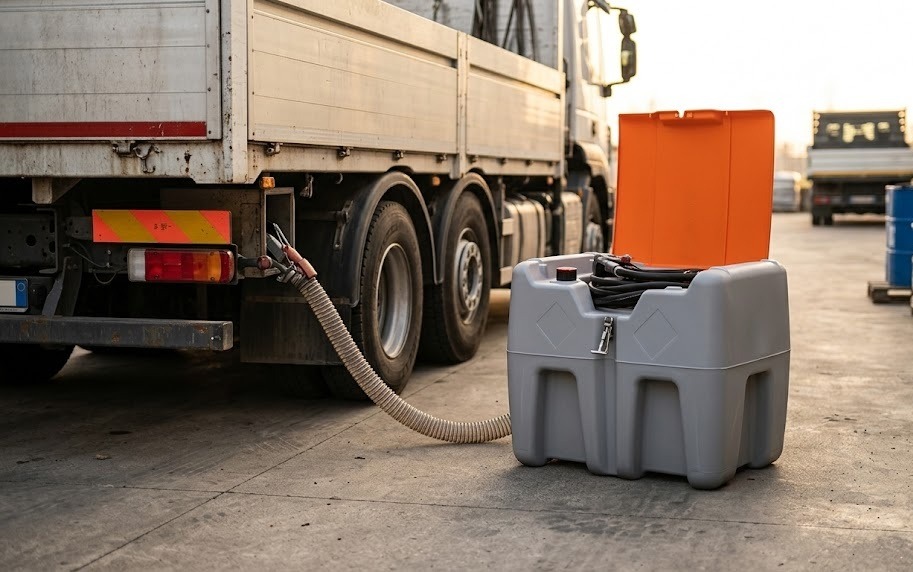
Energy flow management and the availability of mobile refueling stations are crucial factors for optimizing logistics in modern industrial, construction, and agricultural contexts. Choosing the right transportable tanks isn't just about selecting a simple liquid container; it's a strategic decision aimed at eliminating machinery downtime, centralizing consumption control in the field, and ensuring full compliance with stringent environmental and workplace safety regulations. On large construction sites, mining areas, agricultural businesses, or marinas, having an autonomous, mobile dispensing unit allows you to refuel your fleet directly on-site, eliminating costly and risky trips to fixed distribution points. This buying guide is designed to guide you through the various configurations available in the Holity.com catalog, analyzing the chemical compatibility of the fluids, the modularity of the capacities, and the engineering and economic parameters of the transfer units.
The chemical-physical nature of the liquid to be handled determines the choice of construction materials and active safety devices to be integrated into the body. Our catalogue offers targeted and rigidly compartmentalised solutions based on the intended fluid:
The choice of the ideal cubic capacity must be compatible with the autonomy required by the work cycles and with the useful dimensions of the cargo bed or platform of the company vehicle intended for transport. Our professional range is structured to comprehensively cover any logistical need through precise volumetric steps:
The purchase of a professional mobile refueling station represents a very high-yield investment, capable of generating an immediate ROI thanks to the reduction of staff downtime and the protection of engines from contaminated fuels. The flexibility of the range proposed on Holity.com allows you to calibrate the expenditure based on the required system complexity, moving within a price range between €590.00 and €2218.00. The entry-level solutions cover compact single-fluid polyethylene modules, while the top-of-the-range quotations identify high-capacity structured systems or combined bi-fluid units equipped with double independent pumping units, digital flow meters and lockable protective covers.
To configure the ideal supply for your operating context, it is essential to analyse some technical parameters that differentiate professional contract equipment:
The road transport of flammable or dangerous liquids is regulated in Europe by the international agreement ADR . To facilitate the daily activities of businesses, the legislation provides for a partial exemption regime (paragraph 1.1.3.1.c, known as the artisan exemption), which exempts from ADR obligations the transport of fuel intended for the direct refueling of machinery on the construction site, provided they are contained in approved tanks, securely anchored and equipped with anti-leak volumetric vent valves. For maximum volumes or purely commercial transport, the tanks must instead meet ministerial approvals such as IBC (IBC) marked with the UN code and subjected to periodic inspections every two or three years.
Optimize the logistics of your construction sites, protect the health of your workers in the field and preserve the value of your company's equipment. In the Holity.com online catalogue we offer you a specialised and certified range of transportable fuel tanks, developed to guarantee maximum structural stability, constant flow and full compliance with road regulations.
Use our side navigation tools to select the target fluid ( AdBlue, Petrol, Diesel ), set the ideal volumetric capacity for your consumption ( from 120 L up to 980 L ) and configure the price range consistent with your budget (590.00€ - 2218.00€ ). Contact our customer service today to receive complete technical data sheets, chemical compatibility parameters and a personalised quote tailored to your needs.
How does the venting system integrated into transportable tanks work and why is it essential for dynamic safety on the bed of a pick-up truck?
Professional polyethylene or steel tanks are fitted with special spring-loaded volumetric vent valves on top of the filler cap. When the vehicle is exposed to the sun, the rise in temperature causes the fuel to expand and the liquid to partially vaporise, generating internal pressure peaks; the valve opens, allowing the excess vapours to escape. Conversely, when pumping fuel or in the event of a sudden drop in temperature, the valve admits air to compensate for the internal vacuum, preventing plastic deformation or structural collapse of the tank.
What structural features differentiate the 120 L and 190 L units from the maxi 980 L models in managing the vehicle's centre of gravity?
The compact 120L and 190L models feature low profiles and flat geometries designed to keep the fluid's center of gravity as close as possible to the vehicle's load floor, reducing the impact on light van suspension systems. The heavy-duty 980L variants, moving fluid masses close to one ton, incorporate internal perforated baffles and molded body shells with increased wall thicknesses. These internal barriers break the kinetic energy of the hydraulic wave generated by braking or cornering, stabilizing the dynamic attitude of the carrier truck.
How does the positioning of a 12V or 24V pump affect duty cycles and maximum continuous delivery time (Duty Cycle)?
The electric motors of DC volumetric pumps (12V or 24V) connected to the batteries of the work vehicles generate heat by magnetic induction during transfer. Professional contract pump units are designed with a timed operating regime called "Duty Cycle" (usually 30 minutes of continuous work followed by a cooling phase). Respecting this parameter is essential in high-capacity models such as the 440 L or 620 L ones: the transfer speed of the pump must be commensurate with the volume to complete the refueling of the vehicles without triggering a thermal cut-out or overheating of the electric motor.
Why is the presence of an automatic nozzle with swivel connector considered an essential safety and spill prevention device in the field?
The automatic dispensing nozzle integrates a pneumatic back pressure sensor (Venturi tube) in the delivery mouth. As soon as the fuel level inside the tank of the vehicle being refueled touches the tip of the nozzle, the circuit instantly interrupts the transfer flow, eliminating the risk of backflow or accidental spills of hydrocarbons on the ground, a practice strictly sanctioned by environmental directives. The swivel connector also prevents the delivery hose from kinking, making it easier for the porter to maneuver and avoiding cracks in the rubber.
What chemical balances require the use of pure linear polyethylene in the 3 tank models dedicated to storing the AdBlue additive?
AdBlue is an aqueous solution of 32.5% pure urea that reacts chemically on contact with non-noble metals or plastics added with release agents containing zinc, lead, or copper. The leaching of these elements would pollute the fluid; Once introduced into the vehicle, the contaminated additive would destroy the ceramic elements of the SCR catalyst, causing the electronic blockage of the industrial vehicle. The 3 models in the catalogue are moulded exclusively with very high molecular purity virgin polyethylene granules and assembled with pipes and fittings completely free of metal alloys subject to alkaline corrosion.
How does the economic spectrum of the catalogue (€590.00 - €2218.00) correlate with the structural thickness of the sheets and the level of mechanisation of the device?
The modularity of the costs reflects the engineering complexity, the thickness of the materials and the level of automation of the dispensing system. The starting price (€590.00) maps the compact 120 L or 190 L single-fluid modules in polyethylene with essential pump groups without external shields. Moving up the mid-range (210 L to 440 L models), prices increase based on capacity and the integration of precision digital flow meters and water separator filters. The top-of-the-range price (up to €2,218.00) includes professional maxi-capacity 980 L transfer stations or heavy-duty dual-fluid combination units, equipped with perimeter armored shells, dual independent electrical circuits, and maximum security locking systems for continuous industrial contract use.
 English
 Italian
 French
 German
 Spanish