
mon-fri 9-13 / 14.30-18.30
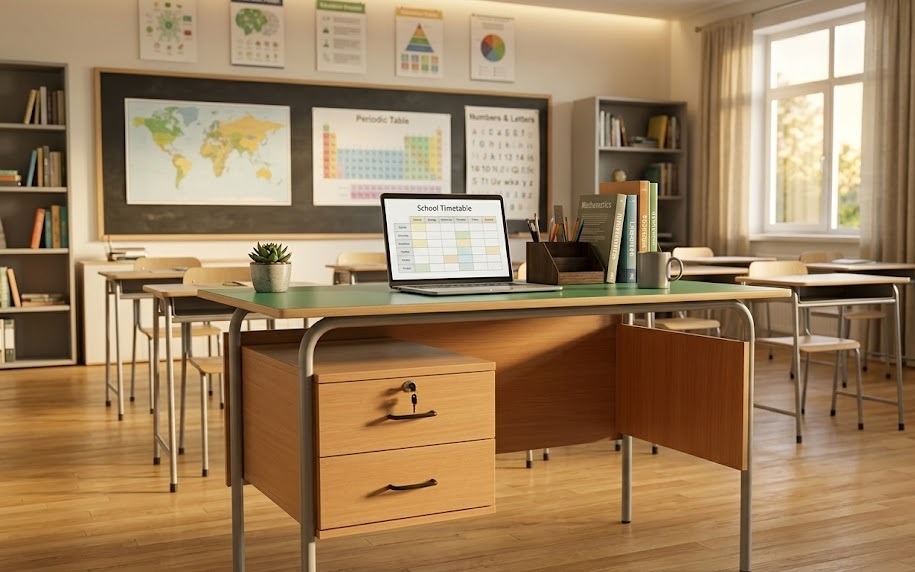
Within the layout of a classroom or learning room, the teacher's desk represents the central organizational axis around which lesson dynamics and the management of educational technology revolve. Choosing the ideal teacher's desks isn't simply a matter of purchasing office desks; it's a logistical decision aimed at ensuring teachers' postural health, ensuring continuity of use under high mechanical stress, and protecting sensitive data in accordance with privacy regulations. From elementary schools to universities, including science laboratories and 4.0 classrooms, the teacher's desk must combine a scratch-resistant, washable work surface with provision for electrical wiring and maximum anti-tip stability. This buying guide is designed to guide you through the various models in the Holity.co.uk catalog, analyzing frame structures, drawer types, courtesy panels, and regulatory compliance requirements.
The configuration of the desk must accommodate the rotation habits of the teaching staff and the storage needs of the classroom:
The classic and complete configuration for face-to-face teaching and material storage.
Minimal solutions aimed at maximum modularity and freedom of movement.
The modesty panel or courtesy panel is a vertical element integrated under the work surface that closes the front part of the desk facing the students. It performs a dual function: it guarantees total postural privacy for the seated teacher and acts as a structural stiffening element for the metal cage, while at the same time hiding the tangles of PC and monitor power cables from the view of the class.
Since these are furnishings exposed to continuous intensive use by different users, the selection of materials must guarantee high resistance to abrasion and daily washing:
The base is made of high-thickness steel tube (with round, square or rectangular section) coated with oven-polymerized epoxy powders. This treatment creates a scratch-resistant, rust-proof, non-porous protective layer that can be washed with pressure washers or cloths soaked in disinfectant detergents. The floor-standing feet feature non-slip tips and, where applicable, height-adjustable articulated joints to compensate for unevenness in historic floors.
The worktops are made of high-density melamine (18 to 25 mm thick) or high-pressure HPL plastic laminate. The key feature is the perimeter edge in high-thickness (2 mm) ABS thermoplastic resin, applied hot: the edges are rounded with a safety radius to eliminate any sharp edges or parts, preventing chipping from impacts and protecting students from accidental impacts.
The variety of the catalogue on Holity.co.uk allows us to satisfy both the integration needs of single classrooms and large supply lots for school building redevelopment projects. The quotations range within a flexible and calibrated cost range for the Public Administration, from essential basic models with an open structure, up to executive chairs complete with monoblock drawer units, modesty panels and highly resistant HPL finishes.
Chairs intended for educational institutions and public bodies must satisfy specific legal constraints regarding safety, non-toxicity and environmental sustainability:
Make your school safe, offer your teaching staff an ergonomic and long-lasting workstation, and adapt your teaching environments to the Minimum Environmental Criteria and European regulations. Browse the online catalog to select the most suitable desk model: set the type (with or without drawers), the presence of the front panel and the useful dimensions for your classrooms.
Request a personalized quote today: our team of experts is at your complete disposal to provide you with technical compliance data sheets, dimensioned drawings and confidential quotations for multiple supply batches.
How does the rounded ABS edge treatment with a safety radius prevent injuries and avoid delamination of the tops?
In inexpensive desks and chairs, the edges of the tops are covered with thin strips of cold-glued melamine paper: under the action of the continuous impacts of chairs or the passage of backpacks, the edges quickly chip, exposing the sharp wooden edge and triggering the infiltration of humidity. The professional ABS edge is 2 mm thick and is applied by melting hot-melt polyurethane glue. During processing, the edges and corners are milled and rounded with a safety radius. This eliminates any sharp points to protect students and teachers and creates a watertight seal that prevents delamination of the top even after years of use.
What mechanical characteristics differentiate epoxy powder-coated steel frames from liquid-coated metal tubes?
Liquid-coated school frames have a thin surface coating that tends to chip easily when impacted by chair legs or cleaning buckets, exposing the underlying metal to oxidation and rust. The epoxy powder coating polymerized in an oven at high temperatures (over 180°C) liquefies the resin powder on the pre-treated steel structure, fusing it with the metal surface. This process creates a very thick protective layer, extremely flexible and impact-resistant, immune to corrosion triggered by washing and completely free of volatile organic compounds (VOCs) harmful to the health of the classroom.
How does the presence of the coded key lock on the drawer units reconcile with the obligations of the GDPR Regulation on the protection of personal data?
The General Data Protection Regulation (GDPR - EU 2016/679) requires schools to adopt adequate technical and organizational security measures to protect students' personal and sensitive data contained in paper registers, assessment forms, DSA, or USB drives and classroom tablets. A teacher's desk equipped with a single-block drawer unit with a lock with an encrypted key (or central locking) allows the teacher to physically segregate and lock confidential documents during breaks or when classes are changed, preventing them from being viewed or stolen by unauthorized third parties and fulfilling the custody obligations required by law.
Why is the presence of articulated and height-adjustable feet essential for the stability of the desk on historic or uneven floors?
Many schools are located in historic buildings with floors in marble, terrazzo or antique parquet characterised by depressions and millimetric differences in level. A desk with a rigid structure and four fixed legs placed on an uneven surface would tend to wobble continuously with every pressure of the hands or while typing on the computer. The adjustable threaded leveling feet at the base of the desk allow the height of each individual leg to be adjusted independently by several millimeters. The non-slip rubber base of the joint also absorbs vibrations, ensuring a perfectly horizontal and immobile work surface.
How does Class E1 panel certification protect the health of the air in closed school environments?
Formaldehyde is a volatile compound used as a binding resin in the production of chipboard or MDF panels. In closed and poorly ventilated environments such as classrooms, the presence of non-certified furnishings can cause the slow and continuous release of formaldehyde into the air, with the risk of respiratory irritation for students and teachers. Class E1 certification establishes an extremely strict maximum formaldehyde emission limit (less than 0.1 ppm). The purchase of Class E1-compliant chairs guarantees the absence of toxic fumes and meets the air quality parameters prescribed by school health protocols.
Why is compliance with the Minimum Environmental Criteria (CAM) a mandatory prerequisite for purchasing school furniture through the MePA portal?
The Public Contracts Code requires contracting authorities and schools to include the environmental clauses established by the Minimum Environmental Criteria (CAM Furniture) in all procurement tenders and direct negotiations on the Public Administration Electronic Marketplace (MePA) portal. The CAM requires that the wood used comes from sustainably managed certified forests (FSC or PEFC), that the metal components contain a percentage of recycled material, that hazardous substances or phthalates are excluded from the finishes, and that the furniture is designed to be easily disassembled and recycled at the end of its life, certifying the institution's commitment to sustainability.
 English
  Italian
 French
 German
 Spanish