
mon-fri 9-13 / 14.30-18.30
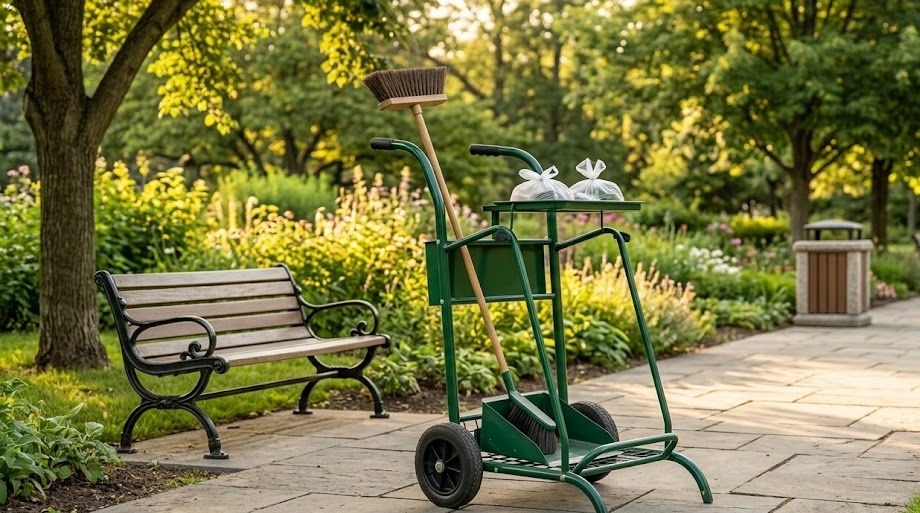
Efficient management of environmental hygiene services and manual or semi-mechanical sweeping of public spaces are fundamental pillars for safeguarding the urban decorum and health of our cities. Choosing the right street cleaning carts isn't simply a matter of purchasing technical furniture or hardware for public institutions; it's a logistical and preventative investment aimed at eliminating the risk of musculoskeletal injuries for sanitation workers, optimizing collection shifts, and increasing waste sorting rates in the area. Whether working within historic alleys with limited floor space, tree-lined avenues, public parks, or large industrial complexes and trade fairs, the pushing equipment must ensure maximum smoothness, impeccable driving ergonomics, and high resistance to atmospheric agents and the corrosive action of organic waste. This purchasing guide was created to help you navigate the many technological and dimensional options available in the Holity.co.uk catalogue, analysing support types, integrated accessories, wheels and price ranges.
The first major architectural distinction in waste collection trolleys concerns the waste containment and handling method, an element that determines the operational versatility of the vehicle during the cleaning process:
Systems designed for the direct collection of waste inside flexible polyethylene bags (single or multiple).
Wheeled structures equipped with shaped compartments, reinforced support plates or bayonet rings designed to accommodate one or more rigid plastic wheeled bins (80, 120 or 240 litres).
The geometric conformation of the streets and municipal depots requires a careful evaluation of the overall dimensions of the trolley. Holity.co.uk's technical filters allow you to select the product profile to the millimetre:
The purchase of equipment for public and municipal property requires financial flexibility to respond both to small neighborhood integrations and large municipal tender specifications. The range available on Holity.co.uk covers a flexible price range that varies from €234.00 to €2250.00 . The entry-level prices (€234.00 - €500.00) map the essential single-frame trolleys in galvanized or painted steel with single or double bag holder. The intermediate and top-of-the-range range (up to €2250.00) identifies motorized or multifunctional sweeping stations with armored frames, large diameter pneumatic or puncture-proof wheels, parking brakes, lockable storage drawers and nautical-grade anti-corrosion treatments for coastal environments.
The durability and maneuverability of a street cleaning cart depend on the quality of the carpentry and the rotation system:
Improve the productivity of your waste collection personnel, ensure the safety of field operators and adapt your company fleet to the most modern standards of hygiene and urban decorum. Use the filters in our online catalogue to select the type of support suitable ( With bag holder or Can be used with bin ), set the dimensional sliders for height, depth and length, and identify the perfect price range for your needs.
Request a personalized quote today : our team of experts is at your disposal to provide you with technical data sheets, CE conformity certifications and confidential quotations tailored to large supply batches.
What mechanical features differentiate trolleys equipped with a bag holder from versions usable with a 120-litre rigid bin?
Models with an integrated bag holder use open tubular cage or ring frames, focused on maximum speed and reduced empty weight (often less than 25-30 kg). They allow the operator to unhook and re-tie the bag in just a few seconds without having to perform heavy lifting. Trolleys usable with a bin instead integrate a cup base or high-load capacity shaped sheet metal support plates with bayonet catches. This structure allows for the transport of the wheeled plastic bin (e.g. 120 L), protecting the waste from attacks by stray animals and preventing the spillage of liquids and leachate.
How does the choice between pneumatic air wheels and puncture-proof solid elastomer wheels affect traction in historic centers with cobblestone pavements?
On the uneven, cobblestone or cobblestone pavements typical of historic centers, pneumatic wheels with an inner tube cushion and absorb the energy of impacts, reducing the vibrations transmitted to the wrists and arms of the waste collector. However, in urban contexts where the streets present a high risk of sharp debris (bottle glass, sheet metal, syringes), pneumatic wheels are at risk of frequent punctures. Puncture-proof solid elastomer or microcellular polyurethane wheels represent the ideal synthesis: they maintain an elastic deformation capacity similar to pneumatic rubber but are biologically and mechanically puncture-proof, eliminating machine downtime costs.
How do the width and depth of the chassis (up to 885.00 mm) affect the overcoming of architectural barriers and narrow pedestrian crossings?
During urban sweeping routes, the operator finds himself having to overcome curbs, ramps for disabled people and pass through narrow gaps in alleys. A trolley with a depth contained within 500-600 mm maintains a very small turning radius and allows the operator to be alongside the pavement without protruding into the traffic lane. The models with larger cross-sectional dimensions (up to 885.00 mm) compensate for the width with a very low centre of gravity and large diameter wheels (up to 310 mm), designed to ensure absolute anti-tipping stability on steep slopes or ramps.
Which anti-corrosion treatments guarantee the inalterability of the steel body against the chemical action of leachate and high-pressure sanitizers?
Organic waste and the unsorted fraction release acidic liquids (leachate) that quickly attack common sheet metal. The protection of the metalwork is based on the hot-dip galvanizing cycle according to the UNI EN ISO 1461 standard, which creates a molecular fusion between iron and zinc. Added to this is the industrial painting with epoxy powders polymerized in the oven, which creates an airtight, smooth and water-repellent body. This treatment allows the trolley to be washed at the end of the shift directly with high-pressure lances and concentrated chemical disinfectants without damaging the metal or generating under-film rust.
Which integrated accessories (tool racks, lockable compartments) optimize the workflow during the manual sweeping shift?
A professional street cleaning trolley acts as a true mobile workstation. The integration of vertical racks with handle clips allows the broom, aluminum shovel, and waste collection tongs to be transported safely without hindering walking. The presence of upper storage compartments or lockable drawers allows the operator to safely store personal effects, spare personal protective equipment (PPE), new bag rolls, and products for the rapid disinfection of benches or public waste bins.
How does the price range (€234.00 - €2250.00) correlate with structural specifications, braking systems, and the presence of double waste containers?
Cost modularity responds proportionally to the density of the materials and the technology applied. The entry-level models (€234.00 - €500.00) map single-structure steel trolleys with single or double bag holders and standard rubber wheels. Moving up towards the medium and high range (up to €2250.00), the price increases by virtue of reinforced frames for double 120/240-litre bins, the integration of pedal or lever braking systems on the handlebars (essential for safety on slopes), puncture-proof wheels mounted on shielded ball bearings, perimeter rubber fenders, and armoured storage compartments.
 English
  Italian
 French
 German
 Spanish