
mon-fri 9-13 / 14.30-18.30
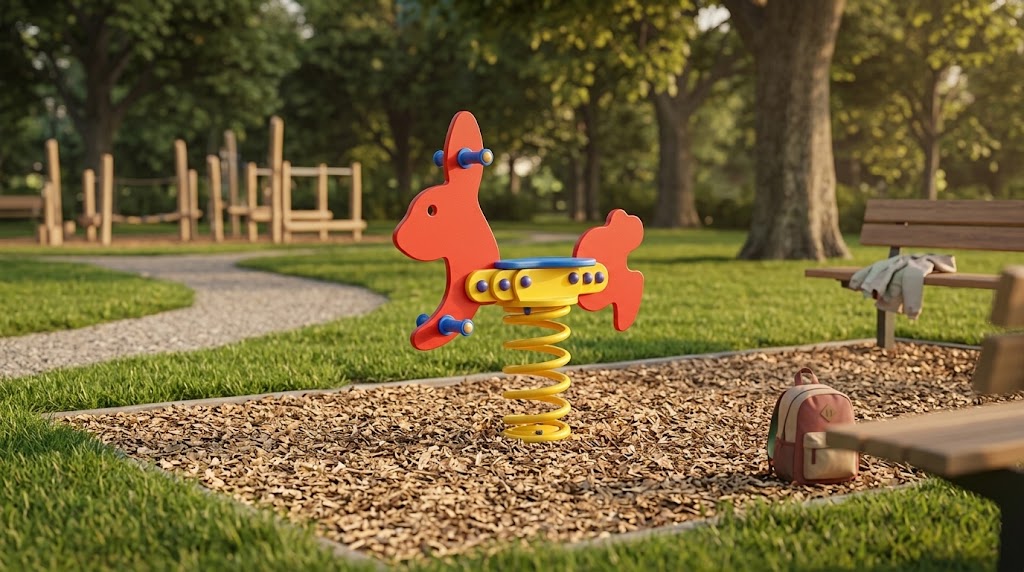
The spring toys Playgrounds are one of the most iconic, fun, and essential elements in any public playground, schoolyard, kindergarten, play center, or recreation area of a hospitality facility. Featuring colorful and diverse shapes—from cute zoomorphic figures like horses, sharks, and giraffes to vehicles like toy cars and motorcycles—these play equipment not only provide entertainment for children, but also play a fundamental role in neuromuscular development. Harnessing the spring's elastic response, the swinging motion stimulates the trunk's stabilizing muscles, improves proprioception, and allows children to safely experiment with balance, acceleration, and motor coordination.
Choosing the ideal spring toy for your project means considering the age of the little users, the weather-resistant materials, the available space, and full compliance with current safety regulations. This buying guide analyzes the Holity.co.uk catalog to guide you toward an informed choice that complies with legal requirements.
The game profile must be aligned with the prevailing age of the children who frequent the play area:
The material composition directly affects the durability of the furniture, maintenance costs and the aesthetic impact on the park:
The Holity.co.uk online catalog offers an exceptional variety of sizes to fit both small private gardens and large public parks. Lengths range from compact models measuring 21 cm, 48.8 cm, 65 cm, and 80 cm to imposing multi-seater structures measuring 120 cm, 189 cm, 268 cm, and 300 cm.
The assortment allows to satisfy every purchasing and investment plan, moving within a price range between €410.00 and €3828.00 for the complete equipment:
Make your community playground unique, safe, and stimulating with the spring toys available on Holity.co.uk. Explore the online catalog to select the most suitable model: set the length of the structure, choose the bright colors (orange, light blue, yellow, lilac, green, purple), and identify the zoomorphic or vehicle-like shapes your little ones prefer.
Request a personalized quote today Our sales team is at your complete disposal to provide technical data sheets, EN 1176 approval certificates, anchoring diagrams, and special offers for batch orders.
What practical advantages does HDPE polyethylene offer over wood for installing a spring ride in a public park?
High-density polyethylene (HDPE) is the ideal modern material for unattended public areas. Being a solid, paste-dyed polymer, it doesn't lose its shine under UV rays, doesn't rot when exposed to rain, and isn't affected by temperature fluctuations. Unlike wood, HDPE doesn't splinter, which could injure children's hands. It's completely non-porous (making it easy to clean from graffiti or dirt). It doesn't require any painting or periodic protective treatment over the years.
What does the UNI EN 1176 standard establish regarding spring and seat protection devices?
The EN 1176 standard requires that the steel spring be designed to prevent the risk of crushing or shearing the child's fingers or toes during maximum swinging. The distance between the coils must be calibrated, or the base of the spring must include a rubber or plastic protective plate/cap to prevent the insertion of hands. Furthermore, handles and footrests must have non-slip surfaces with rounded ends, and the seat must be free of sharp edges.
Is it possible to install a spring ride on a grassy lawn without pouring a concrete base?
To ensure the stability and safety required by law, the spring ride must be anchored to a rigid foundation that can withstand the strong thrust and leverage forces generated by its oscillation. Standard installation involves digging a hole in the ground to embed the steel anchor bracket within a concrete plinth poured underground. Once the plinth is covered with soil and grass (or a shock-absorbing tile is installed), the ride will be perfectly immobile and compliant.
How do you choose the spring stiffness based on the age group of the children?
The spring's spring rate (hardness) must be proportionate to the weight of the child. For early childhood (0-3 years), the spring has a slightly more flexible wire section to allow for a smooth swinging motion even with the child's light weight. For toys intended for children up to 8-12 years old or for two-seater models, the spring uses a high-strength steel wire of 20 mm or more, capable of supporting the loads of two simultaneous users without collapsing or losing its spring response.
How does the price range in the category (€410.00 - €3828.00) correlate with the size of the frame, the materials and the number of seats?
Pricing is determined by the metric development of the figure, the thickness of the HDPE/HPL plates, and the number of springs and anchors used. The entry-level range (€410.00 - €750.00) includes classic single-seater spring rides with shaped HDPE shapes and an in-ground bracket for schools and residential areas. The mid-range range (€750.00 - €1500.00) includes rides with 3D shapes or vandal-proof HPL frames, vehicle versions, and two-seater springs for street furniture. Top-of-the-line prices (up to €3828.00) include large, multi-seater, high-development swinging installations (up to 3 meters in length) with multiple reinforced springs for municipal parks and contract resorts.
 English
  Italian
 French
 German
 Spanish