
mon-fri 9-13 / 14.30-18.30
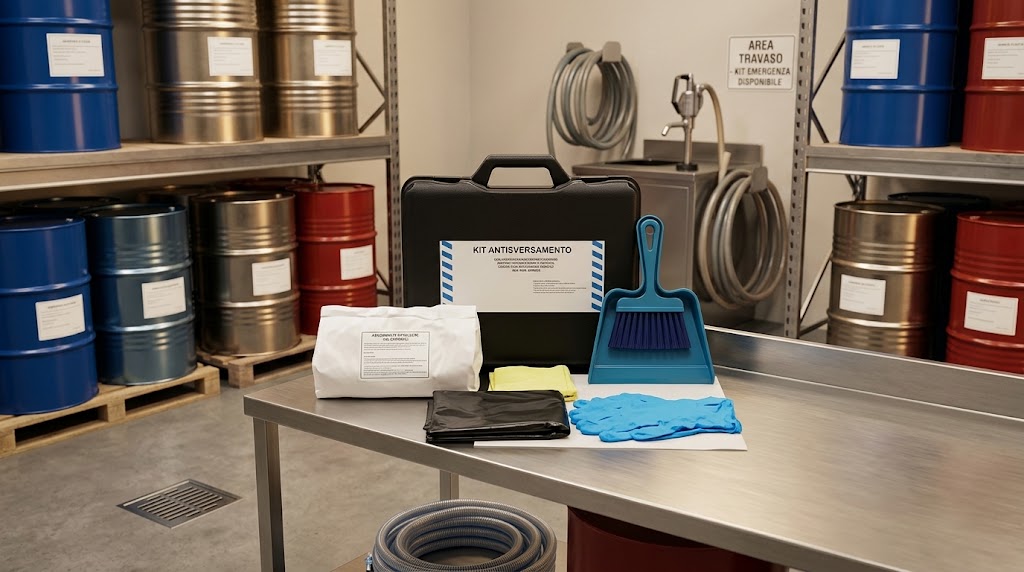
In manufacturing plants, workshops, warehouses and loading and unloading areas, an accidental spill of oils, fuels, industrial liquids or chemicals must be managed with materials compatible with the fluid involved.professional anti-spill kit collects absorbents and accessories useful for confining and collecting the liquid according to the emergency procedures established by the facility.
The choice should not be based only on the declared capacity: it is necessary to evaluate type of liquid, compatibility of the absorbent, potentially spillable quantity, place of use and method of intervention.
Oils and hydrocarbons: Selective absorbents are designed to retain oils, lubricants, and other oily liquids while limiting water absorption. They can also be useful in outdoor areas or on wet surfaces. When handling fuels or flammable liquids, the safety procedures required for the substance must be followed.
Chemicals: They use absorbents designed for specific aggressive or corrosive substances. Compatibility must be verified based on the product handled and the relevant safety data sheet. Absorption and neutralization are not the same thing: neutralization requires a specific, compatible product.
Universal liquids: They are intended for a wide range of industrial fluids, such as water, emulsions, coolants, and oils. However, they should not be automatically considered compatible with every chemical.
Bags and briefcases They are compact and suitable for service vehicles, mobile maintenance and small interventions. Wheeled bins and containers They allow for the movement of larger quantities of sanitary towels in the production departments. Cabinets and fixed stations They can be placed near transfer or storage areas to create an easily accessible intervention point.
Watertightness, approvals and specific transport characteristics must be verified on the individual product.
The capacity in liters is an important factor, but it should not be chosen automatically. It is preferable to consider the maximum reasonably foreseeable spill, the potentially releasable volume, any containment systems already present, the proximity of drains or manholes and the time required to intervene.
If a single kit is not sufficient for the expected scenario, it may be necessary to prepare multiple devices or complementary containment systems.
The PPE included in the kit is not automatically suitable for every substance. Gloves, goggles, and other protective equipment must be appropriate for the liquid involved and the instructions on the relevant safety data sheet.
For vehicles subject to ADR, the spill kit may be part of the operational equipment, but does not replace other devices required depending on the dangerous goods transported.
The kit must be easily accessible without requiring operators to cross the spill area directly. A typical location is near the storage or transfer area of drums and liquid substances, in a visible and accessible location.
Other common locations include workshops, fluid production lines, loading and unloading bays, yards, and refueling areas.
The price may vary depending on Absorbency, type of liquid, quantity and size of pads, container, mobility, PPE and accessories includedIt is therefore preferable to compare kits with equivalent features rather than associating a rigid price range with a certain capacity.
Explore the selection of spill kit on Holity and compare models by type of liquid, absorbency, container and internal features.
For supplies intended for factories, workshops, warehouses or public bodies you can request a personalized quote indicating quantity, substances handled, required capacity and intended use.
What is the difference between oil kits and chemical kits?
Oil kits use selective absorbents for oily liquids; chemical kits use materials intended for aggressive or corrosive substances and must be chosen based on compatibility.
Does a chemical kit automatically neutralize acids and bases?
No. Absorption and neutralization are different operations. Neutralization requires a specific product compatible with the substance.
How do you determine the required capacity?
The maximum reasonably foreseeable spill must be assessed, also considering containment systems, nearby drains and response times.
How do you manage used sanitary pads?
They must be collected, classified and disposed of based on the absorbed substance and the characteristics of the waste, correctly determining the applicable EER code.
Is a spill kit sufficient to comply with ADR?
No. For vehicles subject to ADR, it is necessary to check that all required equipment is included based on the goods transported.
 English
  Italian
 French
 German
 Spanish