
mon-fri 9-13 / 14.30-18.30
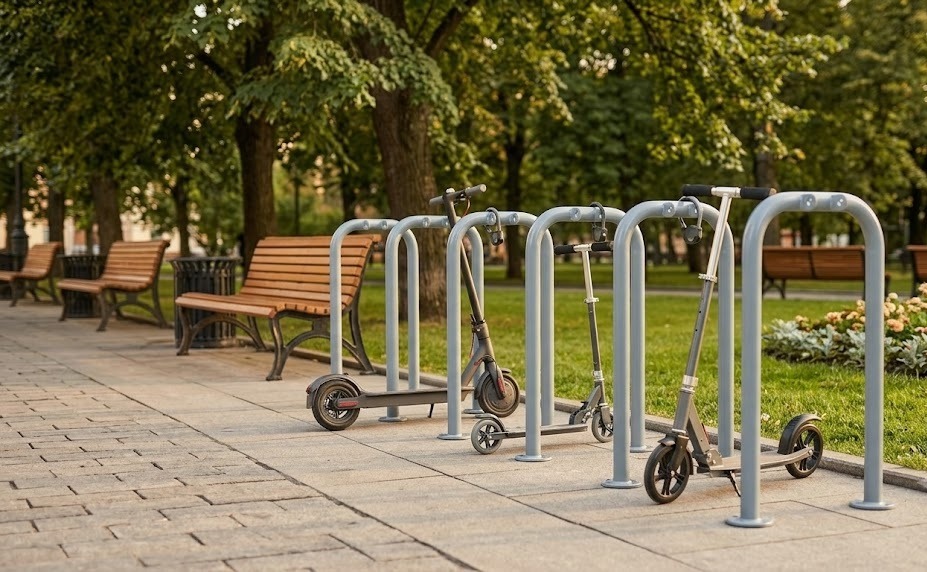
The rise and consolidation of electric micromobility has radically changed the accessibility and use of public and private spaces, making the integration of dedicated cycle stations a crucial factor for architectural order and livability. Choosing the ideal scooter racks isn't just about installing a simple outdoor metal structure; it's a strategic intervention aimed at eliminating unauthorized sidewalk parking, ensuring pedestrian safety, preventing theft, and safeguarding personal vehicles from accidental falls. With often high centers of gravity and frames lacking the stability of traditional bicycles, electric scooters require engineered housings that securely lock the steering column without stressing the fragile side stand. This purchasing guide was created to guide public bodies, facility managers, companies and designers in selecting the ideal models present in the Holity.co.uk catalogue, analysing the modularity of the spaces, the millimetric dimensional parameters and the methods of anchoring to the ground or to the wall.
The constructive configuration of the support must be compatible with the available floor space and with the users' usage habits. Our catalogue offers diversified solutions for every specific construction site:
They represent the standard of excellence for the creation of dedicated outdoor stalls, squares, schoolyards and interchange stations.
Suspension and locking systems designed for indoor contexts or for blind perimeter walls.
Depending on the level of protection required, the range includes models with a simple integrated steel slot for the quick passage of chains and textile cables, and high-end variants equipped with tamper-proof shaped clamps or vices. The latter mechanically wrap around the scooter shaft and allow for tightening with a single U-lock or rigid shackle lock, making it impossible to remove the scooter from above.
---
Planning the correct number of spaces is essential to avoid both the frustration of saturating spaces during peak times and a waste of useful square footage. Our catalog offers extremely granular configuration flexibility, allowing you to combine or select individual modules based on the following capacities:
---
The integration of a bike rack into street furniture requires millimetric profiling to respect the passage dimensions and ensure optimal ergonomics of use for users of any height:
---
The variety of models on Holity.co.uk allows you to calibrate your purchase based on your expected budget, moving within a wide price range that spans from €118.00 to €2228.00. The entry-level options (€118.00 - €300.00) include single brackets or compact 2-3-seater racks in galvanized steel. The intermediate and high range (up to €2228.00) instead responds to the needs of large public and contract specifications, including 10-12-seater modular design stations in AISI 316 stainless steel, polyester powder coating treatments with customizable RAL colors and scratch-resistant rubber protective profiles on the locking clamps.
---
To ensure a long service life in outdoor installations, metallurgical selection is essential:
---
Secure your company's scooter fleet, organize the outdoor spaces of your facility and actively promote eco-mobility in your municipality. Use the navigation filters on Holity.co.uk to set the number of spaces required (from 1 to 12), the type of fastening and the optimal millimetric dimensions for your parking area.
Request a personalized quote today: our team of experts is at your disposal to provide you with technical data sheets, dimensioned drawings and confidential quotations for multiple supply lots.
---
How does the separation distance between the clamps prevent damage to the brake levers and grips in the 10- and 12-seater models?
In high-density scooter racks (such as the 10- and 12-seater variants), the main risk during simultaneous parking maneuvers is the impact and entanglement of the handlebars. Professional models solve this problem by engineering a distance between the locking clamps that respects the average width of modern handlebars (usually between 45 and 55 cm). Furthermore, several models adopt a staggered or inclined arrangement of the clamps, allowing the handlebars of adjacent scooters to overlap on staggered planes without touching, eliminating scratches and breakage of the brake levers.
What kinematic and mechanical tolerance characteristics allow the locking clamps to accommodate steering columns of different diameters?
The steering columns of electric scooters vary significantly between ultralight urban models (thin circular cross-section) and models for sharing or mixed routes (oval or oversized cross-section). The locking clamps integrate a conical or self-adjusting joint kinematics with elastic tolerances. This allows the jaw to shape and adhere firmly to the column regardless of its diameter, while the internal gaskets in EPDM rubber or vulcanized polyurethane protect the frame paint from scratches and avoid annoying mechanical play during tightening.
Which chemical or mechanical anchoring techniques guarantee resistance to uprooting in installations on draining asphalt compared to concrete?
The anchoring of the racks on solid concrete screed is done using traditional steel expansion anchors. Road or draining asphalt, however, has a less tenacious bituminous plasto-behavior under tensile stress. To prevent the rack from being uprooted by theft or heavy loads, on asphalt pavements it is necessary to use threaded rods embedded with epoxy or vinyl ester resin (chemical anchor) in oversized holes, or to provide concrete foundations under the asphalt surface to ensure a burglar-proof structural constraint.
How do the limited depth of 70 mm and the height of 1300 mm affect universal accessibility and the absence of architectural barriers?
The installation of street furniture along sidewalks must not interfere with protected pedestrian paths or pose a danger to the visually impaired. A wall-mounted or column-mounted rack with a stowed depth of only 70-100 mm reduces the protrusion onto the walking path to almost zero. At the same time, the presence of vertical elements rising up to 1300 mm ensures that the structure is easily intercepted by the white cane used by the blind, avoiding the risk of tripping on the ground bases in compliance with the directives on the removal of architectural barriers (Presidential Decree 503/1996).
Why is the use of AISI 316 stainless steel considered mandatory compared to common galvanized steel in coastal locations and along seafronts?
Maritime environments are characterized by an atmosphere saturated with saline aerosol, chlorides and high humidity, factors that trigger the electrochemical corrosion of metals. Traditional galvanized steel, even protected, in the presence of continuous scratches caused by padlock chains may show rust spots in the medium term. AISI 316 austenitic stainless steel contains a percentage of molybdenum (approximately 2-3%) in its alloy, a chemical element that gives the metal exceptional passivation against pitting (corrosion by pitting) caused by salt. This guarantees the structural and aesthetic inalterability of the rack even if positioned a few meters from the shoreline.
How does the price range (€118.00 - €2228.00) respond to different supply needs, from single condominium racks to large smart city lots?
The modularity of the prices reflects the complexity of the carpentry workmanship, the number of stalls and the nobility of the surface treatments. The entry level range (€118.00 - €300.00) optimally meets the needs of private individuals, small condominiums and commercial businesses that need to secure 1 to 3 scooters with simple galvanized steel structures. The high-end range (up to €2,228.00) is designed for large-scale public or corporate projects, including continuous modular stations with 10-12 seats made from high-thickness laser-shaped steel sheets, shock-resistant polyurethane coatings and special nautical-grade protective treatments for intensive and long-lasting use.
 English
  Italian
 French
 German
 Spanish