
mon-fri 9-13 / 14.30-18.30
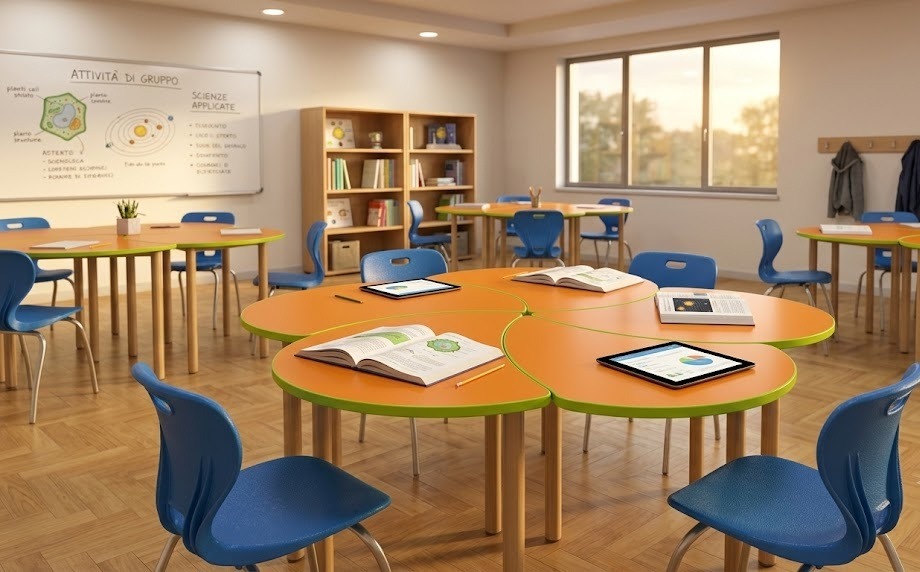
The transformation of learning environments driven by national digitalization plans and the "School 4.0" program (PNRR) requires a definitive overcoming of the traditional classroom with rigid rows. Choosing the right modular school 4.0 desks and tables means converting a static space into a fluid learning ecosystem, capable of reconfiguring itself in seconds from plenary lesson mode to classrooms for group work, debate, peer tutoring, and STEAM activities. High-performance modular furniture must combine impeccable postural ergonomics, extremely high load resistance, and intuitive geometric aggregation, all in full compliance with current regulatory parameters. This purchasing guide will guide you through the Holity.co.uk online catalogue, analysing polygonal shapes, the regulated size scale (from Size 2 to Size 7), CAM environmental requirements and budget options.
The shape of the work surface determines the combinatorial possibilities of the classroom. The design of teaching islands responds to precise rules of spatial kinematics:
They represent the fundamental building blocks of modern flexible classrooms.
Shapes developed to encourage dialogue and visual interaction between students and the teacher.
Large structures designed to accommodate multiple students on the same work surface or for quick floor clearing.
School ergonomics is rigorously codified at European level by the UNI EN 1729-1 standard, which establishes the proportions and heights of the work surface in relation to the height of the student. To avoid the onset of postural pathologies, it is essential to select the correct "Size" (or size) based on the level of education:
Technical note: For multipurpose environments where the classroom is used by different age groups, we recommend purchasing modular tables equipped with height-adjustable telescopic legs, which allow you to switch from a Size 3 to a Size 6 with a simple safety screw fixing system.
Furniture intended for public schools must meet strict requirements for mechanical resistance, non-toxicity and sustainability:
The modularity of the solutions available on Holity.co.uk allows you to calibrate your spending flexibly, moving within a price range that goes from €97.00 to €1646.00:
Design the classrooms of the future, transform your teaching spaces with safe and certified modular solutions, and make your PNRR Scuola 4.0 purchases with maximum procedural serenity. Explore our online catalog to select the geometries, sizes (from 2 to 7) and colors of the ideal tops for your institution.
Are you a School Principal (DS), a Director of General and Administrative Services (DSGA) or a designer in charge? Request a personalized quote today
How does the adoption of swivel wheels with rubber tread and pedal brake balance the speed of reconfiguration with stability while writing?
In dynamic 4.0 classrooms, the presence of wheels is essential to allow students to move their desk without dragging and without generating noise from friction on the floor. The wheels used on professional modular desks have a wear ring in soft, non-marking rubberized polyurethane, which slides extremely silently on both linoleum and tiles. Stability during class is guaranteed by the "Total Lock" pedal locking system: by operating the lever with your foot, the brake simultaneously blocks both the rotation of the wheel and the swivel joint of the support, making the desk perfectly immobile as if it were equipped with a fixed foot.
How is the correct correspondence between the Size of the desk (from 2 to 7) and the conformation of the school chairs calculated according to the EN 1729 standard?
The European standard EN 1729 establishes that each Size of desk must correspond exactly to a chair of the same dimensional size. For example, a Size 4 desk (top height 64 cm) must be paired with a Size 4 chair (seat height 38 cm). This constant interlocking ratio ensures a differential of approximately 26 cm between the table top and the seat, allowing the student to insert their thighs without compression, to rest their forearms at 90 degrees on the surface and to keep their feet firmly on the ground, preventing spinal deviation.
Which chemical release test certifications and fire resistance tests (EN 13823) must be attached to the PNRR funding testing?
To successfully pass the administrative tests for PNRR funding (School 4.0 and Next Generation EU), the supplier must issue the manufacturer's declaration of conformity accompanied by test certificates issued by accredited laboratories. In particular, certification of compliance with the UNI EN 1729-2 standard is required for mechanical safety (resistance of joints, static loads and overturning), Class E1 certification (or EN 717-1 standard) for the lack of formaldehyde emissions, and the fire reaction test report according to the EN 13823 / EN ISO 9239-1 standard for treated plastic materials and woods used in public buildings.
Why does edging the tops using polyurethane fusion technology or laser welding prevent the accumulation of germs and peeling?
In traditional desks with edges glued using standard vinyl or hot-melt glues, the heat and humidity from daily washing cause the glue to crystallize over time, creating a micro-crack around the perimeter where dirt, food residues and bacteria settle, triggering the detachment of the edge. The polyurethane- or laser-applied edging molecularly fuses the ABS edge to the melamine panel seamlessly. This results in a 100% sealed, water-repellent surface that is resistant to impacts between desks during classroom rearrangements and can be completely disinfected with virucidal products.
What layout and transit and evacuation rules must be followed to keep fire escape routes clear when joining desks into 6-seat islands?
When multiple segmented modules are combined to form a circular or hexagonal island for 6 students, the overall surface area of the group increases. The Emergency and Evacuation Plan (Ministerial Decree 10/03/1998) requires that between one work island and another, as well as between the islands and the perimeter walls/exit doors of the classroom, a main passageway free of obstacles with a minimum width of no less than 90-120 cm must always be guaranteed. Modular desks facilitate this compliance: in the event of a simulation or emergency, the individual modules can be pushed back in a second, freeing up escape routes towards the exit door.
How can the economic gap between the €97.00 access module and the €1646.00 advanced multifunctional workstations be explained?
The cost structure reflects the technological complexity, the material dimensions and the transformability of the structure. The entry-level price (€97.00 - €150.00) includes modular single desks (segment or trapezoidal) with a fixed 3- or 4-legged frame and a single-color melamine top. Moving up the mid-range, you'll find telescopic height adjustments, heavy-duty swivel casters, high-density HPL tops, and special color finishes. The higher prices (up to €1,646.00) include large tables for STEAM labs and 3.0 classrooms, featuring fold-down frames on casters, integrated electrical conduits for LAN cables, hidden electrical towers, and structures tested to withstand intensive loads of up to 300 kg.
 English
  Italian
 French
 German
 Spanish