
mon-fri 9-13 / 14.30-18.30
Manhole covers are essential components of modern urban infrastructure, providing controlled access to underground sewerage, drinking water, gas, electricity, and telecommunications systems. Made primarily of ductile iron, reinforced concrete, and engineering plastic, these elements ensure the hermetic sealing of underground networks while maintaining the safety of pedestrian and vehicular traffic. The choice of material and traffic rating depends directly on the installation context, the type of underlying infrastructure, and the specific local and national regulations governing public spaces. A functioning manhole cover is not just a covering solution, but an element that contributes to the urban landscape and the prevention of accidents. Regular maintenance and the choice of components certified according to EN 124 standards significantly reduce the risk of collapse and limit intervention costs over time.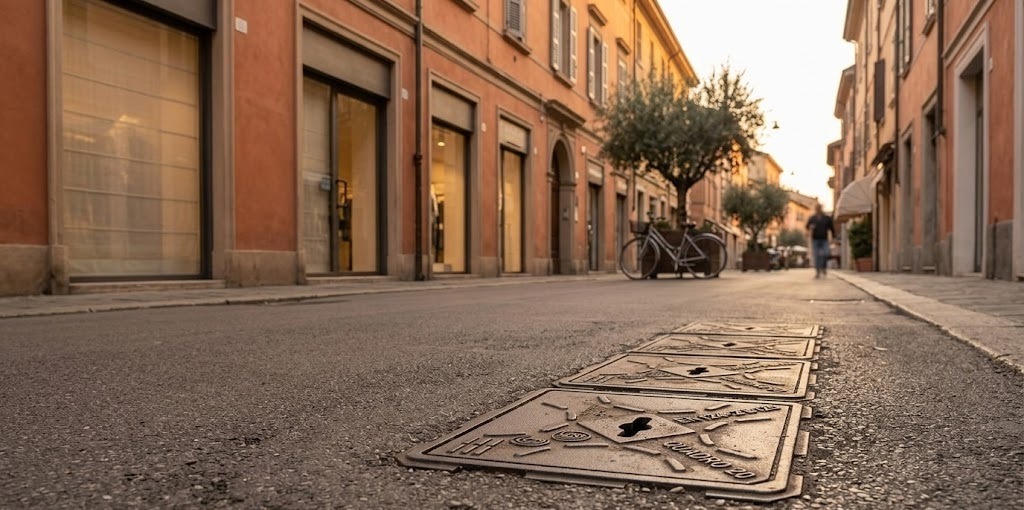
The range of road manhole covers differs primarily in terms of construction material, geometry and specific functional characteristics suitable for different inspection manholes.
They represent the most widespread geometric solution for alignment with traditional and modern pavements.
Advantages: Available in a wide range of standard sizes (200x200, 300x300, 400x400, 500x500, 600x600 and 700x700 mm). They adapt perfectly to square manholes and facilitate installation in the orthogonal grid typical of urban centres. The GJS-500-7 ductile iron guarantees excellent elasticity and robustness, preventing brittle fractures.
Disadvantages: They require perfect geometric alignment during installation to avoid unevenness with the road surface.
Ideal for: City centres, pavements, residential areas and traditional orthogonal street grids.
Targeted geometric solutions for specific system configurations or extended accesses.
Advantages: The circular models (frequently Ø210, Ø240, Ø500 mm) are ideal where space is limited or where the configuration requires cylindrical manholes. The rectangular models (such as the 600x800 mm format) offer a generous clear light which facilitates the entry of operators.
Disadvantages: They have a more sectorial application than the universal square models.
Ideal for: Access to extended sewer systems, technological tunnels and cylindrical inspection wells.
Versions engineered to perform specific technical functions beyond simple covering.
Advantages: The models for hydrants integrate lateral locking screws to prevent involuntary openings, while the models for gates include safety chains and reinforced slots for frequent lifting. The filled models (internal depth of approximately 75 mm) allow the passage of small diameter pipes while maintaining the seal.
Disadvantages: They have a level of specialization that limits their use to the networks of competence only.
Ideal for: Water supply networks, underground fire-fighting systems, gas networks and frequent access inspections.
To structure a safe infrastructure system and prevent road collapses, it is essential to analyse the load parameters and hermetic sealing configurations.
The traffic expected on the installation surface is the most critical parameter to consider. The EN 124 standard defines the following performance classes:
The type of network served determines the configuration of the frame. Sewerage in urban centres absolutely requires anti-odour systems made with "U"-shaped frames and elastic elastomer gaskets to block malodorous fumes and harmful gases. For operator safety, modern systems integrate lifting slots and automatic snap-closing mechanisms that eliminate the risk of accidental lowering of the cover during maintenance. In pedestrian areas, the presence of a non-slip surface is essential to prevent slips in case of rain or frost.
All professional manhole covers must be certified according to the European standard EN 124, which requires strict static load tests, impact tests and fire resistance. In Italy, the provisions of Ministerial Decree 11.02.1992 (Sewerage Regulation) also apply for the correct positioning of manholes in public areas. The spheroidal cast iron must be of grade EN-GJS-500-7, a material that ensures a tensile strength greater than 500 N/mm² and a percentage elongation of over 7%, giving an estimated life of 50-60 years.
Pedestrian squares, sidewalks and residential car parks: Square manhole covers in cast iron or technical plastic of class B125 are preferred. They must have a non-slip surface texture and, in the presence of sewer drains, an anti-odour "U" frame to ensure the healthiness of the surrounding air.
Busy urban roads and provincial arteries: The correct choice falls on class C250 in spheroidal cast iron. These models guarantee the absorption of vibrations generated by mixed traffic and resist the corrosive action of atmospheric agents and anti-icing road treatments.
Highways, logistics hubs and industrial yards: It is mandatory to install class D400 manhole covers made of EN-GJS-500-7 certified ductile iron. Structures equipped with automatic snap-on systems, reinforced slots and frames with lateral drainage are essential to withstand the concentrated loads of heavy vehicles and avoid destructive water infiltration.
Ensure maximum safety on your roads and protect access to underground networks with the professional products available on holity.co.uk. Our online catalogue offers a complete range of EN 124 certified road manhole covers, capable of responding to any technical specification in terms of driveability, geometry and watertightness.
Are you a public administration, a network service company or a construction company? Our team of technicians is at your complete disposal to guide you in configuring the correct sizes and to provide you with dedicated quotes for large lots or special supplies under public procurement. Contact our customer service today to receive a personalized quote.
What is the difference between a class B125 and class D400 manhole cover?
The drive-over class indicates the maximum load capacity that can be supported. A B125 manhole cover supports loads up to 125 kN and is suitable for pedestrian areas and car parks, while a D400 resists up to 400 kN and is specifically intended for motorways and areas with concentrated heavy traffic. The choice must always be based on the actual traffic on the road.
How is a road manhole cover correctly installed?
The manhole cover must align perfectly with the geometry of the underlying well (square on square, circular on circular). The useful height of the manhole cover serves to compensate for the difference in height between the street level and the underlying infrastructure. The frame must rest on flat, stable surfaces, and the sealing is done using elastic gaskets or special mortars to ensure a tight seal.
What is the anti-odor system in sewer manhole covers?
It is a shaped frame with a "U" section combined with an elastic gasket that creates a hermetic seal. This system prevents the release of smelly gases and toxic vapors towards the street surface, an essential measure for sewer systems located in densely populated urban areas.
Which material is more convenient: cast iron, concrete, and plastic?
Ductile iron offers the best durability (50-60 years) and very high mechanical resistance with optimal long-term operating costs. Reinforced concrete is an economical solution for large volumes but has a shorter lifespan, while technical plastic is lightweight and ideal for saline or corrosive areas, although it is less used for higher load classes.
How should a road manhole cover be maintained over time?
It is advisable to carry out a periodic inspection at least once a year to check for cracks, frame failures or abnormal water accumulations. It is necessary to regularly clean the perimeter of debris and sediment and check the integrity of the elastic seal in case of noise when vehicles pass by. For frequent access, the use of models with reinforced slots and safety chains is recommended.
 English
  Italian
 French
 German
 Spanish