
mon-fri 9-13 / 14.30-18.30
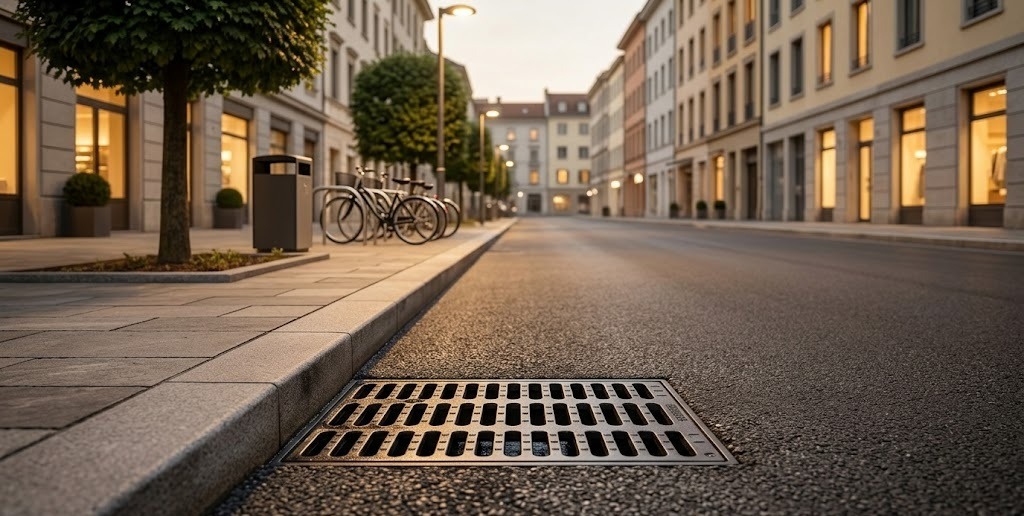
Efficient stormwater management represents one of the most critical engineering challenges in contemporary road design and urban planning. The increase in high-intensity weather events requires the adoption of collection systems capable of rapidly disposing of surface runoff, protecting the road surface from cracks, aquaplaning, and structural failure. Choosing the right road drains doesn't simply mean purchasing a metal grate, but also incorporating a passive safety device sized based on the load class, hydraulic capacity, and the presence of underground utilities. Whether it's a redevelopment project in a historic center, the construction of a commercial parking lot, or the paving of an industrial logistics hub, the selection of ductile iron products must guarantee maximum durability and full regulatory compliance. This purchasing guide will guide you through the solutions available in the Holity.co.uk online catalogue, analysing grating types, drive-over classes, dimensional dimensions and anti-theft systems.
The shape of the upper surface of the gully determines the fluid dynamics of water collection and the architectural integration with the surrounding pavement:
Designed with a frame and a horizontal grating perfectly coplanar with the road surface.
Characterised by a lowered central curvature or flare (with a native difference in height of approximately 15 mm).
Equipped with a pattern of slots with complex geometric intersections.
Since these are elements inserted into the road surface, the drains must be selected in strict compliance with the load classes established by the European standard UNI EN 124 for spheroidal cast iron (GJS 500-7):
The integration of the drain into the underlying manhole requires preliminary verification of the overall dimensions, which can be selected on Holity.co.uk using the dimensional filters:
Ductile iron is a valuable material exposed to the risk of vandalism or accidental lifting caused by the passage of high-speed tyres:
The Holity.co.uk range allows you to flexibly manage both the maintenance of small private sections and supplies for large public contracts, moving within a price range between €22.00 and €349.00 for a single element:
Secure your municipality's road network, prevent the risk of urban flooding and adapt your road construction sites to European UNI EN 124 regulations. Explore our online catalogue to select the most suitable gutter model: set the drive-over class, the millimetric dimensions of the manhole and the type of grate (flat or concave).
Request a personalized quote today: our technical office is at your complete disposal to provide you with suitability sheets, cast iron conformity certificates and reserved quotations for batch supplies.
Why does ductile iron (GJS 500-7) offer superior mechanical performance compared to traditional lamellar grey cast iron?
Traditional grey cast iron contains graphite in the form of flakes, which create internal fracture initiation points that make the metal brittle in the face of sudden impacts and bending. Magnesium is added to ductile iron (GJS 500-7) during melting, transforming the graphite into microscopic isolated spheres. This crystalline structure gives the product a very high yield strength, marked elasticity and resistance to dynamic impact loads comparable to that of steel, reducing the thickness and overall weight of the piece with the same load resistance.
How does the useful height of the frame (from 40 mm to 600 mm) relate to installation tolerances and the presence of underground technological networks?
During construction site excavations for the installation of drainage manholes, shallow technological networks (fibre optic cables, water pipes or power lines) are often encountered. In these conditions, the use of drains with low frames (40-50 mm) allows the grating to be installed flush with the asphalt without interfering with the underlying cables. Conversely, on very high-density heavy traffic roads, a high-thickness frame (100 mm or more) offers a larger lateral gripping surface for the cement mortar at high heights, preventing the frame from being dislodged or damaged by the braking forces of trucks.
What technical features differentiate the spring steel stop bar mechanism from traditional screw locks?
Screw locks with nuts positioned on the grate tend to oxidize or become clogged with asphalt debris and sand, making it impossible for operators to open them manually during maintenance or causing the thread to strip under vibrations. The spring steel bar system uses a shaped spring that is pressure-fitted under the frame seat. When the grate is closed, the bar snaps into place, sealing the lock; to open it, simply use a pickaxe or a lifting bar, eliminating construction time and maintaining the anti-theft seal constant over the years.
How is the correct positioning of concave drains along road gutters calculated to avoid the formation of water veils?
The positioning of concave drains along the road gutter depends on the inflow coefficient of the hydraulic basin, the longitudinal slope of the roadway and the width of the drainage channel. The concave drains, thanks to the 15 mm difference in level, create a local depression that accelerates the passage of water into the grate. The distance between one drain and the next is calculated by maintaining a maximum width of the water blade on the roadway no greater than 0.5 - 1.0 metres from the edge of the pavement, spacing the grates by approximately 15-25 linear metres on sloping sections and bringing them closer together at drainage channels or parabolic curves.
Why is compliance with stability and resistance to de-icing salts tests mandatory for public procurement of winter roads?
During the winter months, roads are continuously treated with sodium chloride or calcium chloride (de-icing salts). These chemical compounds trigger accelerated oxidation reactions on unsuitable metals and cause the surrounding cement binders to flake off during freeze-thaw cycles. Certified ductile iron drains are protected by high-adhesion bituminous or polymerized epoxy paints that insulate the metal matrix. This prevents corrosion of the frame and keeps the non-slip surface intact, avoiding the formation of deep rust that would weaken the original driveability class.
How does the price range for this category (€22.00 - €349.00) correlate with the mass in kilograms, the load class, and the presence of locking accessories?
The wide price range directly reflects the quantity of ductile iron used to cast the piece and the level of mechanical workmanship. The entry-level prices (€22.00 - €60.00) cover small-sized flat or concave drains (300x300 mm) in class C250 intended for residential use. The intermediate range (€60.00 - €150.00) refers to standard D400 drains measuring 500x500 mm equipped with a hinge for common road use. The higher prices (up to €349.00) identify heavy-duty D400, E600 and F900 products with large metric development (up to 940 mm), equipped with stainless steel anti-theft spring bars, high-thickness frames and honeycomb lattice work for large-scale infrastructure projects.
 English
  Italian
 French
 German
 Spanish