
mon-fri 9-13 / 14.30-18.30
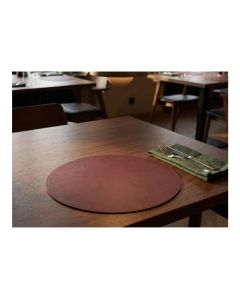
Round placemat in eco-friendly faux leather (Ø 20 cm, thickness 2 mm). Resistant to liquids and wear for a professional mise en place.
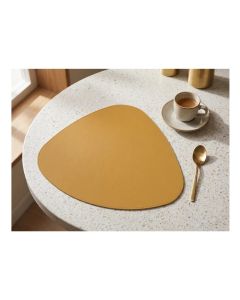
Soft 27x24 cm placemat in eco-sustainable faux leather (2 mm thickness). Liquid-resistant surface and easy to sanitize for HoReCa.
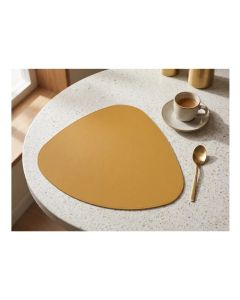
Soft placemat for the HoReCa sector (43x36 cm). 2 mm thickness in eco-sustainable faux leather. Liquid-resistant, wear-resistant and washable.
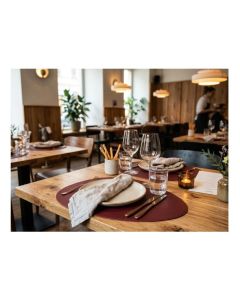
Soft placemat for restaurants (38.5x30 cm) in eco-sustainable faux leather. Thickness 2 mm, resistant to liquids, wear and easy to sanitize.
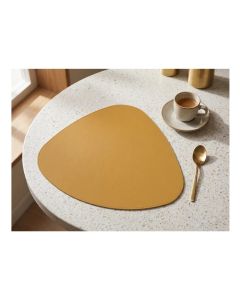
Rigid placemat for restaurants in eco-friendly faux leather 27x24 cm. Thickness 4.08 mm, liquid-resistant, wear-resistant and easy to sanitize.
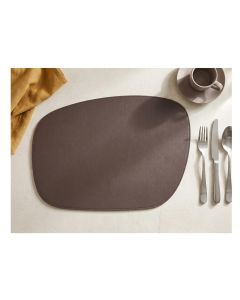
Rigid catering placemat 44x31 cm in eco-friendly faux leather. Thickness 4.08 mm, liquid-resistant, wear-resistant and washable.
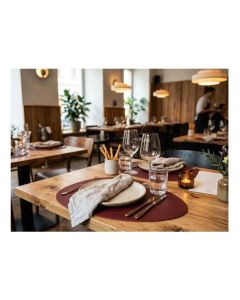
Rigid teardrop placemat for restaurants (38.5x30 cm) in eco-friendly faux leather. Thickness 4.08 mm, resistant to liquids and wear.
In the professional catering sector, table setting represents a fundamental element for defining the venue’s visual identity and ensuring high hygiene standards. Restaurant placemats were created as a functional and versatile response to the needs of modern commercial establishments, combining management practicality and aesthetic impact. The evolution of materials and printing technologies has transformed this tool from a simple protective support into a real vehicle for communication and brand identity, capable of coordinating with the overall design of the room and enhancing the final customer experience.
Choosing the appropriate table covering allows for the optimization of tidying and cleaning operations between services, significantly reducing the downtime of covers and the costs associated with washing and managing traditional fabric linens. The professional solutions available range between different weights, textures, and formats to adapt to every context, from dynamic bistros to structured restaurants, offering options suitable for indirect food contact and designed to withstand intensive daily use.
The adoption of advanced single-use or disposable covers for catering tables guarantees rigorous control over hygiene and health protocols and the operational efficiency of the dining room staff. The use of restaurant placemats radically eliminates the criticalities associated with managing industrial laundries, zeroing out problems related to stubborn stains, fiber wear, and the storage of bulky batches of textiles. During peak traffic periods, the speed of resetting stations becomes a decisive factor for the venue’s profitability; the immediate replacement of the disposable support allows for welcoming new customers in extremely short times with an impeccable and perfectly clean surface.
Alongside the logistical advantages, these solutions offer wide versatility in terms of image positioning and visual personalization. The surface of the placemat represents a direct communication space where the brand story, thematic menus, company logos, or seasonal graphics consistent with the venue’s concept can be inserted. The use of supports printed with ecological inks and certified papers also allows for responding to the growing environmental sensitivities of the clientele, transmitting a message of attention towards sustainability without sacrificing the aesthetic value of the mise en place.
The range of table coverings is divided into various types of materials and structural configurations designed for different levels of service. Straw paper represents the classic choice for taverns, trattorias, and venues with a rustic or informal taste, appreciated for its characteristic raw appearance, good absorption capacity, and remarkable mechanical resistance. Dry paper or airlaid is positioned in a higher segment, offering a consistency to the touch incredibly similar to traditional fabric, high softness, and exceptional resistance to liquids, making it ideal for restaurants looking for refined elegance together with the practicality of disposables.
In addition to standard materials, the offer includes maximum flexibility in terms of formats and chromatic variants, allowing for a range from classic rectangular shapes to contoured, round-oval solutions or with rounded corners to adapt to special tables. The entire chromatic palette is widely customizable with bright solid colors, pastel shades, or elegant neutral finishes, in addition to the possibility of requesting bespoke graphic personalization. This variety allows for integrating the table surface into complex furnishing projects, matching it perfectly with tableware, cutlery, and lighting.
The selection of the ideal placemat requires a careful assessment of the venue’s identity, the type of service offered, and specific workflows. For a business focused on business lunches or fast turnover rates such as pubs and bistros, priority should be given to robust materials with high absorbent capacity that maintain integrity even in contact with grease or liquid substances. Conversely, for refined environments where the sensory experience is fundamental, the choice should lean towards non-woven fabric or high-weight airlaid, capable of giving body to the tabletop and muffling the noise of dishes during the meal.
One of the most common mistakes consists in underestimating the proportions of the work surface or neglecting the consistency of the color palette with respect to the surrounding furniture. It is essential to verify that the dimensions of the support allow for comfortably housing the main plate, cutlery, glass, and bread without invading the space of the diners opposite or adjacent. During the graphic design and logo personalization phase, it is advisable to choose contrasting chromatic combinations ensuring maximum visual clarity and the absence of color transfer, avoiding unsuitable papers that risk deforming excessively upon first contact with moisture.
All materials intended to come into indirect or direct contact with food substances in professional catering must respond to precise legislative requirements to protect consumer health. Disposable covers must be produced in compliance with European regulations regarding FCM (Food Contact Materials), guaranteeing the absence of migration of harmful chemicals, toxic inks, or heavy metals from the support to the composition of the accompanying food. Manufacturers must certify the suitability of the raw materials used through technical documentation traceable throughout the production chain.
From the perspective of traceability and environmental sustainability, the preference given to papers provided with FSC or PEFC certifications ensures that the cellulose used comes from responsibly managed forests. The use of water-based inks or those free of volatile solvents meets both strict food safety criteria and provisions on separate waste disposal. Compliance with standards on compostability and recyclability is a determining factor for facilities that intend to maintain a virtuous operational profile consistent with the requirements established by health and hygiene control bodies.
Explore all the products in the category and compare the available solutions to find the one best suited to your operational context.
The materials most frequently used include 80-100 g/m² straw paper, embossed paper, and 55-70 g/m² dry paper or airlaid. Each support offers different levels of absorption, softness to the touch, mechanical resistance to tearing, and color rendering of the print.
Yes, it is possible to customize the entire surface of the placemat with logos, menus, dedicated graphics, or company colors. Printing is carried out with non-toxic inks suitable for indirect food contact, maintaining high-definition visual performance.
The standard rectangular format usually measures 30x40 cm or 30x42 cm, but square, shaped, round-oval, or rounded corner variants are available. The choice of shape depends on the size of the tables and the type of setup desired.
Placemats intended for professional catering are produced in compliance with the European MOCA (FCM) regulation. The materials and inks used are certified to ensure that there is no migration of harmful substances towards the food placed on the table.
The range includes options in natural Havana Kraft paper, high-gloss white tones, mass-colored solid colors, and generic decorative prints. It is possible to choose between smooth, embossed, or textile-weave finishes.
The use of disposables reduces table clearing times to a few seconds, improving the efficiency of the dining room staff. This system eliminates laundry costs and speeds up the rotation of covers during peak hours.
Disposal depends on the material and the presence of food residues. Placemats made of pure paper or compostable cellulose without plastic coating can be disposed of in the organic or paper fraction, according to current local regulations.
Minimum quantities vary based on the printing technology adopted and the required format, usually starting from batches of 1,000 or 2,000 pieces for digital runs, up to higher volumes for flexo or offset printing.
 English
 Italian
 French
 German
 Spanish