
mon-fri 9-13 / 14.30-18.30
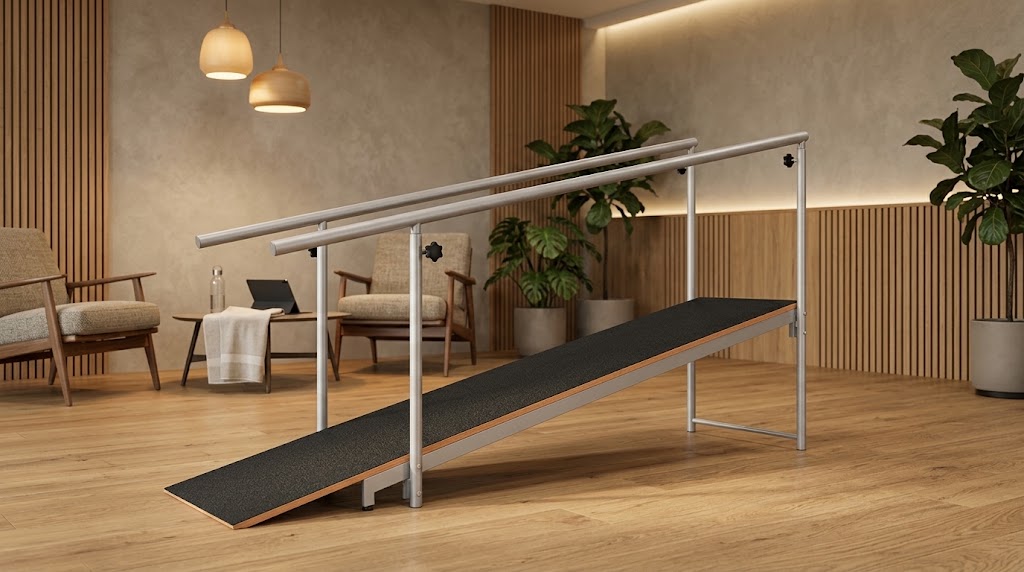
Are you setting up a rehabilitation gym for your physiotherapy practice, nursing home, or hospital ward and aren't sure which parallel bar model is best for your patients? This is a legitimate question. Rehabilitation parallel bars are the backbone of any motor re-education, gait recovery, or proprioceptive exercise program. Choosing the right structure means offering patients the right symmetrical bilateral support and ensuring the physiotherapist a safe, stable, and long-lasting tool.
We at Holity specialize in the supply of medical and functional rehabilitation equipment: we understand the daily challenges of healthcare professionals and are ready to help you identify the most suitable solution. In this guide, we'll walk you through your choice step by step with a practical approach and straightforward answers. If you want to immediately explore the available models, in the rehabilitation parallel bars catalogue on Holity.co.uk you will find a complete range suitable for every clinical and space requirement.
A: Fixed parallel bars with fixing to the floor or weighted bases.
They are the standard for physiotherapy centres and hospital departments. Made with painted steel frames and wooden or metal handrails, they offer unbeatable stability, absorb the loads of neurological or trauma patients without flexing and guarantee high load capacities (up to 160 kg and more).
A: Choose the Folding and Collapsible Parallel Bars.
Designed according to rigorous resistance standards (UNI EN 960), these parallel bars allow you to reduce their bulk in just a few seconds when not in use. They allow you to free up the floor for other therapeutic activities without compromising on safety during exercises.
A: The height should be set so that the patient can grip the handrail while keeping the elbow slightly flexed at an angle between 20° and 30°. For adults, the standard adjustment ranges usually vary between 69 and 108 cm. For patients in wheelchairs or with severe muscle weakness, the integration of gradual access ramps facilitates safe entry onto the path.
A: It depends on the therapeutic objectives. For short exercises of weight transfer, standing and first steps, models from 200 to 250 cm are sufficient. For complete programs of gait re-education, coordination and walking resistance, it is advisable to focus on lengths from 300 to 600 cm.
A: Yes, the pediatric parallel bars are designed with reduced heights (adjustable from 45 to 66 cm) and ergonomics calibrated for children's hands. They can be enriched with essential accessories such as the central separator surface (to avoid involuntary crossing of the lower limbs), upper support monorails or harnesses for partial weight suspension.
A: The handrail in beech or fir wood offers a warm, pleasant tactile sensation and a natural, high-grip grip, ideal for instilling psychological safety in the patient. The handrail in painted or satin-finished steel, on the other hand, offers extreme resistance to mechanical wear and is incredibly easy to sanitize and disinfect frequently, a primary requirement in hospital departments with high infection control.
A: Parallel bars for professional rehabilitation must bear the CE marking and comply with the UNI EN 960 standard, which certifies their mechanical resistance, anti-tipping stability and the quality of the non-slip surfaces. Furthermore, for accredited centres and healthcare facilities, the presence of non-toxic and washable surfaces complies with current health and hygiene directives.
If you want to set up your physiotherapy area with safe, ergonomic and certified equipment, the team of experts at Holity is at your complete disposal. Explore our selection in the section dedicated to rehabilitation parallel bars on Holity.co.uk, where you can filter the models by length, type of structure (fixed or foldable), accessories and price range.
Request a personalized quote today: our consultants will help you choose the solution best suited to your clinical and space needs.
What are the standard dimensions of a rehabilitation parallel bar?
Standard parallel bars vary from 200 to 600 cm in length, with adjustable heights usually between 69 and 108 cm for adults, and between 45 and 66 cm for pediatric versions. The depth generally varies between 50 and 80 cm depending on the base.
Are folding parallel bars less stable than fixed ones?
No, if designed and tested according to UNI EN 960 standards, folding parallel bars do not compromise stability compared to fixed models. They offer the same rigidity during use, adding the advantage of portability and space saving.
What is the minimum recommended load capacity for professional use?
The majority of professional models guarantee a minimum load capacity of 160 kg, suitable for the average adult population. In the case of bariatric patients or in high-intensity hospital settings, it is advisable to check models with increased load capacities.
What additional accessories are useful for neurological or complex rehabilitation?
Among the most requested accessories are the central separating surface (to guide the walk and avoid crossing the legs), access ramps for wheelchairs, upper monorails with weight-bearing harnesses and shaped handrails.
What is the fundamental difference between using parallel bars and that of a walker?
Parallel bars offer symmetrical bilateral support anchored to the ground, ideal for the initial phase of gait re-education and for recovering proprioception in complete safety. The walker, on the other hand, is used for independent walking when moving around, but does not guarantee the same symmetry and structural stability as the parallel bar.
 English
  Italian
 French
 German
 Spanish