Buying Guide: How to Choose Professional Shoe Dryers and Boot Dryers for Locker Rooms, Hotels, and Workplaces
In company locker rooms, food industries, sports centers, barracks, mountain hotels, and alpine refuges, managing wet footwear is a practical requirement for user comfort and workstation organization. Professional shoe dryers, also called boot dryers or boot dryers, are equipment designed to promote the evaporation of moisture from footwear after use. They can be used for work shoes, rubber boots, ski boots, and other footwear compatible with the drying system. Depending on the model, heating occurs via electric resistors, heated supports, or hot water circulation within the structure. Not all devices use fans or forced air: some configurations transfer heat to the footwear through the brackets on which they are placed. Drying can help reduce residual moisture and improve the usable conditions of shoes, but it does not automatically equate to a sanitization or disinfection treatment. The Holity.co.uk catalog includes electric and hot water shoe dryers, available in wall-mounted, vertical and horizontal configurations, with capacities from 5 up to 20 pairs of shoes in the verified models. There are stainless steel structures, versions with integrated timer and systems that can also be used for children's shoes or gloves, when provided by the manufacturer. This purchasing guide analyzes operating technologies, capacities, materials, compatibility with footwear, installation requirements, regulatory references and price ranges to help purchasing managers, hospitality managers and safety managers identify the most suitable equipment.
1. Operating technologies compared: electric systems vs. hot water connection (hydronic)
The choice between an electric shoe dryer and a hot water system depends on the availability of the systems, the frequency of use and the configuration of the stations. The two technologies have different operating characteristics and installation requirements:
Electric shoe dryers: Electric shoe dryers use electricity to heat the support brackets or, in the models designed for this purpose, the air used for drying. The Holity catalogue features stainless steel electric panels with 230 V power supply and plug included, designed for wall installation. Some models have a programmable 24-hour timer that allows you to organise the operating periods in relation to the times of use. For example, the range includes configurations of 5, 10, 15 and 20 pairs, depending on the product. The h1034_09 model, designed for 20 pairs, has a total nominal power of 340 W and a built-in timer. Not all electric shoe dryers are necessarily equipped with centrifugal fans, temperature control, or forced ventilation systems. Before purchasing, it is necessary to verify the operating principle, the power consumption, the installation methods, and the compatibility with the electrical system of the room.
Shoe dryers that operate with hot water (hydronic systems): Hydronic models exploit the heat transported by water coming from a compatible heating system. In the verified Holity products, the hot water circulates inside continuous metal brackets, transferring heat to the shoes placed on the supports. These systems do not necessarily require fans or electrical resistances: for example, the h1034_01, h1034_02 and h1034_03 models are designed for hydraulic connection, with 1/2" connections and a recommended flow temperature of 35-40°C. Installation requires a check of compatibility with the heating circuit and a connection carried out by qualified personnel. The absence of direct electrical absorption of the appliance does not mean the absence of energy consumption, because the heat must still be produced and distributed by the system. Running costs therefore depend on the energy source, flow temperature, dispersion and operating hours. This solution may be interesting for hotels, refuges, sports centres and other facilities that have an adequate hydronic system.
2. Flow dynamics, controlled temperature and protection of technical membranes
To choose a professional shoe dryer it is important to understand how the device transfers heat and which materials can be subjected to drying. The presence of technical components, waterproof membranes or glued elements require particular attention to the footwear manufacturers' instructions:
Air circulation and heat distribution inside the footwear: Shoe dryers can use different operating principles. In forced air systems, when present, a fan conveys air through special ducts or supports to promote the evaporation of humidity. In models with heated brackets, however, the heat is transferred through the supports and the surrounding air, without necessarily using a forced flow. The Holity catalogue includes shoe dryers with rounded brackets designed to support the footwear and facilitate drying. Effectiveness depends on the type of shoe, the initial humidity, the ambient temperature, the air circulation and the duration of operation. It is not correct to attribute uniform drying up to the toe or a standard time of 60-120 minutes to all models. Performance must be evaluated based on the technical specifications and actual conditions of use.
Thermal control and compatibility with footwear materials: Safety shoes, ski boots and technical footwear may contain waterproof and breathable membranes, leathers, synthetic materials, glues and thermoplastic components with different temperature limits. Excessive heat or inappropriate exposure may compromise some of these materials. In verified Holity hydronic models, a water supply temperature of 35-40°C is recommended, but this value does not necessarily coincide with the temperature reached inside the shoe. Not all professional shoe dryers operate in a universal range of 35-45°C. Before use, it is necessary to check the footwear manufacturer's instructions and those of the dryer, especially for shoes with technical membranes, glued components or specific protection requirements. Drying should not be considered automatically without affecting the certified properties of the PPE.
Programmable timer management and automatic switch-off: Some professional electric shoe dryers are equipped with timers to program the operating periods. The Holity catalogue includes models with integrated programmer. 24 hours, useful for organizing drying during breaks between work shifts or during periods of less frequent use of the changing rooms. The timer allows you to set the times set by the device, but does not automatically guarantee complete drying, protection from overheating or fire safety in the absence of supervision. The regulation features and any protective devices must be verified in the technical documentation. In hydronic models without electrical components, however, operation depends on the conditions of the heating system and any external regulation systems.
3. Structural types and spatial layout: wall panels vs. free-standing modules
The number of pairs to be dried simultaneously and the space available in the changing room determine the choice of configuration. It is important to distinguish the orientation of the device from the actual mounting method, always checking the dimensions and installation requirements:
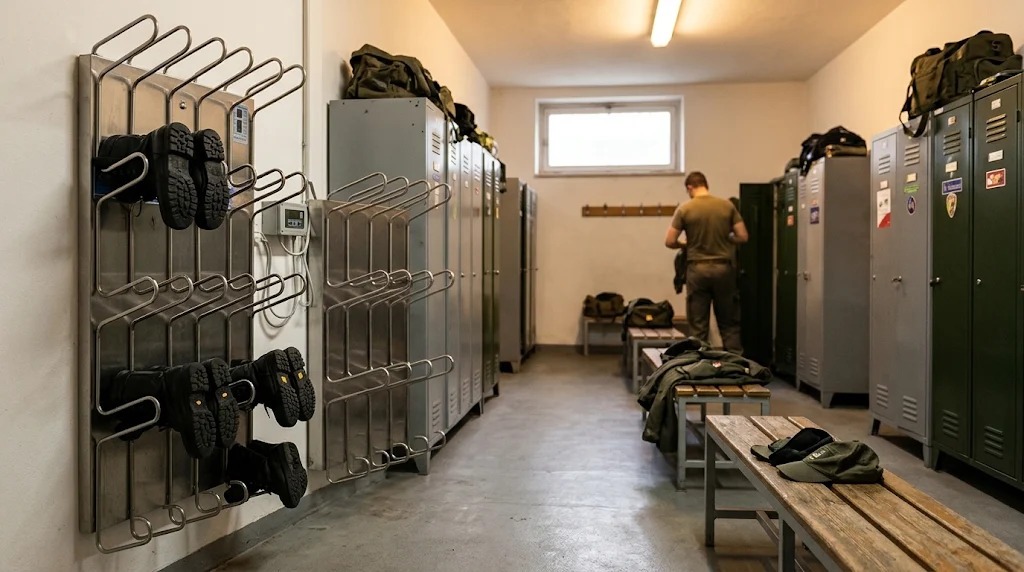
Wall systems (space-saving vertical panels): Wall-mounted shoe dryers use a structure designed to be fixed to a suitable vertical support. The Holity catalogue includes panels Stainless steel with brackets distributed along the height, designed to accommodate multiple pairs of shoes without requiring a floor base. For example, some 5-, 10-, 15-, and 20-pair models have an overall height of approximately 200 cm, while width and depth vary according to capacity. Installation must comply with the manufacturer's instructions regarding fastening, wall load-bearing capacity, and the clearances required for inserting and removing shoes. There is no universal installation height of 30-50 cm from the floor. The suspended structure can facilitate cleaning of the area below, but does not automatically guarantee the absence of clutter or complete accessibility of all surfaces.
Free-standing floor-standing modules and horizontal configurations: Free-standing solutions can be useful when wall mounting is not possible or when you want to organize drying in a dedicated area. However, the availability of free-standing, double-sided, or trolley-mounted structures must be verified for the specific product. The Holity catalog also includes Horizontal electric boot dryers, such as the 5-pair h1034_05 model, which should not automatically be considered self-supporting just because of its geometry. A double-sided configuration does not necessarily double the capacity for the same space, because it requires access space on both sides. Before purchasing, it is advisable to evaluate the overall size, assembly method, number of positions and ease of handling the footwear.
Arms and supports for low shoes, boots and boots: The shape of the brackets affects the ability to support different types of footwear and to promote drying of the internal surfaces. The verified Holity models include rounded metal supports that can be used with shoes and boots, as well as, where declared, with children's footwear and gloves. Compatibility must be assessed in relation to size, weight and materials:
Supports for work shoes and boots: They are suitable for low or medium-height footwear compatible with the geometry of the brackets. It is necessary to check that the support allows you to rest the shoe without deforming the upper or subjecting the internal parts to excessive stress. The length of the arms varies according to the model and should not be considered universally equal to 25-30 cm.
Supports for high boots and technical boots: For rubber boots, ski boots and footwear with a high shaft it is important to check the length and arrangement of the brackets, as well as compatibility with the weight of the product. Not all shoe dryers are designed for knee-high boots or guarantee heat transfer up to the toe. The choice must also consider the drying instructions of the footwear, especially when membranes, padding and temperature-sensitive components are present.
4. Construction materials, cleaning and environmental resistance (stainless steel and IP rating)
In changing rooms, ski rooms and industrial environments, shoe dryers can be exposed to humidity, water from footwear and frequent use. The resistance of the product depends on the materials, design and installation conditions:
AISI 304 Stainless Steel: Stainless steel is used in many professional shoe dryers for its good corrosion resistance and ease of cleaning. The Holity catalogue includes models with an entirely stainless steel structure, but the specific alloy must be verified in the product documentation. It is incorrect to assume that all stainless steel shoe dryers are necessarily made of AISI 304 or that this alloy is mandatory for changing rooms in the food industry. Stainless steel can also be affected by corrosion in the presence of chlorides, incompatible detergents or particularly aggressive environmental conditions. Surfaces must be cleaned with appropriate products and according to the manufacturer's instructions. The presence of stainless steel can contribute to the hygienic management of environments, but does not automatically guarantee the elimination of bacteria, mould or other microorganisms and does not constitute HACCP certification.
Painted Steel and Other Structural Materials: Some professional shoe dryers may use components in painted steel, aluminium or other metallic materials, depending on the characteristics of the product. Resistance to impact, abrasion and humidity depends on the quality of the material, the finish and the conditions of use. Not all steel products are hot-dip galvanized and it is not correct to automatically attribute an epoxy coating or a specific treatment to every structure. For workshops, construction sites and high-traffic changing rooms it is advisable to evaluate the sturdiness of the brackets, the ease of cleaning and the availability of technical information on the materials and surface treatments.
Electrical protection rating (IP): For electric shoe dryers, the IP rating, when declared, indicates the level of protection of the casing against the ingress of solid objects and water, according to the classification provided by the CEI EN 60529 standard. It is not correct to attribute a minimum IP44 or IP54 rating to all models without a specific declaration from the manufacturer. Furthermore, IP44 does not mean that the appliance can be subjected to jets of water or installed freely near showers; IP54 does not imply complete waterproofing. The suitability of the device also depends on the installation position, the electrical system and from environmental conditions. Before purchasing, it is necessary to check the actual IP rating, the distances required from water sources and the manufacturer's instructions. In hydronic systems without electrical components, the IP rating is not a relevant parameter for the operation of the panel.
5. Regulatory framework: electrical safety and hygiene in the workplace
Professional shoe dryers can contribute to the correct management of footwear in work environments and in accommodation facilities. However, the regulatory references must be evaluated in relation to the intended use, the operation of the equipment and the actual needs of the place of installation:
CE conformity and applicable European provisions:
Low Voltage Directive (LVD 2014/35/EU): For electrical appliances falling within its scope, the directive establishes safety requirements relating to electrical risks and other hazards connected to operation. Applicability depends on the characteristics of the equipment, including nominal voltage and intended use. The CE marking does not necessarily equate to certification issued by a third party and does not guarantee the absolute absence of risks. Before purchasing, it is advisable to check the marking, the EU declaration of conformity and the manufacturer's instructions, where relevant.
Electromagnetic Compatibility Directive (EMC 2014/30/EU): Where applicable, it regulates the requirements relating to electromagnetic emissions and the immunity of the equipment to expected disturbances. It does not certify that the devices are completely free from emissions or immune to any interference. Compliance must be assessed according to the actual electrical configuration and the relevant technical standards.
IEC 60335-1 and IEC 60335-2-43 standards: The EN/IEC 60335 series concerns the safety of electrical appliances for household and similar use. Part 2-43 includes, in its scope, certain electrical appliances intended for drying clothes, shoes and gloves, but excludes equipment intended exclusively for industrial use. It is therefore not correct to consider it automatically applicable to any professional shoe dryer or hydronic system without electrical components. The relevant standards must be identified on the basis of the design, the intended use and the manufacturer's documentation.
Hygiene in food environments and EC Regulation 852/2004: In food industries, the organization of changing rooms and changing areas must be consistent with the applicable hygiene requirements and procedures. self-control of the food business operator. The management of footwear used in production departments can help limit the transfer of dirt and humidity between different areas of the plant. However, a shoe dryer does not automatically guarantee the elimination of microorganisms or the prevention of contamination. EC Regulation 852/2004 does not generally prescribe the installation of shoe dryers and their use does not replace the cleaning, disinfection, separation of paths and management of work clothing procedures required by the activity.
6. Economic planning and cost ranges
The Holity catalogue includes professional shoe dryers with different capacities and operating systems. As a reference for the verified assortment, it is possible to consider a price range from approximately €870.00 to €2,302.00, excluding VAT, subject to variations based on available models, catalogue updates and commercial conditions:
Entry level range (approximately €870.00 - €1,300.00, VAT excluded): This range mainly includes professional shoe dryers for approximately 5 pairs, available in electric or hot water configurations depending on the model. The Holity catalogue includes, for example, a vertical stainless steel hydronic panel for 5 pairs and a horizontal electric boot dryer with the same capacity. Electric systems may include a power plug and timer, while hydronic systems require connection to a compatible hot water system. It is not correct to automatically attribute aluminium structures, centrifugal fans or forced air systems to this range, as the characteristics vary depending on the product. These solutions can be considered for small changing rooms, hotels, refuges and locations with a limited number of users.
Intermediate range (approximately €1,300.00 - €1,800.00, VAT excluded): This range includes shoe dryers with higher capacities, including models for 10 pairs. pairs and other configurations subject to availability. The Holity catalog features stainless steel wall panels with electric or hot water operation. For example, the hydronic model h1034_02 is designed for 10 pairs and requires connection to the heating system with a recommended flow temperature of 35-40°C. The choice must consider not only the price of the appliance, but also any installation costs, the energy required for operation, and compatibility with the footwear to be dried. The presence of timers, fans, or electronic controls must be verified in the product sheet.
High-end (approximately €1,800.00 - €2,302.00, excluding VAT): Includes professional shoe dryers with a higher capacity, designed to handle multiple pairs at the same time. The catalog features models for 15 and 20 pairs, with stainless steel structures and different power systems. The electric model h1034_09, for example, can accommodate up to 20 pairs. pairs, uses a 230 V power supply, has a nominal power of 340 W and features a 24-hour programmable timer. The number of pairs supported should not be confused with the drying speed: performance depends on the initial condition of the footwear and the operating time. The high-end does not automatically imply the presence of reinforced ventilation, trolley modules or advanced digital control units. When choosing, it is important to compare the capacity, dimensions, technology and features actually declared.
Request a personalized quote on Holity.co.uk
Organize the drying of footwear in changing rooms, ski rooms and professional environments with the professional shoe dryers and boot dryers available on Holity.co.uk. Consult the catalog to compare electric and hot water models, evaluating the capacity in number of pairs, dimensions and installation methods. Choose between vertical wall panels and horizontal configurations, checking compatibility with work shoes, ski boots, boots or gloves when indicated by the manufacturer. Before purchasing Consider the availability of an electrical power supply or a suitable hydronic system, the space required for assembly and maintenance conditions. For safety footwear, it is important to follow the manufacturer's instructions so that drying does not compromise the protective characteristics of the PPE.
Request a personalized quote from the Holity.co.uk sales team to receive information on available models, dimensions, nominal consumption and supply conditions. For specific needs, you can request details on hydraulic or electrical connections, drying capacity and relevant technical documentation, when available. By comparing technology, number of stations, and installation requirements, you can identify a professional shoe dryer that best suits the layout of your changing room or facility.
Frequently Asked Questions
What is the fundamental difference between an electric shoe dryer and one that works with hot water?
The electric shoe dryer is a self-contained "plug & play" appliance equipped with internal heating elements that heat the air blown by centrifugal fans. It requires only a 230V power connection and is ideal for quick installation in any changing room. The hot water (hydronic) model, on the other hand, uses a heat exchanger that connects directly to the building's central heating system (boiler, heat pump, or district heating). It consumes minimal electricity (just to run the fans) and uses the heat from the system's water, ensuring extremely low running costs in situations where the machine operates for many hours at a time.
Can the hot air it blows damage safety shoes or Gore-Tex membranes?
No, as long as you use specifically calibrated professional equipment. Professional shoe dryers operate at a controlled and moderate temperature, constantly ranging between +35°C and +45°C. This temperature gradient mimics natural body ventilation, quickly extracting internal moisture without reaching critical temperatures (above 50°C-55°C), which would cause glue crystallization, leather shrinkage, or the destruction of the microporosity of breathable membranes like Gore-Tex.
How long does a professional dryer take on average to complete a cycle?
Dehumidification times vary depending on the amount of water present and the type of footwear. For work shoes or boots damp with sweat at the end of a standard shift, about 60-90 minutes of heated ventilation is sufficient. For rubber boots, ski boots, or shoes completely soaked after working in heavy rain or high-pressure washing, the recommended cycle is about 2-4 hours, easily managed using the built-in automatic timer.
Why is AISI 304 stainless steel recommended in the agri-food and pharmaceutical sectors?
AISI 304 austenitic stainless steel guarantees maximum hygiene and chemical resistance, compliant with HACCP protocols. Work boots used in slaughterhouses, dairies, wineries, and food processing plants carry organic residues, grease, acids, and disinfectants that would quickly corrode conventional paint finishes. AISI 304 is completely inert, does not rust when continuously exposed to wet soles, withstands frequent washing with alkaline detergents and sanitizing foams, and can even be disinfected with steam pressure washers.
How does the price range of the category (€870.00 - €2302.00) correlate with the technical characteristics?
Pricing varies based on the number of shoe storage spaces, heating technology, and construction materials. The entry-level range (€870.00 - €1300.00) includes compact electric wall panels for 4-5 pairs of shoes in painted steel or aluminum with a basic electromechanical timer. The mid-range (€1300.00 - €1800.00) includes modules for 8-12 pairs of shoes, versions with extended tubular arms for high work boots, the first models with hot water supply (hydronic), and panels in AISI 304 stainless steel. The upper range (€1800.00 - €2302.00) includes large modular systems for 15-20 pairs in AISI 304 stainless steel, freestanding double-sided models, and control units with separate, enhanced ventilation for barracks, large industrial facilities, and professional contract supplies.

 English
 Italian
 French
 German
 Spanish