
mon-fri 9-13 / 14.30-18.30
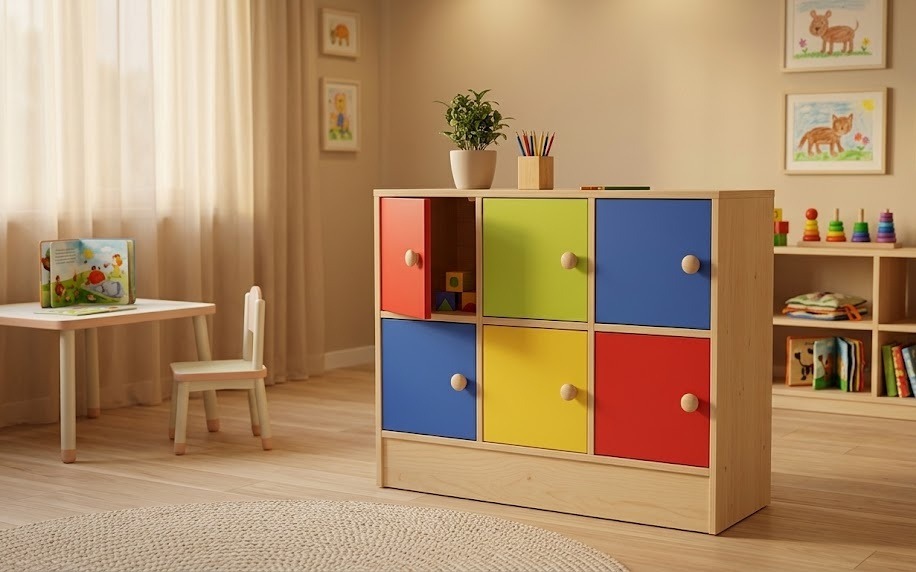
The organization of interior spaces in nurseries, preschools, and childcare centers plays a crucial role in structuring the learning dynamics and cognitive growth of children between the ages of zero and six. Choosing the ideal preschool furniture isn't just a matter of purchasing shelving, but rather of designing the classroom's pedagogical architecture. A well-structured learning environment divides the space into dynamic centers of interest (a reading corner, a symbolic play area, a creative workshop), encouraging independent exploration and conveying a sense of welcome and security. Furniture dedicated to early childhood must combine flexible modularity with compliance with the strictest regulations regarding passive safety, non-toxic materials, and ease of sanitization. This purchasing guide was created to guide educators, school managers and designers in the selection of products in the Holity.co.uk catalogue, analysing structural materials, millimetric dimensions, safety devices and budget.
The layout of the nursery classroom must be able to easily adapt to the transition between the different activities of the school day:
In line with the pedagogical principles of self-esteem and self-regulation (Montessori methodology), low-height furniture allows the child to see, choose and put away books, games and teaching materials completely independently.
Storage systems designed for the storage of teaching materials reserved for educational staff.
Multifunctional elements designed to divide large open-space rooms into intimate and cozy sub-areas without requiring masonry work.
Since these are furnishings subjected to continuous intensive use, to the handling of glue, tempera or food, and to daily washing cycles with disinfectants, the choice of raw material is fundamental:
The integration of the furniture into the classroom requires careful calibration of the plan spaces and the heights of use, selectable via our navigation filters:
The variety of the catalogue on Holity.co.uk allows us to satisfy both small completion projects and complete supplies for the creation of new school buildings, with a price range between €154.00 and €4588.00:
Furnishings intended for early childhood in Public Administration must satisfy strict regulatory constraints:
Create stimulating, safe and compliant childhood environments. Explore the online catalog on Holity.co.uk to configure your classroom: select the structural materials (plywood or laminated), set the ergonomic heights and find the most suitable solutions for your project.
Request a personalized quote today: our team of experts is at your disposal to provide you with technical approval data sheets, layout drawings and confidential quotes for the complete supply of your institution.
How does the use of soft-close hinges and 110° locking systems prevent small children from getting their fingers crushed?
In nursery schools, cabinet doors are a source of injury due to the risk of accidentally crushing fingers. Professional furniture uses hydraulic hinges with a decelerated action (soft-close). This mechanism brakes the door in the last few centimetres of travel, allowing it to close smoothly and silently even when pushed forcefully. Furthermore, the 110° opening stops prevent the door from tipping over and hitting a nearby child or creating shearing points along the rear hinge of the cabinet.
Why is anti-tip wall fixing a mandatory passive safety requirement for tall cabinets?
Preschool children spontaneously tend to climb on furniture shelves to reach high objects. If a cabinet is not anchored to the wall, the imbalance in the center of gravity generated by the child's weight would cause the structure to suddenly tip forward, with very serious consequences. School safety regulations require that all storage units higher than 80 cm be firmly anchored to the wall using anti-tip steel plates located on the back of the body.
What resistance characteristics to tempera and marker stains do high-pressure melamine coatings offer compared to paint?
Wooden furniture painted with traditional paint has a porous surface film that absorbs the colored pigments of tempera, markers, and vinyl glue, making cleaning impossible without removing the paint itself. High-pressure melamine-faced chipboard, on the other hand, is heat-sealed with non-absorbent melamine resins. This chemical-physical barrier makes the surface water-repellent and inert: residues of paint, water, wax, or glue can be instantly removed with a simple damp cloth and neutral soap, without leaving streaks or damaging the furniture's finish.
How do safety mirrors integrated into dividing furniture affect safety and the perception of space in nurseries?
The mirrors integrated into the back of dividing furniture are not made of ordinary mineral glass (which would shatter into dangerous sharp shards in the event of an impact), but of highly flexible and impact-resistant mirrored acrylic/methacrylate, applied to a solid wood support. This technology guarantees a legally shatterproof surface. From an educational point of view, the mirror allows newborns to develop the perception of their own bodily identity (mirror phase) and doubles the brightness of the classroom, amplifying the sensation of depth in the spaces created.
What hygienic advantages do washable transparent plastic pull-out trays offer compared to fixed wooden drawers?
Removable, non-toxic transparent polypropylene trays represent an ergonomic and hygienic standard in nurseries. Unlike fixed wooden drawers (which have internal corners that are difficult to clean), plastic trays can be removed entirely from the cabinet with a simple gesture and brought to the work tables. At the end of the day or in the event of a liquid spill, the plastic tray can be washed and disinfected directly under running water or in an industrial dishwasher, ensuring thorough hygiene that prevents the proliferation of germs in the storage compartments.
How does the economic cost range (€154.00 - €4588.00) correlate with the choice of materials between wood veneer and birch plywood for contract use?
The wide range of prices offered in the catalogue reflects the density of the materials used, the overall dimensions, and the complexity of the carpentry. The entry-level threshold (€154.00 - €300.00) includes single, compact open units or shelving units in melamine-faced chipboard. The intermediate range (€400.00 - €1200.00) includes closed cabinets with doors, partition walls with acrylic mirrors, and double-sided bookcases. The higher prices (up to €4588.00) are reserved for large integrated furniture compositions for entire school classrooms, custom-made structures in high-quality exposed birch plywood with laser-cut finishes, and fitted walls for contract-use children's libraries.
 English
  Italian
 French
 German
 Spanish