
mon-fri 9-13 / 14.30-18.30
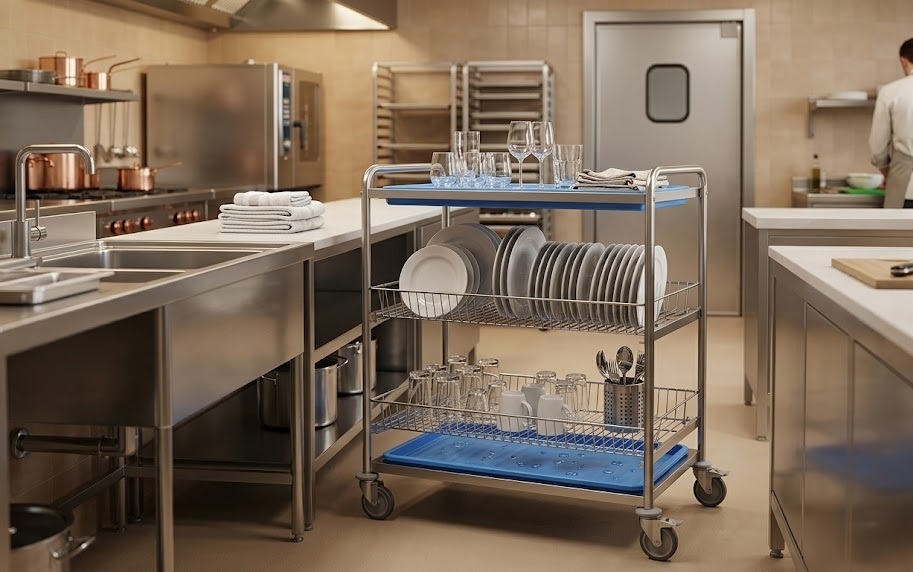
The efficiency of the dishwashing area is the true logistical engine of any successful restaurant business. In high-turnover environments such as large canteens, hotels, and industrial kitchens, the movement of clean dishes must be smooth, safe, and hygienically impeccable. Choosing the right dish and glass draining carts isn't just a technical detail, but an engineering investment to eliminate manual drying downtime, prevent accidental breakages, and ensure constant restocking. These mobile systems allow water to drain naturally into dedicated collection basins, keeping floors dry and preventing the risk of slipping injuries for the staff. This purchasing guide is designed to help you explore the Holity.co.uk online catalog, analyzing frame architectures, drainage dynamics, and optimal configurations to maximize your back-office productivity.
Professional mobile drying equipment is divided into macro-constructive categories, each developed to accommodate specific dish geometries and optimize airflow between the shelves.
The configuration of choice for the intensive management of dinner plates, soup plates, and dessert plates.
Advantages: Usually structured on 3 or 4 levels, they are equipped with shaped steel rod racks that keep the dishes in a perfectly vertical position. This forced distancing maximizes natural air flow, accelerating the evaporation of humidity and preventing the formation of unsightly halos or limescale stains on porcelain.
Ideal for: Traditional restaurants, pizzerias, company canteens and specialized banqueting facilities with a high turnover of tableware.
Engineered horizontal systems for glassware, cups and direct housing of standard dishwasher baskets (e.g. 50x50 cm).
Advantages: They feature flat shelves made of perforated sheet metal, fine mesh grille or special "L"-shaped lateral guides. They allow staff to transfer the entire basket of glasses directly from the dishwasher exit to the trolley in a single movement, eliminating the need to handle individual glasses and drastically reducing chipping rates.
Ideal for: Wine bars, cocktail bars, hotel breakfast rooms and catering services.
Combined solutions that offer complete modularity within a single metal chassis.
Advantages: They combine in a single frame upper shelves dedicated to the vertical storage of plates and flat lower shelves for draining glasses, cutlery or cookware. They represent the quintessence of spatial versatility.
Ideal for: Kitchens with limited space, bistros, nurseries and small trattorias that need to centralise drying in a single workstation.
To integrate a durable logistics module capable of withstanding the harsh humidity conditions of the plonge, it is essential to calibrate the choice on precise physical and construction parameters.
Continuous exposure to water, high-temperature steam and chemical surfactants requires absolute material choices. Professional trolleys must be made entirely of stainless steel (e.g. AISI 304). Tubular steel frames (generally 25 mm square or round section) guarantee not only total immunity to deep rust, but also the torsional rigidity necessary to avoid warping or giving way under static loads that can easily exceed 100-150 kg of wet dishes.
A professional trolley must never discharge residual water onto the floor. It is imperative to check the presence of a lower drip tray or bowl. This cold-formed element, positioned at the base of the structure, intercepts all dripping water from the upper floors. The most advanced models integrate a slightly inclined bottom converging towards a screw drain plug or a ball valve, allowing the controlled emptying of fluids directly into the floor drains, ensuring the safety of personnel.
Moving hundreds of plates in confined spaces requires impeccable kinematics. The trolleys must have four multidirectional swivel wheels (at least two of which must have a foot-operated parking brake). For use in dishwashing areas, the wheel fork supports must be galvanized or stainless steel, while the ball bearings must be hermetically sealed to prevent seizure due to steam. The non-marking gray rubber treads also ensure smooth, silent movement and do not damage resins or kitchen tiles.
Evaluate the nominal capacity based on your peak service loads. A standard three-tier trolley (approximately 1000-1200 mm long) can comfortably hold 90 to 120 dishes. It is crucial to measure the width of the doors, the entrance to the cold rooms or storage areas in advance, ensuring that the overall dimensions of the frame (including the rubber corner bumpers) allow for easy transit in every area of the room.
Industrial Kitchens, Canteens and Meal Production Centres: The priority is massive volume. Opt for 4-tier trolleys in heavy-duty stainless steel with capacities exceeding 200 kg, oversized wheels (125 mm in diameter) to overcome differences in level and thick rod grids. In these contexts, the presence of a drip tray is essential for the logistics of large spaces.
Hotels, Banquet Halls and Fine Dining Restaurants: The need to simultaneously manage delicate glassware and porcelain requires the use of hybrid trolleys or basket trolleys. Smooth movement and perimeter corner bumpers are essential to protect precious loads from impacts against jambs or narrow aisles during transfer to the dining room.
Pubs, Cafes and Small Restaurants: Space-saving two- or three-tier modules (lengths of 800-900 mm). Often, models are preferred that, once the dishes have dried, can also function as passive and orderly storage behind the counter, optimising the use of the few square metres available.
Eliminate downtime, ensure the safety of your dining room and kitchen staff, and protect your investment in tableware with the professional solutions available on Holity.co.uk. Our store offers a carefully selected range of stainless steel equipment, designed by leaders in the HoReCa sector to ensure maximum structural stability and durability over time.
Use our navigation categories to filter trolleys based on the number of shelves, the type of racks (for plates, glasses, or baskets), and the size suitable for your space. Contact our customer service today to receive engineering advice on the flows of your plonge and a dedicated quote.
How does stainless steel prevent cross-contamination and material degradation compared to plastic structures?
Stainless steel has a molecular lattice structure completely free of microporosity, physically preventing the nesting and proliferation of bacterial colonies and mold. Unlike plastic polymers, which over time can micro-crack, absorb odors and weaken under continuous weight and thermal changes, stainless steel alloys remain unalterable. They tolerate the high temperatures exiting the dishwasher and are not subject to biochemical attacks by surfactants and industrial sanitizers.
What fluid dynamic principles govern the operation of the drip tray and why does it prevent operational accidents?
The lower tray acts as a closed containment basin. By channeling runoff water internally, the formation of puddles and liquid films on kitchen flooring (often made of smooth stoneware or resin) is prevented. Eliminating spillage stabilizes the floor's dynamic friction coefficient, eliminating the risk of dangerous falls for rapidly moving workers and maintaining a healthy work environment.
What is the optimal maintenance protocol for dissolving calcium silicate (limescale) deposits from rod grates?
Mineral encrustations resulting from the evaporation of hard water should never be treated with abrasive metal sponges or steel wool, which would scratch the steel finish and trigger oxidation. The correct protocol involves spraying with professional descaling detergents or citric/acetic acid-based solutions, followed by brushing with soft nylon bristles and a thorough rinse with water. Final drying with microfibre cloths preserves the natural passivation and shine of the frame.
How is the distribution of the centre of gravity load calculated to maximise the capacity in a 3-shelf trolley (e.g. 90-120 plates)?
The volumetric sizing depends on the pitch (distance) between the grid ribs, calibrated to accommodate soup or dinner plates without mutual contact. To preserve the smoothness of the wheel bearings and avoid dangerous imbalances during cornering, operating practice dictates that the heaviest stacks of dishes (such as large thick porcelain pizza plates) be placed on the lower shelves, lowering the overall centre of gravity of the vehicle, and light saucers or glasses be placed on the upper levels.
What engineering barriers protect the wheel kinematics from steam saturation and debris from the plonge?
High-end trolleys adopt pressed steel load-bearing forks protected by cold-dip galvanizing baths or made of solid stainless steel. The rotating hubs house hermetically sealed ball bearings (2RS shielding or similar), which prevent the ingress of saturated humidity, atomized grease or mop fibres. This sealing prevents the internal lubricating grease from leaching, preventing wheel seizure and keeping the trolley's pushing effort within optimal ergonomic parameters.
Is the architecture of the dish draining trolley suitable for long-term inert storage (passive buffer)?
Yes, the "open" perimeter configuration and the absence of side panels promote uninterrupted natural air flow, making the trolley a perfect mobile warehouse. However, if idle times in the back kitchen or corridors extend for entire shifts, the dishes are exposed to airborne dust. To convert the trolley into hygienic, extended storage, simply cover it with special covers or hoods made of breathable technical fabric or nonwoven fabric. These covers block dust while allowing any residual moisture to escape, keeping the china ready for service.
 English
  Italian
 French
 German
 Spanish