
mon-fri 9-13 / 14.30-18.30
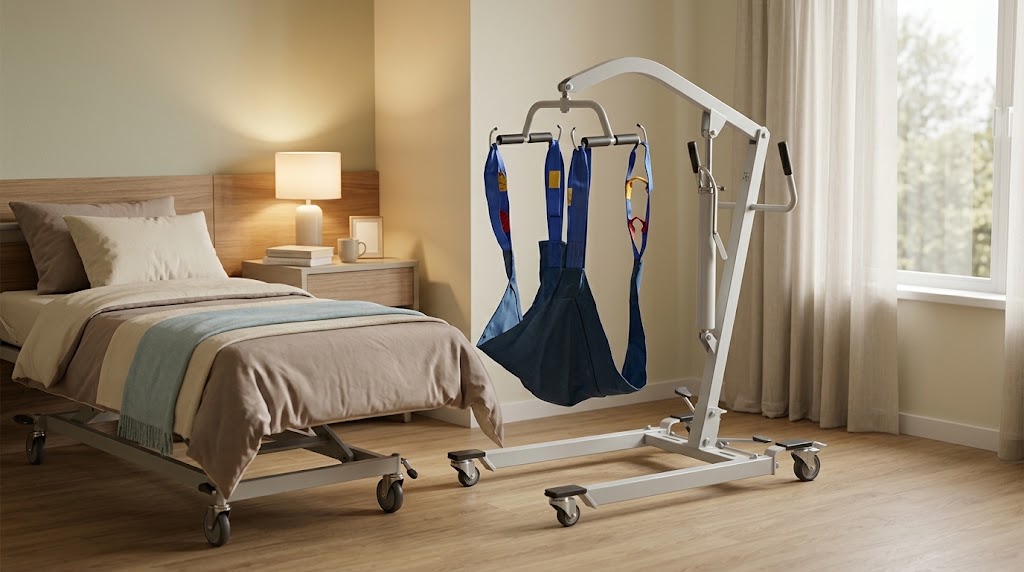
Caring for an elderly family member or a patient with reduced mobility is a delicate task that requires dedication, empathy, and, above all, the right tools. Every single transfer—from bed to wheelchair, from wheelchair to chair, or to the bathroom—puts a strain on the physical health of healthcare workers and caregivers. Manually lifting a body lacking muscle tone or incapable of cooperating exposes caregivers to the constant risk of strains, hernias, and spinal injuries, while also creating anxiety and a sense of instability in the patient.
The lift for the disabled and elderly was created precisely to eliminate this physical strain, transforming a complex and tiring maneuver into a smooth, dignified, and safe transition for both people involved. We at Holity specialize in the supply of medical-health equipment for hospitals, nursing homes, nursing homes, and home care. In this guide, we'll help you choose the ideal patient lift, analyzing operating modes, payloads, harnesses, and space-saving solutions. If you'd like to immediately browse the available models, you'll find a wide range of certified, ready-to-use devices in the disabled and elderly lift catalog on Holity.co.uk .
The first major distinction between the devices concerns the drive system of the mechanical arm. The choice affects ease of use, battery life, and the purchase budget:
Electric lifts: They represent the most modern, widespread, and comfortable solution. The lifting and lowering of the arm are managed completely automatically via a convenient keypad or a remote control with directional arrows. Powered by high-power rechargeable batteries, they allow a single operator—even elderly or physically impaired—to complete the transfer completely independently and effortlessly. They are equipped with charge indicators, control units, and an emergency manual stop/lower button.
Hydraulic and Oleodynamic Lifts (Manual): They use a manual lever connected to a high-pressure hydraulic pump to raise the mechanical arm, while the descent speed is gradually adjusted by acting on a special crank or pedal. The great advantage of hydraulic lifts is their complete independence from the mains or batteries: they are always ready for use, extremely robust, and represent an economical and reliable choice in contexts with occasional use or where it is not possible to guarantee constant charging.
To choose the correct device, it is necessary to evaluate the weight of the patient and the conformation of the spaces in which the structure will move:
Evaluation of the Useful Load Capacity: The available range goes from compact models with a load capacity of 105 kg, 120 kg, 130 kg, 135 kg, 136 kg, 140 kg, 150 kg and 160 kg, up to reinforced lifts of 170 kg, 175 kg, 180 kg, 190 kg, 200 kg and to the bariatric versions for heavy loads capable of supporting 250 kg, 280 kg, 310 kg and up to 330 kg . It is essential to choose a load capacity that maintains a safety margin with respect to the actual weight of the patient.
Maneuverability in Tight Spaces (Spreadable Base): Transferring a patient into a private bathroom or approaching a solid chair requires maximum flexibility. The lifts are equipped with high-speed swivel wheels (with parking brakes) and a width-adjustable base . Using a lever or a pedal, the rear/front base can open and widen (from approximately 50 cm up to 80 cm) to embrace the outside of the wheelchair or chair, and then close tightly to pass easily through doorways in domestic corridors.
The lift performs the mechanical movement, but it is the harness (or sling) in direct contact with the patient's body that guarantees comfort and correct posture during the air journey:
Resistant and Waterproof Materials: Standard harnesses are made of high-tenacity synthetic fabrics that are tear-proof, breathable and washable at high temperatures for maximum hygiene. Many models use quick-drying perforated mesh sheets, specifically designed for use in the bathroom or during the shower.
Head and Neck Support: If the patient has good control of the trunk and head, standard dorsal containment harnesses are used. For neurological patients, bedridden patients or patients with severe muscle hypotonia who are unable to support their head, it is essential to combine a harness with an extension and rigid support for the head and cervical area.
Holity supplies all lifts complete with a standard harness and offers the possibility of ordering special shaped or bariatric harnesses to meet any specific clinical need.
All the lifts for disabled and elderly people offered are certified medical devices that comply with the strict requirements of the European regulation EN 12182 and the directives on electrical and electromagnetic safety (CE). The standard requires that the metal frame in steel or aluminum pass tests and static load tests equal to 150% of the declared nominal capacity, without undergoing bending or permanent deformations.
The devices integrate essential emergency systems, including the immediate shutdown button of the electrical circuit, manual mechanical descent mechanisms to be activated in the event of an electrical fault and harness anchoring hooks designed to prevent accidental release during the maneuver.
Choosing professional quality means preserving the health of those who assist and giving the patient comfortable, dignified and anxiety-free transfers. In our store you will find solutions to suit any budget, with a price range between €215.00 and €12,991.00 for high-profile hospital electrified stations.
Request a personalized quote today: our team of experts is at your disposal to advise you on the model and harness best suited to your needs.
What is the main difference between an electric and a hydraulic lift?
The electric lift is operated by a battery-powered motor controlled by a keypad, requiring zero physical effort and offering fluid maneuvers ideal for a single caregiver. The hydraulic lift, on the other hand, works via a manual lever pump: it does not require batteries or recharging and is always ready for use, representing an economical and robust choice.
How do you get the lift through narrow doorways at home?
Lifts for domestic and professional use are equipped with a base with spread legs. Using a footrest or lever, the base can be narrowed (to approximately 50-55 cm) to pass through doorways or corridors and widened (up to 80 cm or more) to embrace the outside of armchairs, wheelchairs, or beds when picking up the patient.
How do you choose the right sling for a patient who cannot support their head?
If the patient has problems controlling their trunk and cervical area, a high-containment sling with an integrated rigid or padded headrest support should be chosen. For use in the bathroom or shower, quick-drying, waterproof polyester mesh slings are recommended.
Can a single operator use the lift safely?
Yes, modern electric lifts are designed to allow assisted maneuvering even with a single operator. Thanks to the control panel and the stable positioning of the harness, the caregiver can guide the arm with one hand and reassure the patient with the other. For completely immobilized or bariatric patients, the presence of two operators is recommended.
What happens if the electric lift's battery runs out while the patient is being lifted?
No danger: all certified electric lifts are equipped with a mechanical emergency lowering system located on the central piston. By manually operating a ring or a safety cord, the arm descends slowly and gently even in the event of a total power failure.
 English
  Italian
 French
 German
 Spanish